What to expect tonight as Trump addresses the nation
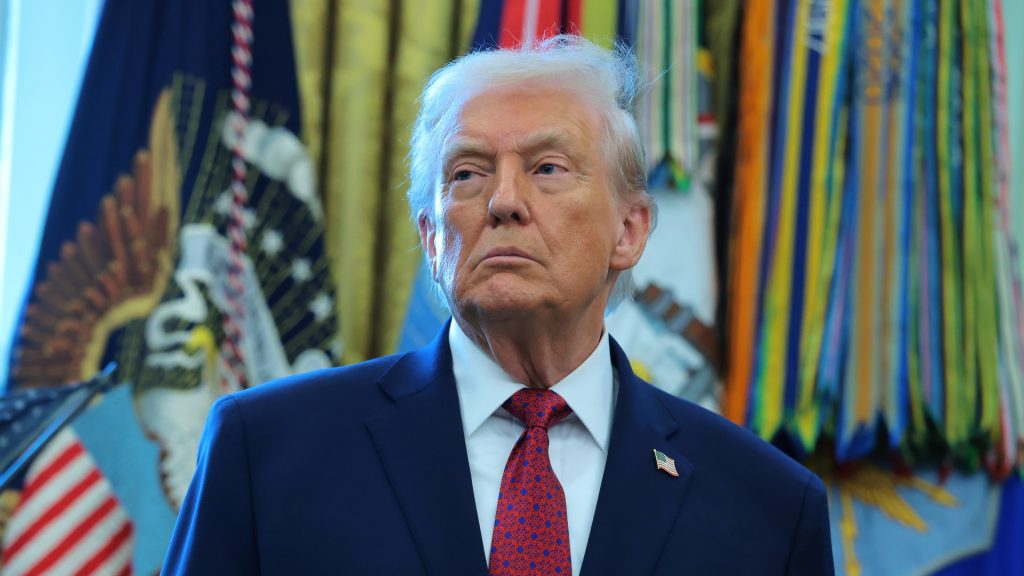
With his popularity eroding a year after his return to office, President Donald Trump will address the nation in an address broadcast live Wednesday night from the White House. While it’s unclear exactly what the president plans to say, White House press secretary Karoline Leavitt said the speech will focus on Trump’s “historic accomplishments such as the border, inflation and what’s to come.”
Trump himself said on Truth Social that he’ll reflect on “a great year” for the country, while promising that “the best is yet to come.”
He may have a tall order persuading his audience to accept his optimistic outlook. A new poll shows that only slightly more than one-third of Americans approve of how he is handling the economy.
Trump’s popularity
The latest NPR/PBS News/Marist poll shows Trump has a 38% approval rating, down from previous polls.
In the same poll, 36% approved his handling of the economy — the lowest rating the survey has found for any president in the past six years. In addition, 70% of those surveyed said the cost of living has become unaffordable.
Trump is likely to address the economy in the speech.
“I imagine he’ll try to make the case that the economy is not bad and it’s going to get a lot better,” George Edwards, distinguished professor of political science and Jordan chair in presidential studies emeritus at Texas A&M University, told Straight Arrow News.
No matter the party affiliation, the new poll found most Americans now list the economy as their top concern heading into the new year.
“I think [Trump] clearly recognizes that public sentiment is becoming increasingly negative on the economy and other issues,” Robert Rowland, communications professor at the University of Kansas and author of “The Rhetoric of Donald Trump: Nationalist Populism and American Democracy,” told SAN. “He’s trying to spin things the way he learned as a real estate developer. He’s going to say things are great with the theory that that will persuade people that that is the case.”
The poll found that 37% of Americans now believe Democrats could better handle the economy than Republicans — a significant shift from three years ago, when the GOP had a 13-point advantage on that same question.
“Part of his brain, maybe all of his brain, knows that the best he’s going to do is reinforce his base,” Edwards said. “And maintaining the base is a core goal in all politics, right?”
The president has also caused some internal rifts within his MAGA movement this year.
“He’s very concerned about his base fraying a bit, and one of the causes of the fraying is his focus on foreign policy,” Edwards said.
Presidential addresses history
Presidents have been directly addressing the American people for more than a century.
Former President Warren G. Harding gave the first national speech over the radio while addressing a crowd at the Lincoln Memorial. Three years later, Harding’s successor, Calvin Coolidge, gave the first radio-specific address.
The first televised presidential address didn’t happen until decades later, on Oct. 5, 1947, when President Harry Truman gave a speech to ask Americans to cut back on their grain usage to help starving Europeans still recovering from World War II.
In the 78 years since, presidents have given national addresses for a variety of reasons. John F. Kennedy discussed the Cuban Missile Crisis in 1962. Lyndon B. Johnson announced he would not seek re-election in 1968.
Arguably the most famous presidential address of the modern era came in 1974 when Richard Nixon announced his resignation following the Watergate scandal.
“More often than not, it is about some foreign policy event,” Edwards said. “And more often than not, they’re short. They’re not long addresses.”
Over the last 50 years, presidential addresses have mostly related to a major news event: Ronald Reagan’s Challenger disaster speech in 1986, George W. Bush’s post-9/11 address, Barack Obama’s announcement of the killing of Osama bin Laden in 2011.
“Aside from the State of the Union message, of course, presidents rarely make a sustained argument,” Edwards said.
Recently, presidents have used the platform to speak on observations and those arguments. Former President Joe Biden spoke on the divisiveness within the country in a national address in 2022.
During his first term, Trump spoke from the White House to declare a national emergency because of COVID-19 in 2020. He also gave an address about border security on Jan. 8, 2019, amid what at the time was the longest government shutdown in U.S. history.
Addressing policy
While most addresses are used to address a major event, presidents have also used these moments to speak on policy.
On Feb. 5, 1981, Reagan gave a speech to the nation about the economy and what he planned to do about it.
“We remember Reagan as an actor, but I’ve spent a lot of time with his rhetoric, and he really worked at laying out a case,” Rowland said. “And that’s something that President Trump has not done to this point, as a candidate or a president, is laying out a strong case for his policy proposal.”
Obama also used the national platform when presenting the Affordable Care Act, which became known as Obamacare.
“One way to test something is to ask, what kind of evidence does the person present that this policy will, in fact, work,” Rowland said. “Both conservatives and liberals have focused in the past on laying out a case.”
With Trump expected to speak on his economic policies, the president could announce some of the proposals he’s floated in recent months, including tariff rebates to Americans — an idea that would need congressional approval.
“He doesn’t hesitate to make promises on the fly,” Edwards said. “So, I think that is likely to be part of what he has to say.”
What to expect from Trump
But no one knows for sure what to expect.
“It’s really very difficult to predict President Trump, because he’s impulsive and doesn’t stick to script, anyhow,” Edwards said.
The speech is set to begin at 9 p.m. EST. The president has said he thinks more Americans would back him if they heard him describe his track record.
“I anticipate that this probably will not be really long,” Edwards said. “It won’t be a sustained analysis. There won’t be a grand overview of things. It’s a quick attempt to reassure.”
While there’s been no attack on the United States, no national disaster for the president to discuss, the eyes of the nation still will be on the White House. If Trump addresses the economy, his audience will already have its own opinions and experiences to filter his words through.
“The second American president, John Adams, before he was president, said famously, ‘The facts are stubborn things,’” Rowland said. “And I think President Trump is running into the stubbornness of economic facts that people are experiencing and to this point, spin has not worked when people are experiencing contrary facts.”
The post What to expect tonight as Trump addresses the nation appeared first on Straight Arrow News.
Ella Rae Greene, Editor In Chief