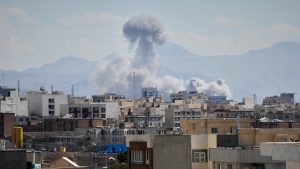
What affect will attack on Iran have on oil, gas market?
Oil and gas prices will likely rise following the United States and Israel’s strikes on Iran on Saturday, experts predict, though they say a lot depends on how the situation plays out.
Iran, which produced over 3 million barrels per day in January, is the fourth-largest oil producer in the Organization of the Petroleum Exporting Countries, or OPEC.
With this in mind, Bob McNally, a former White House energy adviser to former President George W. Bush, told CNBC traders are underestimating the threat possible Iranian retaliation could have on the market.
“This is the real deal,” McNally told the outlet. He expects crude oil future prices could rise by $5 to $7 per barrel once trading opens on Sunday evening.
The Strait of Hormuz is a waterway connecting some of the largest oil producers in the Gulf, including Iran, Iraq, the United Arab Emirates and Saudi Arabia, with the Gulf of Oman and the Arabian Sea.
Ron Bousso, energy columnist for Reuters, wrote that the scale of the attack’s disruption will be determined by how long the conflict lasts.
“For now the threat and the uncertainty are already enough to severely impact flows from the region that accounts for 20% of global oil supplies,” he wrote.
Questions still remain over the status of the Strait of Hormuz, a waterway linking the Persian Gulf to the Indian Ocean. Around 20 million barrels of oil pass through the Strait of Hormuz every day, making it one of the world’s most important oil chokepoints.
While Iran has hinted at shutting the strait down before, “doing so would invite a near immediate naval and air response from the U.S.,” Forbes noted.
Still, Patrick DeHaan, head of Petroleum Analysis at GasBuddy, wrote that even the perception of risk in the Strait of Hormuz could potentially send oil prices higher.
When oil markets reopen, he said, crude oil will “almost certainly jump.”
“My early expectation is a 5–10% increase, potentially pushing oil back above $70 per barrel,” DeHaan wrote. “The exact move will depend heavily on how deep and prolonged the attacks are — and whether oil flows are materially disrupted.”
Gasoline and diesel prices in the U.S., meanwhile, won’t skyrocket overnight, DeHaan said, though a seasonal climb already underway will be accelerated. Some states are already in the middle of a summer gasoline transition as well, which can also cause price cycling and short-term jumps regardless of what’s happening globally, according to DeHaan.
This could mean the national average may surpass $3 come Monday, DeHaan said. That would be the first time in 2026 that it’s hit that mark. Prices are likely to increase to at least $3.10 to $3.15 a gallon.
“That outlook could shift depending on how the situation evolves in Iran and whether oil flows are materially disrupted,” DeHaan noted.
Still, Joseph Brusuelas, chief economist at RSM US, a finance and consultancy firm, said in a note Saturday that “while oil markets continue to react to potential tensions in the Middle East, history has shown that the price increases are temporary and quickly fall back.”
Israel shuts down gas field
After the attack on Iran, the Israeli Energy Ministry ordered a temporary shutdown of parts of its natural gas reservoirs. Three sources told Reuters the Leviathan gas field offshore Israel, which is operated by Chevron, was closed as well as Energean’s.
Israel’s ministry said the decision was based on “the current situation and in accordance with security assessments,” the outlet reported. The ministry declined to say which specific fields were affected, Reuters wrote.
The country’s energy needs will be through alternative sources, the Israel Energy Ministry said. If needed, the electricity sector can operate power stations using alternative fuels. and that the electricity sector was prepared to operate power stations using alternative fuels if necessary.
This is similar to what Israel did when it last attacked Iran in June 2025 — it shut its biggest gas field — Leviathan — as well as Karish, Bloomberg said.
Ella Rae Greene, Editor In Chief