Was Maduro’s capture legal?
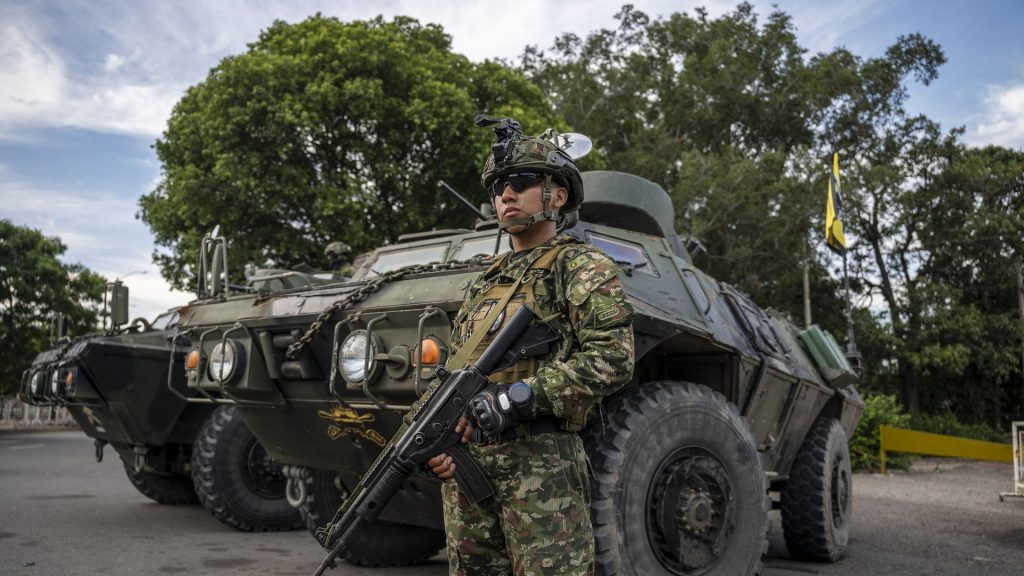
In the dead of night last Saturday, U.S. Army Delta Force troops descended on Caracas, capturing Venezuelan President Nicolás Maduro and his wife, Cilia Flores, and killing at least 56 security officers. This razor-sharp operation left little time to consider Venezuelan sovereignty or international law.
In the days since Maduro and Flores were brought to New York to face drug-trafficking charges, however, the legality of the military assault has been challenged by both domestic and foreign critics of President Donald Trump.
Trump and other members of his administration say the action was legal. But Maduro, when he pleaded not guilty to the drug charges Monday, asserted that he had been “kidnapped.” And many Democrats in Congress and legal experts worldwide say seizing the Venezuelan president on his own soil violated international laws.
Among those raising concerns is the United Nations High Commissioner for Human Rights.
“It is clear that the operation undermined a fundamental principle of international law – that states must not threaten or use force against the territorial integrity or political independence of any state,” a spokesperson for the high commissioner said Tuesday.
Even if the UN or other international bodies officially find the U.S. committed violations, it remains unclear what, if any, consequences Trump, his administration or the country might face.
‘Absolute right’
The Trump administration has vigorously defended the raid and military strikes in Caracas and other Venezuelan cities. Officials said taking Maduro and Flores into custody was a law enforcement operation, rather than a military action, because both had been indicted by a federal grand jury in New York on drug-trafficking and other charges.
“The United States has an absolute right to go and arrest people charged with horrible crimes,” Deputy Attorney General Todd Blanche told NBC News.
“What we did was not only right and not only legal,” Blanche said, “but it’s what the American people expect us to do when we file charges against individuals like [Maduro].”
Blanche’s boss, Attorney General Pam Bondi, wrote on X that “this operation reflects the Department of Justice’s unwavering commitment to accountability, the rule of law, and the protection of U.S. national security.”
‘Territorial integrity’
Before ordering the raid, Trump did not notify Congress, specifically the bipartisan Gang of Eight, which he is required to brief before sensitive missions. He also did not seek approval from the UN Security Council.
At a Security Council meeting Monday, representatives of several countries said Trump violated Article 2(4) of the UN Charter, which holds that a country’s “territorial integrity or political independence” must be respected. There is a caveat: one country may attack another if the Security Council grants permission or in cases of self-defense after an armed attack.
“All members shall refrain in their international relations from the threat or use of force against the territorial integrity or political independence of any state, or in any other manner inconsistent with the purposes of the United Nations,” the UN charter says.
Use of force
Under the UN charter, Trump’s sending armed forces into Venezuela, a sovereign nation, was a use of force that could be considered an act of war.
“The United Nations charter makes crystal clear that all UN members are to refrain from the ‘use of force’ against the territorial integrity or political independence of any state,” Donald Rothwell, a professor of international law at Australian National University, wrote for The Guardian. “The U.S. violation of Venezuelan airspace, ensuing airstrikes in Caracas, the seizure of Maduro and his illegal removal from Venezuela are all egregious violations of this. Any suggestion it was justified as an act of U.S. self-defense is not supported by the facts. The U.S. had not suffered a Venezuelan armed attack, nor is there any evidence to suggest such an attack was imminent.”
Writing in Diplomacy and Law, Edmarverson A. Santos, an international law analyst from Dublin, Ireland, argued that arresting Maduro on his home turf “compels a reassessment of foundational legal rules governing sovereignty, the prohibition on the use of force and the limits of unilateral enforcement in the international system.”
“At its core,” Santos wrote, “the episode raises a simple but destabilizing question: can a state invoke domestic criminal jurisdiction to justify military action onto the territory of another sovereign state without international authorization?”
Leaders from some countries, including Argentina, supported Maduro’s ouster, and several U.S. allies have taken a measured approach to discussing the action.
But the chair of the foreign affairs committee of the United Kingdom’s House of Commons, Emily Thornberry, said that the UK and its allies should say, “we cannot have breaches of international law like this. We cannot have the law of the jungle.”
Consequences
Even if the U.S. violated international laws, it’s not likely to affect Maduro’s prosecution. How a defendant is brought into the U.S. from another country can be beside the point. Establishing what is known as the Ker-Frisbie doctrine, the Supreme Court ruled in the 1950s that the means of bringing a defendant into the jurisdiction where he or she is charged does not affect the prosecution.
It’s also unlikely that Congress — controlled by Republicans — will punish Trump or his administration.
Democrats, however, continue to criticize the Venezuelan raid, suggesting Trump is exceeding his authority by declaring war without congressional or UN approval.
“It appears to violate the very international laws and norms that have protected the United States and our partners and allies for more than 80 years,” Rep. Adam Smith, D-Wash., the top Democrat on the House Armed Services Committee, said in a statement. “Based on the administration’s National Security Strategy, I am deeply concerned that this may be an indication of more to come as the administration seeks to dominate the Western Hemisphere.”
Trump continues to celebrate Maduro’s capture, but laments not getting enough praise. While he spoke to House Republicans on Tuesday, he complained that lawmakers on both sides of the aisle were reluctant to congratulate him. “At some point, they should say, you know, ‘you did a great job,’” Trump said. “Wouldn’t it be good? I would say that if they did a good job, their philosophies are so different, but if they did a good job, I’d be happy for the country. They’ve been after this guy for years and years and years, and he was a violent guy.”
The post Was Maduro’s capture legal? appeared first on Straight Arrow News.
Ella Rae Greene, Editor In Chief