US spent $145 billion rebuilding Afghanistan. Nearly $30 billion was wasted, report says
The U.S. wasted nearly one of every five of the billions of dollars it spent trying to rebuild Afghanistan after it ousted the Taliban from power more than two decades ago, a new report says.
The Special Inspector General for Afghanistan Reconstruction (SIGAR) issued a final report Wednesday after monitoring U.S. efforts in the country from 2002 to 2021. It found that multiple factors contributed to “the failure of the U.S. effort to transform a war-torn, underdeveloped country into a stable and prosperous democracy.”
Success “may never have been achievable,” the report says, noting that the “seeds of failure in Afghanistan had been sown long before the final withdrawal” of U.S. troops in 2021, which resulted in the Taliban’s seizing power again. The report blames, in part, “early and ongoing U.S. decisions to ally with corrupt, human-rights-abusing powerbrokers,” which bolstered Afghan insurgents and undermined the U.S. mission.
The costs of this failure, the report concludes, were “immense.” Between $26 billion and $29.2 billion was lost to waste, fraud and abuse, and tens of thousands of people were killed, including more than 2,450 U.S. service members.
SIGAR’s final report
“I think it’s a good summary,” John Sopko, the former inspector general who led SIGAR for more than a decade, told Straight Arrow News. “It’s not exactly what I had intended it to be. My approach would have been different. I think the final report should have focused not so much on listing every audit or investigation we did, but focus on, what were the big issues, and what did we really learn? And what should the American taxpayer know were the big issues?”
SIGAR will be disbanded at the end of the month after nearly 20 years of investigations.
“The work that they have done, highlighting the incompetence of the U.S. intervention in Afghanistan is, I think, very important,” Jennifer Murtazashvili, a professor at the University of Pittsburgh and the author of “Informal Order and the State in Afghanistan,” told SAN. “And I’m speaking as someone who is not against the U.S. work in Afghanistan.”
Sopko initiated this final report before President Donald Trump fired him and numerous other inspectors general earlier this year, a move that drew significant criticism.
“The big question is, could we have ever won in Afghanistan, and can you ever win in a situation like Afghanistan, where you’re really talking about basically rebuilding a country that did not have a functioning economy, a functioning government, a functioning justice system, functioning rule of law, a functioning military,” Sopko said. “This is why the report could be important, is to ask the question, can this ever work?
Sopko said his watchdog group had a singular mission.
“SIGAR was unique because Congress, probably by mistake, I don’t know if it was planned, gave us jurisdiction over any U.S. government agency operating in Afghanistan doing reconstruction, not doing the war fighting, but doing reconstruction,” Sopko said. “So that was the whole of the government, and that was unique, and allowed us to look at the Department of Justice, the FAA, the weather bureau, USAID, DOD, you name it.”
Wasting money
The final report found America spent roughly $145 billion attempting to reconstruct Afghanistan following the removal of the Taliban from power post-9/11.
The report identified more than 1,300 instances of waste, fraud or abuse of that money, totaling between $26 billion and $29.2 billion.
“I think the American taxpayers should be upset,” Sopko said. “I think the American taxpayers should hold people accountable. So far, the only person who was fired for the screw ups in Afghanistan was me.”
Waste was the most prevalent issue, accounting for 93% of the lost funding.
Examples of that waste came in the form of leaving behind billions of dollars’ worth of military equipment after the 2021 withdrawal.

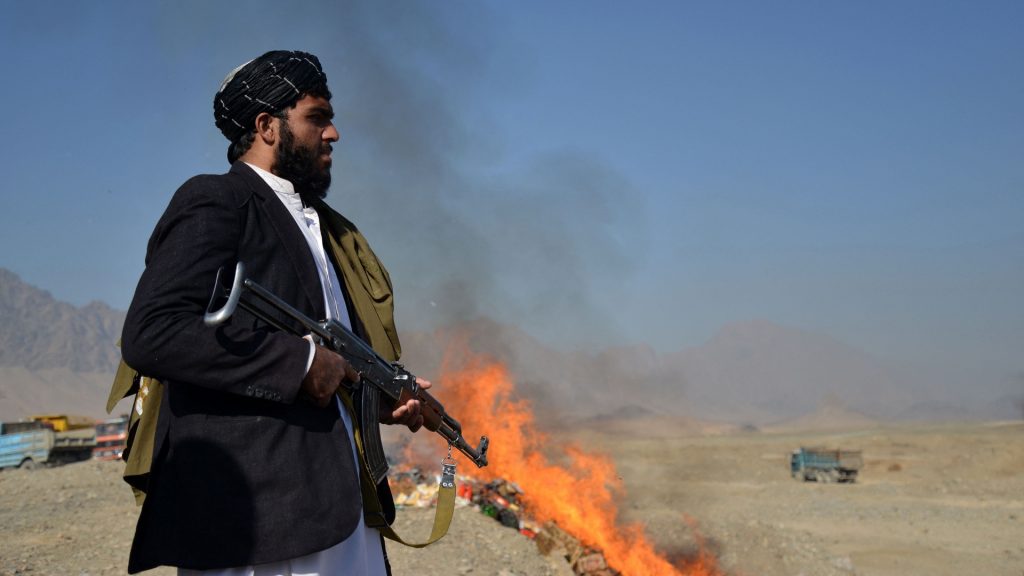
Other examples cited in the report included $7.3 billion on ineffective counternarcotics programming that reportedly did little to curb the production and exportation of illegal drugs. Afghanistan remains the world’s leading supplier of opium.
Another $4.7 billion was wasted on ineffective stabilization programming. “Stabilization” in this case means keeping insurgents out of areas where they had been expelled.
“If you look very closely, there were not a lot of oversight hearings, except by a couple committees,” Sopko said. “But the big ones, they didn’t pay attention to this thing. They just let the money flow.”
Contractor waste
Another large chunk of funds went to contractors hired by the government to carry out missions, including security, infrastructure development and more. Many of those contractors could not deliver, overbilled and were paid for incomplete work.
Murtazashvili pointed to former President Barack Obama’s 2009 military and civilian surge in Afghanistan as a major flashpoint in this work.
“What that did was just infuse billions and billions and billions of dollars of aid into an economy and a society that couldn’t absorb it,” Murtazashvili said. “The government didn’t have capacity to handle this, so it was channeled through these aid contractors who were very expensive, who couldn’t work in most of the country. And then the cost for implementing programs was exorbitantly expensive, because to do anything you needed security.”
She pointed to a 2010 report that laid out a scenario where the U.S. government needed to hire contractors to get fuel to military bases.
“They hire these security contractors, and it turns out the security contractors are blowing up the trucks because they understand incentives, that yields more security,” Murtazashvili said. “And so, they can pay more of their people.”
Another case involved one of the largest tax evasion crimes in the history of the U.S. Department of Justice. Former defense contractor Douglas Edelman and his wife engaged in a lengthy scheme to evade taxes on hundreds of millions of dollars of income from his contracts with the government.
Edelman pleaded guilty to those crimes earlier this year.
SIGAR investigations led to 171 criminal convictions and recoveries that totaled about $1.7 billion.
Establishing democracy
The report also found the U.S. goal to rebuild Afghanistan and “create a Vermont in the Middle East,” as conservative commentator Pat Buchanan once put it, was unrealistic from the beginning.
The vision of giving Afghans the chance to elect leaders never fully materialized.
“We put in a governmental system that was highly centralized, that didn’t allow any local elections, didn’t allow elections for mayors,” Murtazashvili said.
Security played a large role. A previous SIGAR report outlined how elections that did happen “were marred by accusations of fraud, low turnout, corruption and voter manipulation.”
This latest report cited the 2019 presidential election, the last one before the Taliban retook the country, as an example. Only an estimated 10% of voters cast ballots, and allegations of fraud led to a five-month delay in announcing the results.
“Afghans understood very well what democracy is and they understood that they did not get that,” Murtazashvili said.
The resurgence of the Taliban
The billions of dollars wasted, the thousands of American soldiers killed in Afghanistan and the Taliban’s return to power overshadowed any accomplishments from the decades that Americans spent in the country.

“History just seems to go in cycles,” Murtazashvili said. “After Vietnam, the U.S. said, ‘We’re never going to do this again. We’re never going to do counter insurgency. We’re never going to do any of this foreign intervention. Never send our soldiers overseas.’ And so, what happened is, after that, we just forgot.”
Still, Murtazashvili said the American involvement wasn’t all for nought.
“You can’t even compare what Afghanistan is now to what it was 20 years ago,” Murtazashvili said. “So, if you want to look at from the inherent human dignity perspective, the Taliban’s gender apartheid notwithstanding, people’s overall wellbeing improved significantly.”
Who’s to blame?
Although the American presence in Afghanistan continued under four presidents, Sopko said the buck doesn’t stop with them.
“Presidents have 10,000 issues to deal with everyday,” Sopko said. “So, I don’t blame the presidents.”
Sopko said the real problem is with presidential advisers and key members of Congress.
The report names several committees that were involved in approving funding, including the House Foreign Affairs Public Committee, the Senate Committee on Homeland Security and Governmental Affairs and the Senate Appropriations Subcommittee on Defense.
“They’d hold maybe one or two hearings on an issue,” Sopko said. “And their view of an oversight hearing, which is not oversight, is you bring in the Secretary of Defense or the Secretary of State or the head of USAID, and there’s your oversight hearing. You never really dug deeply.”

Sopko was a part of many of those hearings.
“I testified twenty-some times,” Sopko said. “And I got sick and tired of numerous members saying ‘Mr. Sopko, or General Sopko, thank you for your service.’ Well, OK, do something.”
What did we learn?
SIGAR has issued reports on the Afghan rebuild for nearly two decades. The final document came with a warning about the future.
“The outcome in Afghanistan should serve as a cautionary tale for policymakers contemplating similar reconstruction efforts in the future,” the report reads.
Similar reconstruction efforts are in the immediate future in places like Gaza, Ukraine and Syria. Sopko felt this final report should’ve taken a deeper dive into the big questions.
“We should have raised a bunch of the wickedly difficult questions that policymakers need to ask before we do reconstruction in Gaza, or reconstruction again for the umpteenth time in Haiti, or reconstruction someplace else in the world,” Sopko said. “And Congress needs to learn these lessons and do something about it.”
Murtazashvili hopes the failures in Afghanistan will inspire U.S. officials to learn from the mistakes rather than avoid tough issues altogether.
“I worry that we take the lesson of isolationism or retreating from the world because we’re incompetent rather than learning the hard lessons of what we did wrong and how to do better,” Murtazashvili said.
Some positives can be taken from what happened, she said.
“I think it’s really important that we take the lessons of this report very seriously and read them and engage with them, rather than just saying, ‘Oh, you know, that was stupid, we didn’t do anything good,’” Murtazashvili said. “There were a lot of things, some very good things that came out of what we did in Afghanistan. The education system is something that I could really point to, not necessarily because of aid, but there were certainly moments where the U.S. had a tremendous impact, but it was very ineffective and it was wasteful.”
Sopko echoed those sentiments.
“I’m an eternal optimist, and I think if enough people see a problem, the American people will rise to the situation,” Sopko said. “And I think you do have some, a few brave men and women in Congress and the Senate who arise to the calling. Will it be enough? I don’t know. I hope so.”
The post US spent $145 billion rebuilding Afghanistan. Nearly $30 billion was wasted, report says appeared first on Straight Arrow News.
Ella Rae Greene, Editor In Chief