Trump’s birthright citizenship ban encounters skepticism at Supreme Court
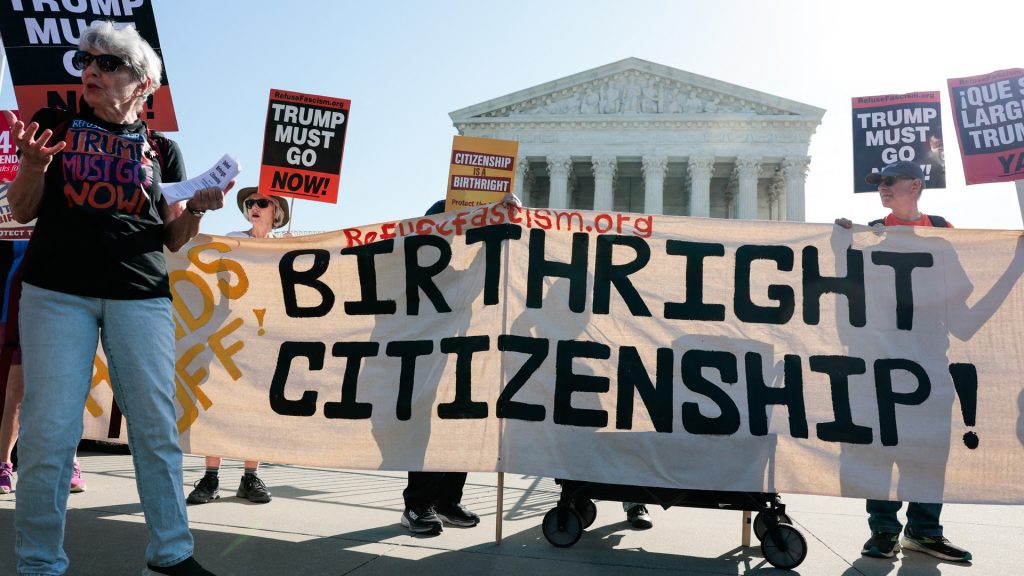
With President Donald Trump watching from the gallery, a majority of Supreme Court justices seemed skeptical Wednesday about his ability to ban automatic citizenship for children born in the United States.
In deciding whether the president could terminate birthright citizenship through an executive order, the court could reshape history and redefine what it means to be an American.
Trump’s order, signed the day he took office for his second term on Jan. 20, 2025, would deny citizenship to children born of parents in the country illegally. Likewise, children of parents who have temporary legal status to be in the U.S. would not be considered citizens.
Although the court’s decision won’t likely be released until June or July, justices grilled Trump’s attorney, U.S. Solicitor General D. John Sauer, on just how much of the 14th Amendment protects birthright citizenship.
He argued the amendment was intended for “newly freed slaves and their children,” claiming that a broader interpretation has led to so-called “birth tourism,” with residents of other countries traveling to the U.S. to give birth and secure citizenship for their babies.
Across more than an hour of questioning, Sauer hesitated and stammered over questions posed by the justices, both from the more liberal leaning and conservative judges.
Are Native Americans granted birthright citizenship? Justice Neil Gorsuch asked.
“Uh, I think so,” Sauer answered. “I have to think that through.”
Justice Ketanji Brown Jackson asked Sauer how parents’ immigration status would be determined. “Is this happening in the delivery room… Are we bringing pregnant women in for depositions?” the justice asked.
Again, Sauer struggled to answer, saying there are computers that can help with this, though he said he didn’t have a computer in front of him. Finally, he said if the parents take issue after their American-born baby has been deemed not a citizen, a process would be established for them to challenge it.
Trump sat silently in the courtroom during Sauer’s argument — the first time a sitting president has attended oral arguments at the Supreme Court. Trump, who was accompanied by Attorney General Pam Bondi, left the courtroom before Cecillia Wang, the legal director of the American Civil Liberties Union who was representing people affected by the executive order, presented her arguments.
“Under the 14th Amendment, ratified in 1868, virtually everyone born on U.S. soil… is a citizen,” with only a few narrow exceptions, Wang said.
Justice Brett Kavanaugh suggested the case would be resolved if the court upheld its landmark 1898 decision in U.S. v. Wong Kim Ark, in which it affirmed that a child born in the U.S. to noncitizens is indeed a citizen. The decision established the modern understanding of the birthright citizenship clause in the 14th Amendment.
Lower courts, including a federal trial judge in New Hampshire and the 9th U.S. Circuit Court of Appeals ruled that Trump’s order violated the 14th Amendment.
If the court rules in Trump’s favor, birth certificates alone may no longer be sufficient proof of citizenship, and parents could be required to verify their own legal status. Legal experts say this could leave many children in legal limbo. State and local governments could face many logistical and costly challenges in verifying nationalities and legal statuses for every birth.
Ella Rae Greene, Editor In Chief