Trump orders oil tanker blockade; Wiles interview puts White House on defense
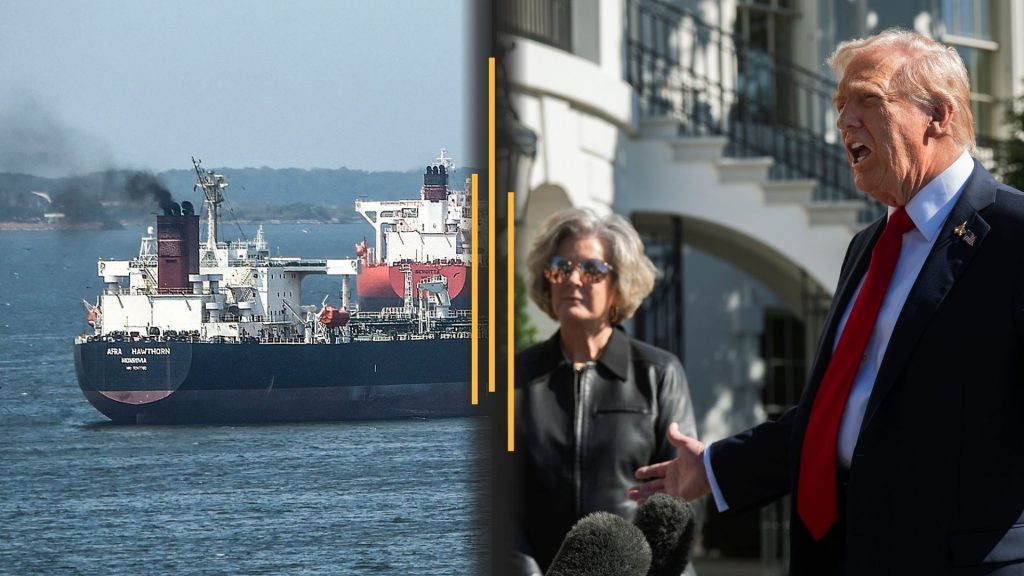
President Donald Trump announced what he calls a “total and complete” blockade of sanctioned Venezuelan oil tankers. It’s a move Caracas is calling illegal and dangerous.
Plus, Chief of Staff Susie Wiles broke her usual silence, and it quickly turned into a cleanup operation. Why a two-part Vanity Fair interview has sparked pushback from the administration.
And Warner Bros. Discovery prepares to urge shareholders to reject Paramount’s takeover bid and stick with its Netflix deal, just as Jared Kushner’s firm exits the Paramount offer.
These stories and more highlight your Unbiased Updates for Wednesday, December 17, 2025.
Thanks for sticking with us. Craig Nigrelli returns Thursday, Dec. 18, with new episodes of Unbiased Updates.
Trump announces ‘total and complete’ blockade of Venezuelan oil tankers
President Donald Trump is escalating tensions with Venezuela, ordering what he calls a “total and complete” blockade of all “sanctioned oil tankers” entering and leaving the country.
In a post on Truth Social, Trump claimed Venezuela is now “completely surrounded by the largest Armada ever assembled in the History of South America,” warning that pressure on the country will intensify until “they return to the United States of America all of the Oil, Land, and other Assets that they previously stole from us.”
It’s not clear what specific assets the president was referring to. The U.S. has been increasing its military presence in the region and last week seized an oil tanker off Venezuela’s coast. The administration has accused Venezuela of using oil revenue to fund drug trafficking and other criminal activity.
Venezuela’s government pushed back sharply, accusing the U.S. of “violating international law, free trade, and the principle of free navigation” with “a reckless and grave threat.”
“He assumes that Venezuela’s oil, land, and mineral wealth are his property,” the statement said. “Consequently, he demands that Venezuela immediately hand over all its riches. The President of the United States intends to impose, in an utterly irrational manner, a supposed naval blockade on Venezuela with the aim of stealing the wealth that belongs to our nation.”
The government said it plans to raise the issue before the United Nations.
The escalation comes as the administration continues a campaign of U.S. strikes on suspected drug-smuggling boats in the Caribbean, many of which U.S. officials say are linked to Venezuela. Trump has also said land action is coming, though he has not provided details.
Meanwhile, Defense Secretary Pete Hegseth has decided not to release the full, unedited video of a now-controversial U.S. strike carried out in September. Lawmakers from both parties have been pressing the Pentagon to make the footage public after reports that the U.S. struck two survivors following an initial attack.
Some members of Congress have already viewed the video, and members of the House and Senate Armed Services committees are scheduled to see it on Wednesday.
After a classified briefing on Tuesday with Secretary of State Marco Rubio, Hegseth told reporters the video would not be released publicly.
“Of course, we’re not going to release a top-secret, full, unedited video of that to the general public,” he said.
Instead, he said the Pentagon will share it “with the appropriate committees.”
White House rallies around Susie Wiles after Vanity Fair interview
It’s perhaps one of the most revealing interviews we’ve seen from inside the Trump White House.
Trump’s chief of staff, Susie Wiles, typically known as a disciplined, behind-the-scenes operator, gave a rare, month-long, two-part interview to Vanity Fair that’s now generating a wave of headlines for the administration.
In it, Wiles offers unusually blunt assessments of the president and his inner circle.


She describes Trump, who doesn’t drink, as having what she calls an “alcoholic personality.” She calls Vice President JD Vance a conspiracy theorist. She says Attorney General Pam Bondi “completely whiffed” the Epstein files rollout. And she paints a picture of internal chaos around issues like tariffs, Venezuela and the dismantling of USAID.
The administration’s reaction, though, was swift and unified.
Wiles quickly went on X, calling the piece a “disingenuously framed hit piece,” accusing the magazine of stripping out context to create a negative narrative.
She did not deny the quotes, however.
Trump followed with his own defense in an interview with The New York Post, saying he stands by Wiles and even agrees, in part, with her description of him. The president said he’s long acknowledged having what he called a “possessive and addictive” personality, adding that Wiles has done a “fantastic job.”
Others rushed to her side as well. Vance leaned into the criticism with a joke, saying he does believe in conspiracy theories, “but I only believe in the conspiracy theories that are true.”
Bondi praised Wiles’ loyalty. And budget director Russ Vought, whom Wiles labeled a “right-wing absolute zealot,” called her “an exceptional chief of staff.”
Still, the interview landed at a sensitive moment.
Beyond the personal remarks, Wiles appears to undercut some of the administration’s public messaging. She seemed to suggest U.S. boat strikes tied to drug trafficking are really about pressuring Venezuela’s president, and acknowledged Trump’s appetite for retribution against political enemies.
Taken together, the interview paints a rare, unvarnished portrait of how this White House operates, from internal debates to the way power ultimately flows.
And for a chief of staff who usually avoids the spotlight, Susie Wiles has now become part of the story.
Accused Bondi Beach shooter faces 59 charges in antisemitic terror attack after waking from coma
The surviving suspect accused of opening fire on a Hanukkah celebration in Sydney, Australia, has now been formally charged with murder and terrorism.
Police say Naveed Akram, 24, and his father carried out a mass shooting Sunday on Bondi Beach that targeted Jews and left 15 people dead.
Akram was charged on Wednesday after waking from a coma in the hospital, where he’s been since police shot him and his father during the attack. His father, Sajid Akram, 50, was killed at the scene.

Prosecutors have filed more than 50 charges against the younger Akram, including 15 counts of murder, one count of terrorism, 40 counts of causing grievous bodily harm with intent to murder, placing an explosive near a building with intent to cause harm, and publicly displaying a terrorist organization’s symbol.
Authorities say they are now investigating the suspects’ possible links to ISIS, including a past trip to the Philippines, a region that counterterrorism officials have previously identified as a hub for extremist activity.
Judge allows White House ballroom to proceed, but with limits
A federal judge has allowed the construction of the new White House ballroom to continue — at least temporarily — while imposing strict limits on future development.
According to CBS News, U.S. District Judge Richard Leon denied the National Trust for Historic Preservation’s request to halt the project temporarily.
-

White House ballroom designs -

White House ballroom designs -

White House ballroom designs -

White House ballroom designs -

White House ballroom designs -

White House ballroom designs -

White House ballroom designs -

White House ballroom designs -

White House ballroom designs -

White House ballroom designs -

White House ballroom designs -

White House ballroom construction -

White House ballroom construction -

White House Ballroom -

White House ballroom construction -

White House ballroom construction -

White House Ballroom -

Kevin Dietsch/Getty Images -

Celal Gunes/Anadolu via Getty Images -

Andrew Harnik/Getty Images
The judge said the group failed to show immediate, irreparable harm sufficient to justify an outright halt to construction.
Still, Leon ordered the administration not to build any underground structures for the next two weeks. That work would effectively lock in the ballroom’s final location. He warned that violating that order could force the White House to tear down whatever is built.
The judge also directed the government to submit construction plans to the National Capital Planning Commission by the end of the year.
The preservation group has argued that the issue isn’t the ballroom itself but whether the administration complied with the law. The White House has countered that no final plans exist and that courts have limited authority to review executive actions.
A preliminary injunction hearing is scheduled for next month.
The ruling comes as new questions arise about the project’s scope and cost.
On Tuesday night, Trump said the ballroom will now cost $400 million, a figure that reflects a significant increase from earlier estimates and has drawn renewed scrutiny from Democrats and preservation advocates over funding and transparency.
Warner Bros. Discovery to reject Paramount bid
Breaking news: Warner Bros. Discovery has moved from signaling resistance to going on the offensive, urging shareholders to reject Paramount’s takeover bid. It’s accusing the Ellison family of misleading investors about how the deal would be financed.
In a letter sent to shareholders on Wednesday, Warner Bros. directly challenged Paramount’s claim that its $108 billion offer is fully backed by billionaire Larry Ellison and his family. Warner Bros. said that the claim is simply not true.
“It does not, and never has,” Warner Bros. wrote, disputing Paramount’s repeated assertions that the bid has a full financial backstop.
This is a developing breaking news update. Check back for more updates and read the full story here: Warner Bros. tells shareholders to reject Paramount bid, questions Ellison backing.
Original report: The Wall Street Journal reported that Warner Bros. Discovery is preparing to advise shareholders to reject Paramount’s $30-a-share hostile bid and to support its existing deal with Netflix.
That recommendation could come as soon as Wednesday, putting Paramount in a position to decide whether to raise its offer before a Jan. 8 deadline.
At the same time, one of the more politically sensitive backers of Paramount’s bid is stepping back.
Jared Kushner’s private equity firm, Affinity Partners, says it is no longer participating in the deal, citing “changed dynamics.”

The firm has been a relatively small equity investor, but its involvement drew scrutiny because Kushner is Trump’s son-in-law and because Warner owns CNN.
Paramount said the withdrawal doesn’t materially affect its financing, which is primarily backed by Oracle founder Larry Ellison, the father of Paramount CEO David Ellison, and Middle Eastern sovereign wealth funds.
Still, the timing is notable.
Warner’s apparent move to formally reject the bid, combined with Kushner’s exit, leaves Paramount with a clear choice: sweeten its offer — or walk away — as regulators closely watch.
Hyundai and Kia to add anti-theft technology to millions of vehicles
Years after certain Hyundai and Kia vehicles were found vulnerable to theft, the automakers are now required to fix the problem.
The issue came to light in 2021, when videos showing how some models could be stolen with little more than a screwdriver and a USB cable spread widely on social media, leading to a surge in thefts nationwide.
On Tuesday, Minnesota’s attorney general, who led a multistate effort involving 35 states, announced a settlement requiring Hyundai and Kia to provide free repairs for millions of vehicles nationwide. The companies must also equip all future U.S. models with engine immobilizers and pay up to $4.5 million in restitution to vehicle owners whose cars were damaged by thieves.
The settlement covers vehicles sold between 2011 and 2022, affecting about 9 million cars nationwide.
Repairs are expected to be available from early 2026 through early 2027, and owners of eligible vehicles will have one year to complete the repairs at authorized dealerships.
More from Straight Arrow News:

Wildfires and a ‘black box’ of utility spending drive California’s record electric rate hikes
After paying all her bills, Araceli Salinas said she didn’t have enough money left to take her family out for a pizza. The high cost of living in Madera, California, was exceptionally high in the summer months. For years, her monthly electric utility bills have routinely ranged from $300 to $400.
“With PG&E that high, sometimes you have to buy just the basics for you and your kids,” said Salinas, in an interview with Straight Arrow News.
For Salinas, the basics meant rice, beans, tortillas, bread and milk. She works in in-home care for seniors — a role that gives her flexibility to spend time with her four kids. Even with the air conditioning set to 78 degrees, summertime electric bills have long been a burden for Salinas.
“I was barely saving a little money to buy groceries because I had to pay my electricity,” Salinas said. “I believe it’s a big percentage in California who lives in the same situation.”
She is right.
California’s electricity prices have skyrocketed, particularly for the three major investor-owned utilities in the state: Pacific Gas and Electric (PG&E), Southern California Edison and San Diego Gas and Electric.
California has the second-highest electricity prices in the United States, behind Hawaii. And in recent years, the gap between California and the national average has widened. On Thursday, the California Public Utilities Commission will vote on the three companies’ 2026 return on equity. The commission is expected to reduce the utilities’ profit margin by 0.35%, which could keep the rate stable for now. But the amount of money companies spend on generating electricity and operating the grid—not their return on equity — is the main driver of rate increases. The state has several programs aimed at blunting the burden of high costs. Still, families like the Salinas’ in the heat-prone Central Valley pay some of the nation’s highest monthly bills. Read the full story now>
The post Trump orders oil tanker blockade; Wiles interview puts White House on defense appeared first on Straight Arrow News.
Ella Rae Greene, Editor In Chief