The Civil War ended 160 years ago. Why is Robert E. Lee trending today?
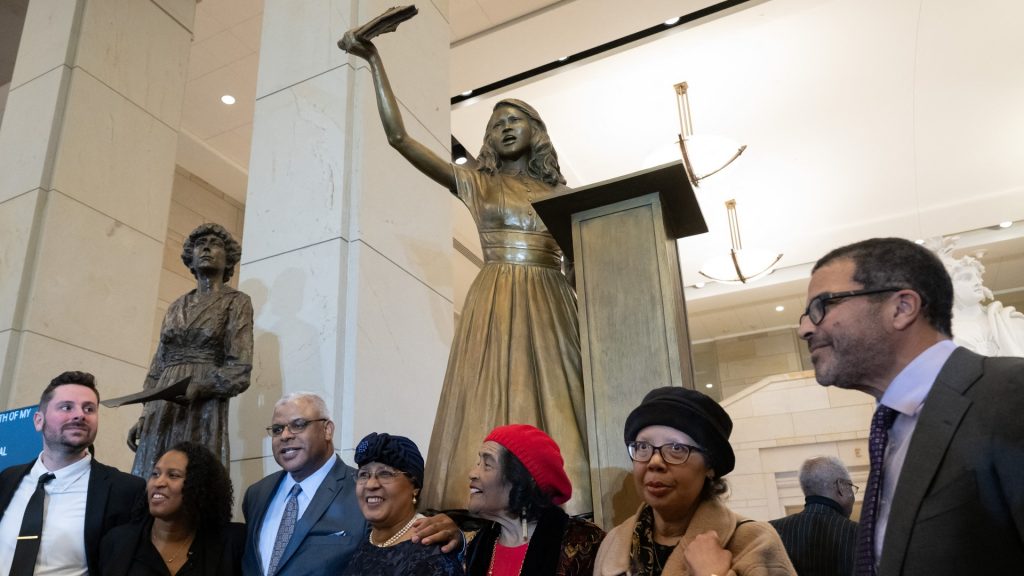
A Black woman who led a walkout to protest conditions at her segregated high school in Virginia is now immortalized in the U.S. Capitol. Her statue rests in the same space that one of Confederate Gen. Robert E. Lee formerly stood, and many conservatives are not happy about it.
A controversy erupted online, as many commenters complained that the statue switch erased Lee’s legacy. Some claimed the Confederacy was in the right during the Civil War, and others evoked a conspiracy theory that white people are being replaced in American society.
The complaints, however, were met with derision from people who pointed out that Lee led an army against his own country and that history has judged him as a cruel master to the enslaved people on his Virginia plantation.
“The past is never dead,” William Faulkner wrote 75 years ago. “It’s not even past.”
The dispute over a statue in the Capitol proves his point.

Why Lee’s statue was taken down
In 2020, then-Gov. Ralph Northam, D-Va., requested that Lee’s statue be removed from Emancipation Hall in the U.S. Capitol after weeks of protests and public pressure following the murder of George Floyd by a Minneapolis police officer. People then pointed to Lee’s ownership of slaves, his leading the Confederate Army in the Civil War and his negative views about Black people’s rights.
Northam’s Republican successor brought a very different statue to the Capitol.
“Today we gathered in Emancipation Hall of the U.S. Capitol to dedicate the Barbara Rose Johns statue, to honor her legacy as a trailblazer, and ensure her story of courage and conscience is a story for generations to come,” Virginia Gov. Glenn Youngkin wrote on X Tuesday. “You can’t tell the story of Virginia, or the story of how our nation overcame segregation, without telling the story of Barbara Rose Johns.”
The statue of Johns rests in the National Statuary Hall Collection, which honors two historic figures from each state. Johns and George Washington represent Virginia. Other notable statues include former President Gerald Ford for Michigan, Chief Standing Bear for Nevada and Po’pay for New Mexico, to name a few.
House Speaker Mike Johnson, R-La., called Johns “one of America’s true trailblazers” on Tuesday during an unveiling ceremony.
However, online commenters quickly began criticizing the statue — and Johns herself, for being supposedly unremarkable.
“One way to destroy a people is to demonize their past while erasing the symbols and understanding of their own history,” Adam Johnston, a contributor to the conservative publication The Federalist, wrote on X. “Another is by replacing the native population through mass immigration. We are suffering through both.”
A teen’s fight for equality
Johns was 16 in 1951 when she walked out of the segregated Robert Russa Moton High School in Farmville, Virginia, leading a student strike to demand better facilities and supplies, according to the Architect of the Capitol.
Artist Steven Weitzman constructed the bronze statue that showed Johns holding a tattered textbook, “The History of Virginia,” that represented the quality of materials provided to students at the high school. She convinced 450 peers to walk out and commence a two-week strike, which ended after a threat for legal action. Students later persuaded lawyers from the NAACP to represent them in court.
Their case was one of five consolidated into Brown v. Topeka Board of Education before the U.S. Supreme Court case. A landmark 1954 decision outlawed segregation in public schools.
Johns attended Spelman College in Atlanta and graduated from Drexel University in 1979. She married William H. R. Powell Jr. and had five children. Johns died in 1991 from bone cancer.
Weitzman inscribed a quote from Johns on the statue: “Are we going to just accept these conditions? Or are we going to do something about it?”

Statue ignites social media debate
The erection of the bronze statue featuring Johns sparked debate online about Lee’s contributions to American history, his role in the Civil War and an even thornier topic: who gets honored in America.
A number of posts criticized Virginia officials for honoring a person whom “nobody knows,” as far-right podcaster Matt Walsh wrote on X. Walsh has often amplified the great replacement theory that non-white immigrants are taking over places and countries with majority-white populations. It started in Scandinavia, and has since spread to other western societies, according to George Washington University.
Others on social media pointed to Lee’s stance in the Civil War, which split the country in the 1860s over the right to own slaves. Lee, a West Point graduate, was offered a leadership role in the Union Army, but turned it down to head Confederate forces through the bloody four-year war. Then-President Abraham Lincoln’s Emancipation Proclamation declared slavery illegal in 1863, and the Union finally won the war two years later.
“The problem with Robert E. Lee was that he took up arms and sought to kill Americans in defense of a regime that wanted to preserve literal slavery in perpetuity, even though it’s self evident that our Creator endowed all of us w/ rights to liberty and the pursuit of happiness,” journalist Conor Friedersdorf of The Atlantic wrote on X in response to Johnston.
Lee statue’s status
The Lee statue was retired from the capitol following Northam’s directive.
It now rests in the Lost Cause long-term exhibit at the Virginia Museum of History and Culture in Richmond. The museum sits on a street named for tennis great Arthur Ashe, a descendant of slaves.
The post The Civil War ended 160 years ago. Why is Robert E. Lee trending today? appeared first on Straight Arrow News.
Ella Rae Greene, Editor In Chief