Tehran warns of ‘painful’ response as US fleet arrives in region
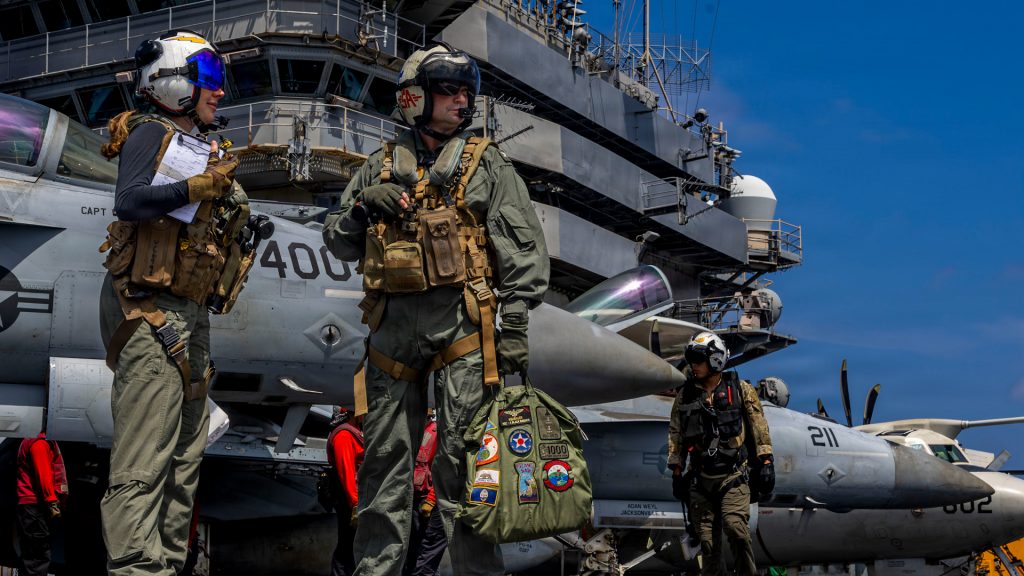
The USS Abraham Lincoln carrier strike group has officially entered the Middle East as tensions with Tehran reach a boiling point. The fleet — which includes three destroyers, along with advanced F-35 fighter jets — is now a part of U.S. Central Command, arriving just as President Donald Trump weighs potential military strikes against the Iranian government following a lethal crackdown on protesters.
“We have a big force going toward Iran,” Trump said last week to reporters as he left the Global Economic Forum in Davos, Switzerland. “I’d rather not see anything happen, but we’re watching them very closely.”
In Tehran, officials remain defiant, telling state media they are ready for “any scenario” and warning that any American or Israeli aggression would be met with a “decisive” counterattack.
“The United States is unpredictable, so we are prepared for any scenario, including any possible aggression,” Iran’s Permanent Representative to the United Nations Office at Geneva, Ali Bahreini, said.
Why the carrier move raises stakes with Iran
Iran is grappling with its most significant internal challenge in years. Anti-government demonstrations erupted in late December. According to Iran International, an independent news outlet, classified government documents and medical reports suggest a death toll of more than 36,500 from the crackdown on Jan. 8 and 9 alone. Iranian state media has said about 3,100 people died in protests in recent weeks.
The toll on the health care system is also severe. Iran International reports that the Health Ministry has recorded 12,986 surgeries on wounded protesters, with thousands more hospitalized in just a six-day period.
European leaders are also escalating their rhetoric. Italian Foreign Minister Antonio Tajani posted on X that the civilian casualties demand a “clear response,” pledging to push the EU to designate Iran’s Revolutionary Guards as a terrorist organization.
Similarly, German lawmaker Norbert Roettgen said no government could “in good conscience” refuse to designate the Revolutionary Guards as terrorists after what he described as a massacre.
What U.S. and Iranian officials are signaling
According to CBS News, the strike group features the USS Abraham Lincoln and three destroyers — the Frank E. Petersen Jr., Spruance, and Michael Murphy — carrying an air wing that includes F-35Cs, Super Hornets and Growlers.
However, a senior U.S. official told Fox News the Lincoln is not yet in position for potential strikes. The official added that Washington is reinforcing its footprint due to instability within Iran, a move that includes deploying heavy transport aircraft and at least one squadron of F-15s.
Tehran’s rhetoric remains combative. Revolutionary Guard Gen. Mohammad Pakpour warned Washington and Tel Aviv against “miscalculation,” stating that his forces have their “finger on the trigger,” according to reports cited by CBS News.
“If there is any aggression by the U.S. or Israel, it will be met with a more painful and decisive response than in the past,” Iran’s Defense Ministry spokesperson, Gen. Reza Talaei-Nik, said.
While First Vice President Mohammad Reza Aref insisted Tehran does not seek war, he confirmed the government has drafted “wartime” management plans.
New military signals on both sides
Citing security assessments of a heightened U.S. threat, Iran International and Fox News report that Supreme Leader Ayatollah Ali Khamenei has been relocated to a secure bunker within the capital.
On the U.S. side, Al-Monitor reports that Vice Adm. Brad Cooper, the top Pentagon commander for the region, recently held a “lengthy personal meeting” with the Israeli military’s chief of staff. However, neither side explicitly mentioned Iran in their readouts.
Meanwhile, Cameron Chell, the chief executive of the drone manufacturer Draganfly, told Fox News that Tehran’s use of cheap delivery systems combined with low-cost warheads has created a potent threat. He warned that a saturation attack involving hundreds of drones could potentially overwhelm naval defenses.
“These drones give Iran a very credible way to threaten surface vessels,” Chell said. “U.S. assets in the region are large, slow-moving and easily identifiable on radar, which makes them targetable.”
“If hundreds [of drones] are launched in a short period of time, some are almost certain to get through,” Chell said.
Regional neighbors are attempting to distance themselves from the escalation. The United Arab Emirates officially ruled out providing logistical aid or allowing the use of its territory and airspace for strikes on Iran, according to a foreign ministry statement.
Diplomatic channels appear strained. Iran International reports that while some informal messages have passed between U.S. envoy Steve Witkoff and Iranian officials, Tehran denies reports that it asked Washington to delay military action.
Al-Monitor reports that the USS Lincoln’s arrival provides the U.S. with more flexibility to strike deep inside Iran.
Conversely, Talaei-Nik claims any attack would result in a “heavier defeat” for the U.S. or Israel.
The post Tehran warns of ‘painful’ response as US fleet arrives in region appeared first on Straight Arrow News.
Ella Rae Greene, Editor In Chief