Street preacher asks Supreme Court to overturn law limiting public protest
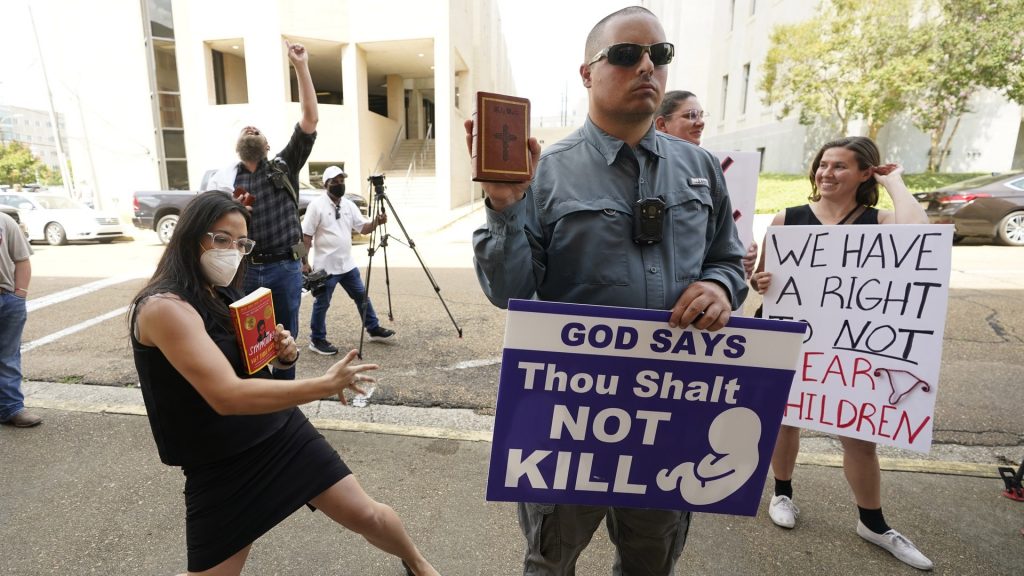
WASHINGTON — “Drunkards!” “Jezebel!” “Nasty!” The street preacher condemned people as he proselytized on the sidewalks outside public events. But after the town of Brandon, Mississippi, adopted an ordinance dictating where people are allowed to protest, Gabriel Olivier was arrested, fined and placed on one year of non-supervised probation.
This was just the beginning of Olivier’s legal fight. He later filed a First Amendment lawsuit in federal court, asserting that evangelizing in public spaces follows a tradition “old as the history of printing presses.”
Olivier’s legal showdown reached the nation’s highest court on Wednesday. With evangelical supporters gathering outside, the nine justices of the Supreme Court listened to an hour and a half of oral arguments. The main question before the court: Can the convicted preacher bring a federal lawsuit against the same law that got him arrested in the first place?
“[I]t would be quite radical to say that someone who is in custody — would it not — someone who is in custody for violating a statute can, while in custody, bring a [civil rights] action to challenge the constitutionality of the statute under which the person is serving a sentence?” Justice Samuel Alito asked.
While the Supreme Court routinely hears First Amendment cases — with its conservative majority most often ruling in favor of religious speech — Olivier’s case focused more on the procedural matters than First Amendment rights. The high court is considering whether the 5th U.S. Circuit Court of Appeals erred when it said Olivier couldn’t challenge the Brandon ordinance’s constitutionality when he hadn’t appealed his actual conviction.
Conservative justices Alito, Amy Coney Barrett, Neil Gorsuch and Clarence Thomas questioned Olivier’s lawyer, Allyson Ho, about whether a ruling in the preacher’s favor would lead to similar challenges under Section 1983 — a federal law allowing individuals to sue states for violating their civil rights — from people convicted of crimes.
“Let’s say that a defendant who has a prior conviction for a non-violent offense is convicted for possession of a firearm,” Alito said. “And let’s suppose that that individual then brings a 1983 claim seeking to have the statute declared unconstitutional insofar as it applies to someone like him with a prior conviction for a non-violent felony. … Let’s suppose he wins on that and then he is — meanwhile, he’s charged once again with possession … of a firearm. … Doesn’t that invalidate that prosecution?”
“No, your honor, because I think the key is what is the relief that the individual is seeking,” Ho said. “So, if you’re seeking prospective relief that you cannot be prosecuted under a law going forward that — that is a set of facts in the future.”
Ho also said a ruling in Olivier’s favor would not undermine a 1994 Supreme Court ruling that prevents people convicted of crimes from using civil lawsuits to effectively reverse their convictions.
That ruling, Ho said, “protects individual convictions, not the criminal law in the abstract.”
Justice Elena Kagan, a member of the court’s liberal wing, seemed to disagree.
“[If] you win and you have the statute declared facially unconstitutional,” Kagan said, “what follows from that logically is that the past conviction was infirm, the past conviction was invalid, and whether or not you’re looking to change that conviction in any way, you have just demonstrated the invalidity of your conviction.”
Attorney Todd Butler, who represented the city of Brandon, argued that the preacher had myriad opportunities to challenge the ordinance through the state courts.
“Petitioner had the opportunity and presumably still has the opportunity to challenge the ordinance under the Mississippi Constitution, which offers greater First Amendment protection than the federal Constitution,” Butler said. “Although Petitioner claims in this case that the courthouse doors are closed, that argument ignores the countless doors Petitioner chose not to enter. What this case is about is Petitioner’s preferred door, one that offers his favored venue and an opportunity for attorneys’ fees.”
The post Street preacher asks Supreme Court to overturn law limiting public protest appeared first on Straight Arrow News.
Ella Rae Greene, Editor In Chief