Social media like X changes your politics whether you want it to or not
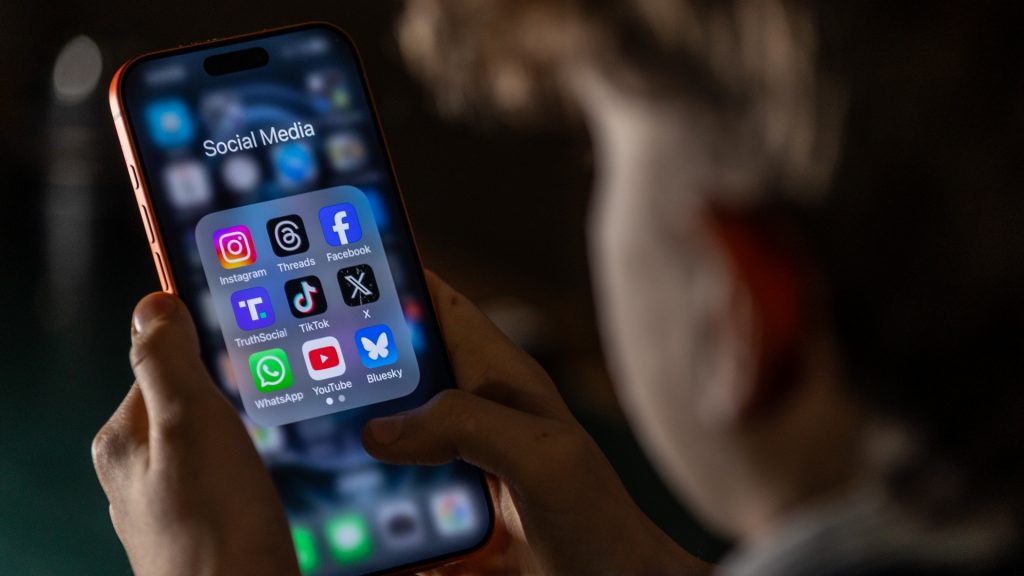
A new study shows the algorithm used by X, still commonly referred to as Twitter, is helping shift users’ political views to the right. It comes as social media comes under increasing scrutiny for its role in shaping U.S. elections.
X Study
The new study published in the scientific journal Nature shows X pushes users’ political views to the right.
“X was a great opportunity to study the effects of algorithmic feeds, because the platform explicitly allowed users to opt out of their algorithmic feed and replace it with a simple reverse-chronological ordering of the posts of accounts you followed,” Germain Gauthier, one of the study’s authors and an assistant professor in the Department of Social and Political Sciences at Bocconi University in Italy, told the HuffPost. “We could look at a sample of X users without relying on the platform’s collaboration.”
Gauthier and his team looked at nearly 5,000 U.S.-based accounts and split them into two groups. The first group used X’s “For You” timeline while the second group used the chronological feed.
“Over the seven-week treatment period, users who switched from the chronological to the algorithmic feed shifted their political opinions to the right,” Gauthier said to HuffPost.
The study also found the group using the algorithm had a more favorable view of Russia and President Vladimir Putin.
“The algorithm is censoring certain types of voices, and more generally, it tends to drive more extreme content than ever,” Ramesh Srinivasan, professor of information studies at UCLA, told Straight Arrow News. “And extreme content in extreme positions largely are being voiced more vocally by folks that might be tied to the right, including some fringes of the MAGA rights as well.”
For the study, 46% of the participants identified as Democrats while 21% called themselves Republicans.
The study found that conservative-leaning posts were 20% more likely to appear in algorithmic feeds than just 3.1% for more liberal-leaning posts.
“The issue is that it’s not actually the spectrum of voices, or, let alone, credible voices that are being shared on these platforms,” Srinivasan said. “It’s the most extreme ones.”
Sky News found the same issue in British politics, with right-wing content appearing far more frequently, even among users who leaned more to the political left.
Musk ownership
“In my research, we don’t look at the effect of the algorithm specifically, but what we do look at is the effect on people that were using Twitter before it was bought by Elon Musk,” Theo Serlin, a lecturer in the Department of Political Economy at King’s College London, told SAN.
Serlin said before Musk purchased the platform, users were typically more liberal and had a more optimistic view of the platform’s potential benefits.
“What we find is the people that were using Twitter before the acquisition become more conservative relative to people that weren’t during that period,” Serlin said.
Musk famously aligned himself with President Donald Trump during his campaign ahead of the 2024 election.
“There’s pretty significant evidence, including in relation to, firing content moderators and certain kinds of algorithms, since Musk has taken over, have become more polarizing than ever,” Srinivasan said.
“Last Week Tonight with John Oliver” recently produced a segment on X and the spread of misinformation on the platform, especially in politics.
As part of that piece, they also found that Musk was making sure his posts were more likely to be seen.
“The owners of social media sites do have quite considerable power to persuade the users of their sites, and the example of Twitter kind of lets us study that, because we observe this change in kind of what the owners of the website wanted,” Serlin said.
Other social platforms
“We’re seeing pretty similar problems around the other platforms as well,” Srinivasan said.
The impact of Facebook on U.S. elections is well-documented. A study published in that same journal three years ago analyzed data from 208 million American adults’ Facebook accounts.
They found significant political-ideological segregation between conservative and progressive users, with most users being fed posts that echoed their own political beliefs.
Researchers also found it wasn’t equal: more political posts were seen by conservative users, and a “homogeneously conservative corner” of the site existed with no progressive counterpart. Most of the items flagged as misinformation were also concentrated in that conservative corner.
Experts SAN spoke with said Meta’s other major platform is seeing a lot of the same issues as X.
“Instagram is well known for pushing a lot of extreme content, not just politically, but also a lot of content that’s designed to target people in areas where they feel a sense of anxiety, right?” Srinivasan said. “Like young women around body image issues, for example.”
Srinivasan said there’s another issue at hand, too.
“The real problem is the fact that they are not at all open for public audits,” he said. “The heuristics are not collaboratively designed. They’re basically using our data and leveraging our attention with us having almost no knowledge of why we see what we see.”
When it comes to a new social platform like Bluesky, which was presented as a progressive alternative to X, there’s not a lot of research on that platform’s impact on American politics.
“I’ve not seen any research that studies the effects of Bluesky,” Serlin said.
Ella Rae Greene, Editor In Chief