Salt Lake City is in a drought. Can it spare water for an ICE detention center?
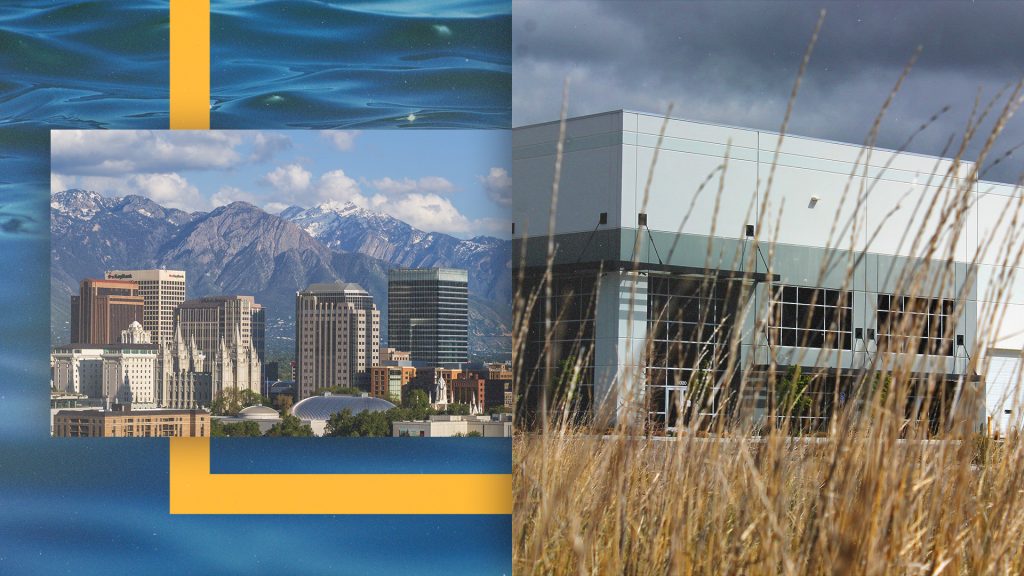
With water shortages already gripping the region, Salt Lake City officials and environmental experts face an urgent question: Can the valley support an immigration detention center the size of a small city?
Utah’s 2026 water outlook is especially precarious. The state relies on snowpack for roughly 95% of its annual water supply, yet this year’s underwhelming accumulation melted weeks earlier than usual after a record warm spell.
Against that backdrop, concerns are growing about the physical limits of the valley as the Department of Homeland Security (DHS) spent $145.4 million in March to purchase an 833,000-square-foot warehouse on the city’s west side. Located in the Utah Inland Port industrial district just south of the Utah State Correctional Facility, the site is under review for conversion into one of eight planned “mega centers” across the nation capable of holding 7,500 to 10,000 immigration detainees.
A facility of that size would require a lot of water to run daily operations. More, even, than Salt Lake City officials told Straight Arrow News the city has to spare.
A water system already at its limits

“We don’t have the water to house 10,000 people in the western side of Salt Lake Valley,” said Dr. Brian Moench, president of Utah Physicians for a Healthy Environment.
“We don’t have the infrastructure, we don’t have the water as a resource,” Moench told SAN. “We don’t have the sewage system.”
To better understand the scale of the shortage, SAN reached out to the Salt Lake City Department of Public Utilities. The department deferred questions to the mayor’s office, where spokesperson Andrew Wittenburg provided a comparison based on the nearby Utah State Correctional Facility. That prison uses about 450,000 gallons of water per day to serve roughly 3,000 inmates, staff and operational needs — about 150 gallons per person per day. Scaled up, Wittenburg said the city water department reported a 10,000-person detention center would require approximately 1.5 million gallons daily.
Nearly all of that water would add demand to the system: The warehouse currently uses 5,600 gallons a day in its current life as storage space.
The comparison underscores the magnitude of what is being proposed — not just a building conversion, but the effective addition of an entirely new population center.

“From the standpoint of the limits of what the environment here can bear in terms of water quantity, water quality and air quality, bringing that many people into the valley is not sustainable,” Moench said.
Most of the state of Utah is currently in some level of drought, and the Great Salt Lake has been drying up for years, with an exposed lakebed becoming a source for toxic dust. To mitigate the crisis, Salt Lake City passed an ordinance in late March, limiting new nonresidential developments to 200,000 gallons per day. The ordinance came two weeks after the federal government purchased the warehouse as part of the Trump administration’s nationwide push to expand immigration detention capacity using roughly $45 billion in funding for warehouse-based facilities.
The new rule has the potential to disrupt DHS’s plans for the facility. It is one of several similar efforts, which appear to be aimed at blocking the federal government’s detention plans, playing out across the country.
Similar efforts, which appear to be aimed at blocking the federal government’s detention plans, are playing out across the country.
In January, Immigration and Customs Enforcement (ICE) quietly toured a warehouse facility in Kansas City, Missouri. Within hours of the secret visit, all but one city council voted to approve an ordinance that would block applications to expand detention facilities not owned or operated by the city through Jan. 15, 2031.
In Salt Lake City, even before the ordinance capping water at 200,000 gallons, the city had already urged residents and businesses to conserve 10 million gallons of water per day as part of a Stage 2 drought advisory. That advisory level is the second in a five-stage system, which progresses from a “watch” at Stage 1, to “critical” at Stage 5. The “mild” Stage 2 degree was last issued in 2022, according to local reports.
Mosquitoes, air quality and echoes of prison problems
“It is not easy to turn a warehouse into a habitable place for thousands of people,” Salt Lake City Council Member Alejandro Puy told SAN.
People housed at a facility would need water for drinking, hygiene, showers, culinary services and cleaning, among other things, said Polly Prince, co-founder of the Med-Team Utah Prisoner Advocate Network.
“It’s concerning that we’re putting it in Salt Lake City, in a county that’s been warning us about our water usage for years,” Prince said.
Water scarcity is a big problem on the west side of Salt Lake City, but it isn’t the only concern. Air pollution and mosquito mitigation pose ongoing threats in the heavily industrialized area where the new detention center is planned. Because of the neighborhood’s proximity to the massive Kennecott Copper Mine — one of the world’s largest open-pit operations — the west side is exposed to multiple sources of air pollution that are not found on the east side of the Salt Lake Valley, according to Moench.
“If you’re bringing in here, essentially a new city of 10,000 people, you’re going to aggravate all those problems,” Moench said.

A spokesperson for ICE told SAN that “ICE fully complies with the National Environmental Policy Act (NEPA) as implemented by DHS directives and policies when planning and executing all ICE actions, including real estate acquisitions.”
The agency added that prior to purchasing the warehouse, it evaluated existing facilities to “help minimize environmental impacts, including potential impacts to protected species, sensitive natural resources and valued cultural resources.”
Mosquitoes are perhaps not a valued cultural resource. But they are a potential health concern. When the Utah State Correctional Facility relocated to the west-side area a few years ago, inmates and staff reported being swarmed by mosquitoes both indoors and outdoors, with complaints pouring in about bites during short walks between buildings, standing water and unbearable conditions that limited time outside. Families and advocates described inmates being “mauled” by the insects, prompting repeated calls for repellent and abatement. The state prison now spends thousands of dollars yearly on mitigation efforts.
In 2023, a West Nile virus-positive mosquito pool was detected at the site, according to the Utah Department of Corrections.
Officials relied on repeated pesticide applications, which has ushered in concerns about pesticide-resistant mosquitoes.
Prince, who has visited the prison and worked with mosquito abatement efforts, said mitigation measures such as removing sod for gravel and treating standing water helped somewhat last summer. The proposed warehouse site — farther south in the Inland Port and thus farther from the main wetlands — will likely face a less severe problem than the prison itself. Still, she cautioned, mosquitoes remain a concern.
“I can’t imagine the retrofitting that would be necessary for that warehouse,” Prince said. “I know the federal government can come in and do eminent domain, but it’s very concerning that they’ve chosen to do this in an industrial area.”
Transparency and a “bulldozer approach”

Salt Lake City officials say they were not meaningfully consulted before the purchase. In fact, the city learned of ICE’s plans to convert the warehouse into a detention center only after the deal was closed, leaving local leaders blindsided and struggling to respond to the sudden development.
Puy described it as a “bulldozer approach.”
“There is a disregard of local communities and local leaders,” he said.
Across the country, DHS has justified similar projects through an internal finding that the proposed projects will have “no detrimental effect,” excusing limited early local engagement.
Chris Judd, a city council member in Surprise, Arizona, told SAN he learned of DHS’s $70 million purchase of a large warehouse in his city during a phone call with a reporter, only after the deal had closed.
In a Feb. 4 letter to then-DHS Secretary Kristi Noem, Arizona Rep. Paul Gosar asked, “What consultations, if any, have occurred with the City of Surprise, Maricopa County, local school districts, and public safety agencies prior to site selection?”
Noem responded by writing in part, “Site selection was predicated on a ‘No Detrimental Effect’ determination.”
Noem indicated local officials in Surprise didn’t need to know about the deal by adding, “ICE will continue to engage with state and local stakeholders when appropriate.”
The ‘practical implications’
Back in Salt Lake City, Puy said ICE’s approach is part of a “we don’t care what you think” mindset and “we’re going to do whatever we want.” And that, he said, “is really not the American way.”
Under the Constitution’s supremacy clause, the federal government can bypass many local rules, but Puy said basic safety requirements remain.
“There are some basic things they still need to abide by. Like health and code,” he told SAN. The city is now focused on enforcing those standards, including plumbing, fire safety and habitability.
“We’re going to highlight every code violation… we need to make sure they’re following the rules even if it takes us to court,” he said. “We’re not going to stop.”
Utah Gov. Spencer Cox, a Republican, has expressed general support for the state’s additional ICE detention capacity, but did not respond to SAN’s requests for comment. Salt Lake City Mayor Erin Mendenhall’s office has emphasized the city’s duty to protect reliable utilities for residents.
ICE did not respond to SAN’s request for comment regarding concerns about water scarcity and mosquitoes posing potential health risks to detainees, but previously told SAN the warehouse “will be very well-structured detention facilities meeting our regular detention standards.”
But Moench said he is worried the region’s drought is not being seriously considered.
“Do they understand it? No, they don’t,” Moench said. “Do they care about it? No, they don’t. They’re not paying any attention to the practical implications of what they’re doing.”
Ella Rae Greene, Editor In Chief