Proposal could shift Virginia’s House delegation to 10-1 Democratic advantage
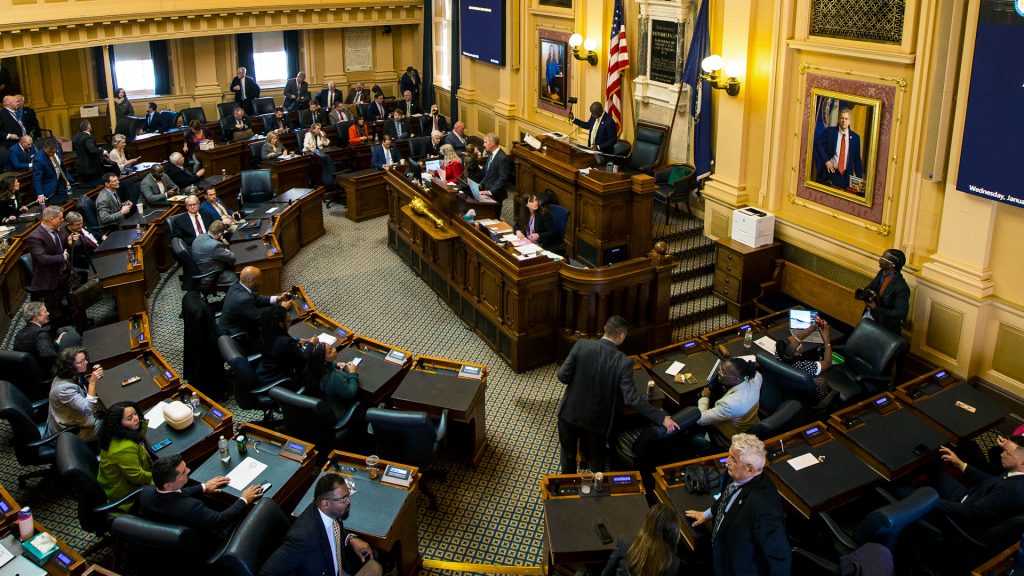
Virginia voters may be asked to approve a proposed constitutional amendment that could transform the state’s congressional delegation from its current 6-5 Democratic-Republican split to a 10-1 Democratic advantage. The amendment would let the Virginia General Assembly redraw the state’s U.S. House map in 2026, sidelining a bipartisan commission on redistricting.
Gov.-elect Abigail Spanberger, a Democrat, has not committed to signing a redistricting plan into law. However, she “believes it’s important that the General Assembly be ready to respond to the concerns of Virginia voters if needed,” her spokesperson told Virginia Public Media.
State House Speaker Don Scott, also a Democrat, told Newsweek the proposed constitutional amendment responds to what he called President Donald Trump’s “bullying” of Republican-led states to redraw their congressional maps to preserve a GOP majority in Congress.
How the maps could change
Although Democratic leaders frame the proposed amendment as a contingency to be used if other states redraw maps before next November’s midterms, they have outlined ambitious goals.
Senate Majority Leader Scott Surovell, a Democrat, told VPM that at least two seats now held by Republicans are “obviously in play.”
House Speaker Scott went further, suggesting to Newsweek that a new map might contain just one likely Republican district.
How the amendment could get on the ballot
The process for amending Virginia’s constitution is complex.
According to The Hill, Democrats cleared the first hurdle in October by passing a redistricting bill. To finalize the change, the legislature must approve the measure a second time.
Only then could a constitutional amendment giving legislators authority over redistricting be placed on the ballot for voters, potentially as early as the spring or summer of 2026.
What Republicans and process advocates say
Republicans strongly oppose the move.
State Sen. Ryan McDougle, a former member of the independent redistricting commission, told VPM that voters originally backed the bipartisan system to “take the politics out” of the process.
McDougle argued against the new effort, saying maps “should not be rigged so one party always gets the result that they want.”
Why national context matters to Virginia
The push in Virginia mirrors moves elsewhere. In Texas, Republicans enacted a new map following pressure from Trump. A federal court initially blocked the plan as a likely racial gerrymander, but on Thursday, a divided Supreme Court said Texas may use the new map for the 2026 elections while a legal challenge continues.
California voters approved a Democratic-friendly map in November, although Republicans are challenging it in federal court. Indiana leaders advanced a draft map aimed at creating nine Republican-leaning districts. North Carolina and Missouri have enacted new maps, and Utah’s map shifted after litigation, according to The Hill and Ballotpedia.
Republicans hold a 220-213 majority in the House, with two seats formerly held by Democrats currently vacant. The party occupying the White House typically loses House seats in midterm elections.
The post Proposal could shift Virginia’s House delegation to 10-1 Democratic advantage appeared first on Straight Arrow News.
Ella Rae Greene, Editor In Chief