Presidential power, culture wars dominate Supreme Court’s January docket
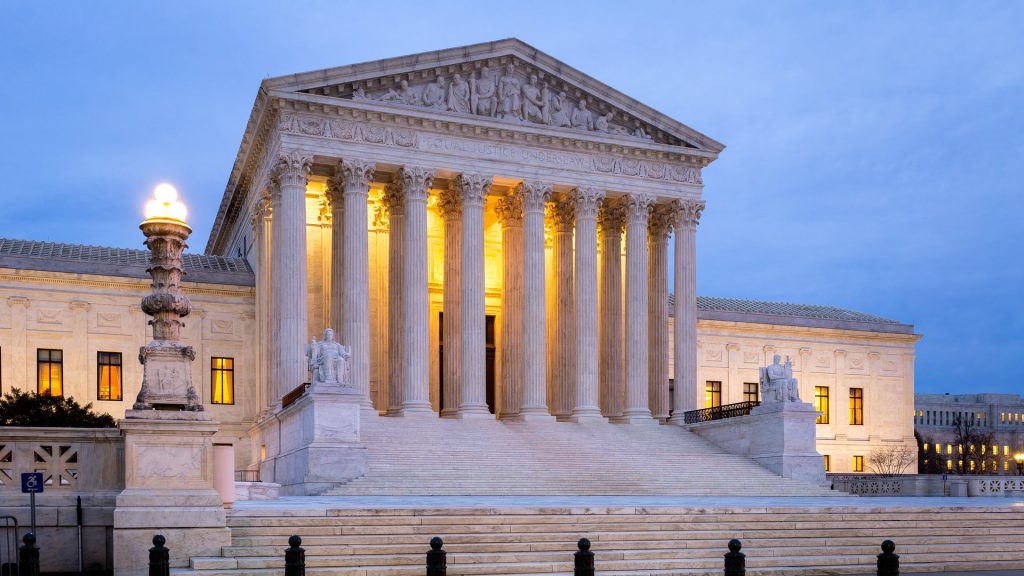
As the Supreme Court ushers in the new year, its January docket reflects some of the country’s highest-stakes culture wars and political showdowns. Halfway through the 2020s, the lineup reveals a snapshot of America’s current zeitgeist.
Trans women in sports. Second Amendment rights. Corporate responsibility. Climate change. All are among the hot-button topics dominating the six cases the justices will hear next month.
The court has a solid, 6-3 conservative majority. But that doesn’t necessarily foretell the outcome of the high-profile cases on tap for January.
“Overall this term, the big question will be, will the Republican-appointed block split — and if so, in what ways?” Zach Shemtob, executive editor at SCOTUSblog, told Straight Arrow News. “The big issue then is will there be fissures among the Republican-appointed justices? And that is likely to determine the outcome of some of these cases.”
The justices cherry-picked just a small portion of the thousands of cases vying for their attention. The justices’ decisions could potentially change — or even reshape — the fabric of the nation.

Presidential power on trial
Shemtob identified two main themes of the court’s January docket: “issues in the ‘culture wars’ and the president’s power over independent agencies.”
One of the term’s most consequential cases, Trump v. Cook, is slated for oral arguments on Jan. 21. At stake is the reach and scope of presidential authority, a core question of the constitutional separation of powers.
The case concerns whether President Donald Trump had the authority to fire Lisa Cook, a member of the Federal Reserve Board of Governors, over alleged mortgage fraud. A decades-old precedent insulates officials from independent agencies like the Fed from political interference.
“Trump v. Cook may reflect on the court’s potential willingness to embrace the unitary executive theory, which is the idea that the president has authority over personnel in independent agencies, so he can fire — based entirely on his own discretion — the heads of those agencies,” Schemtob said.
Transgender athletes
On Jan. 13, the court will hear back-to-back cases dealing with one of the most charged debates of the 2020s: transgender girls and women joining female sports teams.
“They are ready and willing to enter the ‘culture war,’ and they’re certainly willing to engage with these pressing social issues,” Shemtob said. “Obviously these transgender issues, as we saw last term as well, it’s at the center of that. We’ll see two interconnected cases in January.”
In one case, the justices will consider whether the state of Idaho can categorically exclude trans girls from female sports using the “Fairness in Women’s Sports Act.” In the other case, the court considers whether a similar ban in West Virginia violates Title IX and the Constitution’s equal protection guarantees.
‘Cancer Alley’
Meanwhile, as tides rise and temperatures warm, many fret about the effects of climate change. Opening the Supreme Court’s 2026 session is the case of Chevron v. Plaquemines Parish. Its implications challenge the scope of corporate responsibility in the face of environmental pollution. Certain companies, like Chevron, face legal confrontations demanding accountability.
An 85-mile stretch along the Mississippi River, the site of predominantly Black communities, has been dubbed “Cancer Alley.” More than 200 petrochemical plants and other facilities crowd the riverbank. Plaquemines and other Louisiana parishes filed a lawsuit against Chevron and other corporate entities, saying the companies used a discriminatory land use program to put the facilities in marginalized communities, causing harm to neighborhoods and coastlines.
At issue is whether Chevron and the other oil companies can have the case removed from state jurisdiction. The companies say that because the crude oil they produced was under World War II-era contracts, the issue should be heard in federal court, which they would consider a more favorable venue.
Second Amendment
The court also will wade into the highly contentious battle over the Second Amendment.
In Wolford v. Lopez, the court is asked to decide whether Hawaii can enforce a law that prohibits gun holders from concealed carry on private property unless the property owners give consent. The legal question is: Where exactly are guns allowed and who can give the permission?
“These kinds of cases are generally much more complicated, and have a more complicated fact pattern than the popular narrative,” Shemtob said. “There’s a lot of prongs in Wolford v. Lopez. Bottom line, the court is revisiting the Second Amendment.”
This reexamination comes in the wake of New York State Rifle & Pistol Association v. Bruen, a 2022 decision that made it easier for people to carry firearms.
“And that it is at the forefront of the courts’ jurisprudence on the Second Amendment,” Shemtob said. “This case in January will be a further exploration of the implications of the Bruen case.”
Additional cases
On Jan. 14, the court will hear arguments about whether the public transportation entity NJ Transit is considered an arm of the state, which would shield it from outside lawsuits. Justices will decide whether a state-run entity is entitled to immunity from certain actions taken outside of its state.
The court also will hear arguments around pension funds in M & K Employee Solutions v. Trustees of the IAM Pension Fund. The case involves calculating the withdrawal liability when an employer withdraws from a multi-employer pension fund.
The court is likely to rule on the January cases, as well as those heard later in the winter, shortly before it adjourns its current session in late June or early July.
The post Presidential power, culture wars dominate Supreme Court’s January docket appeared first on Straight Arrow News.
Ella Rae Greene, Editor In Chief