Missouri proposal reignites debate over Chromebooks in schools
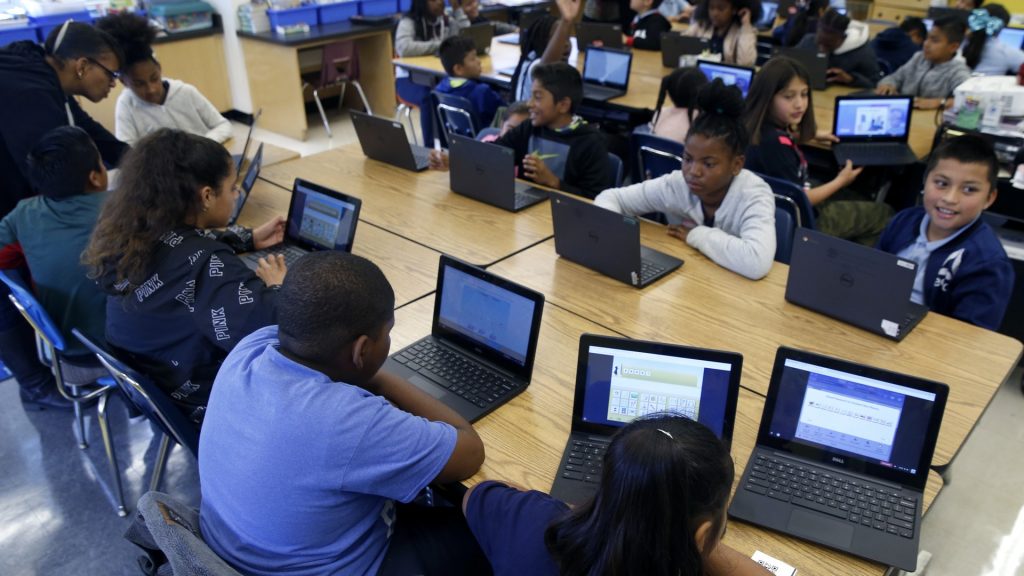
A proposal in the Missouri Legislature to scale back the use of Chromebooks in schools has sparked debate among educators, parents and health professionals about how much technology belongs in the classroom.
HB 2230 would reduce Chromebook use in middle schools and eliminate it in elementary grades, while largely leaving high schools untouched. This would be the first state-wide legislation addressing the issue in the United States.
Mercy Pediatrician Dr. Emily Laugges told Straight Arrow News she sees both benefits and risks in classroom technology and cautioned against broad rollbacks without balance.
“There are benefits to technology in the classroom,” Laugges said. “It can make education more inclusive for children with dyslexia, ADHD, autism, and hearing or visual impairments.”
She pointed to studies showing improved student achievement when laptops are paired with evidence-based math and reading programs. Laugges said eliminating access entirely could take away learning opportunities for some students.
“At the same time, excessive screen time is a real concern,” she said. “What’s most important is finding a balance between developing healthy media habits and optimizing children’s learning.”
The debate over Chromebooks comes amid a national discussion on classroom tech. In a May 2025 survey by the EdWeek Research Center, more than half of educators reported that off-task behavior on laptops, tablets or desktops is a significant source of classroom distraction that cuts into instructional time — and ranked it as a greater distraction than cellphones. The survey found that 56% of teachers and administrators said off-task technology use was a major problem, and one-third reported that students using devices for learning were off task more than a quarter of the time.
“Giving some students a device is like asking an alcoholic to hold a drink — it’s just too tempting,” one high school teacher told Education Week. Another noted that devices open up “a lot of potential and possibilities for education,” especially in preparing students for life after school.
Educators’ views remain mixed. While 53% of respondents said one-to-one computing — where each student has a device — has had a positive impact on learning, about 27% said it has had a negative effect on classroom management, up from 20% in 2019.
Some teachers say monitoring screens can pull them away from instruction, while others worry that students use school laptops to play games, listen to music or otherwise become disengaged. Districts have adopted monitoring tools to keep students on educational sites, but teachers say that can still leave them policing screens rather than guiding learning.
Laugges said too much screen exposure — particularly low-quality or recreational screen time — can lead to medical and developmental problems in children, including obesity, sleep disruption, eye strain and poor posture. She also cited concerns about cognitive development, mental health and social skills.
Teenagers are particularly vulnerable, she said, noting that many already spend eight to 10 hours a day on recreational screen use.
“If high school students are also on screens throughout the school day, that total can exceed 12 hours a day,” Laugges said. “That’s simply too much.”
Parents have also raised concerns about what may be lost as classrooms become increasingly digital. Some note that students no longer learn cursive writing consistently and rely heavily on online platforms rather than textbooks or printed materials.
“When everything is online, it can be hard for students to study or review material without internet access,” Laugges said. “That can put families without reliable internet at a disadvantage.”
She added that heavy reliance on screens at younger ages may interfere with fine motor development, including handwriting skills.
“There’s a difference between typing your name and learning how to write it,” she said.
The American Academy of Pediatrics recommends no screen time for children under 18 months, except for video chatting. For preschool-aged children, the limit is one hour per day of high-quality educational content. For children ages 6 and older — including teenagers — the recommendation is no more than two hours of recreational screen time per day.
“Almost everyone exceeds those recommendations,” Laugges said. “I spend a lot of time talking with families about setting boundaries.”
She encourages parents to establish screen-free zones, such as at the dinner table, and to keep phones and devices out of bedrooms at night to protect sleep.
Laugges also said increased screen use and social media exposure have contributed to rising rates of anxiety and depression among children and teens, along with cyberbullying concerns.
“We need to make technology work for us — not take from us,” she said.
She noted that much of today’s classroom technology expansion stems from the COVID-19 pandemic, when schools shifted rapidly to online learning.
“A lot of these systems were rolled out quickly, without time to fully think through long-term use and safeguards,” Laugges said. “Hopefully, we can now take the time to do it in a more thoughtful and safe way.”
While there are no firm limits on educational screen time, the U.S. Department of Education recommends that schools design curricula that emphasize active engagement with technology and minimize passive use.
“While there are potential benefits to technology in the classroom, it is important that we continue to advocate for our children and teens,” Laugges said. “Classrooms should be using technology in appropriate and safe ways, with clear boundaries for both teachers and students.”
Straight Arrow News reached out to HB 2230’s sponsor, Representative Tricia Byrnes. After multiple back and forths with her office, Byrnes did not comment before press time.
The post Missouri proposal reignites debate over Chromebooks in schools appeared first on Straight Arrow News.
Ella Rae Greene, Editor In Chief