Loyalty over mercy: Straight Arrow News examines Trump’s use of clemency
President Donald Trump has created what legal scholars describe as a new, “personal model” of granting clemency. The modern-day process is shaped less by traditional ideas of mercy and more by loyalty to Trump’s allies.
In early 2025, Trump issued sweeping blanket pardons for more than 1,500 people charged in connection with the Jan. 6, 2021, attack on the U.S. Capitol, an unprecedented move that set the tone for his clemency strategy. The action was followed by a steady stream of pardons and commutations for political allies, including several who played prominent roles in efforts to overturn the 2020 election.
A departure from mercy
The approach is a sharp departure from the historical purpose of granting clemency, which prioritized providing mercy to those who’ve expressed remorse and rehabilitated themselves, said Mark Osler, a law professor at the University of St. Thomas–Minnesota and a leading expert on clemency.
“There’s thousands and thousands of petitions that have piled up from people who are in prison, who have rehabilitated themselves, and those are being ignored,” Osler told Straight Arrow News. “This is being done to the exclusion of everybody who doesn’t have $100,000 to pay to a lobbyist, who doesn’t have that access, who can’t stop by Trump’s table at Mar-a-Lago.”
The Constitution gives presidents broad authority to grant clemency, with the exception of someone who is under impeachment, or for future crimes.
The reasoning behind a president’s decisions, according to Osler, often reflects his personal values.
“It reveals what their deepest values are,” he said. “When we look back at Obama, he visited a prison, visited some people who had been drug offenders, walked out and literally said, ‘there but for the grace of God go I.’ And then [he] started a program that was targeted at drug offenders. With Trump, loyalty is at the center of his being and his values.”
Osler said it’s not unusual for a president to pardon an ally, but excluding people who don’t have access to the president, or those around the president, poses a problem.
“Always, there’s at least been some people who come out of that pool of those who aren’t rich, who aren’t famous, who don’t have a connection.” Osler said. “And we’re not getting that right now.”
The White House did not respond to SAN’s questions about who has access to the pardon process.
Still, Osler said Trump is acting within his constitutional power.
“I hear a lot of people saying that it’s corrupt, and I’d be very careful about saying that,” Osler said. “I don’t see evidence of corruption in the sense of someone is paying the president or his family directly. There’s lobbying, but that’s historically been OK in our society and our government.”
An imperfect system
The clemency process has long been under scrutiny.
During Trump’s first term, Jared Kushner, whose father was pardoned by Trump in 2020, invited Osler as an expert to discuss what many felt were needed changes for the clemency system. Much of that discussion centered around streamlining and expanding the use of clemency to those who earned it, Osler told SAN.
Dan Kobil, a professor of constitutional law at Capital University Law School in Columbus, Ohio, was once an advocate for expanding clemency power.
“The danger in the past was that [presidents] were too afraid to use the power and wouldn’t give it to people in deserving cases because they thought it would hurt them” politically, Kobil said.
In light of the Jan. 6 attack on the Capitol, Kobil has changed his position and wants to put limits on clemency power. Kobil’s concerns center less around the number of pardons issued during this administration, and more around the purpose behind them.
“It’s heartbreaking for me because presidential norms have been sufficient, for the most part, to keep presidents within the rails of responsible pardoning,” Kobil told SAN.
The White House did not answer SAN’s questions about the president’s approach to issuing pardons.
“There’s a different cast to the type of principles he’s applying to the use of clemency, or as some people would say, a lack of principle,” said Osler.
Clemency, pardons and commutations
Presidents have the power to grant clemency in a variety of ways.
“The broadest form of clemency would be a pardon, which essentially wipes out the conviction and eliminates many of the consequences of ever having been convicted,” Kobil said. “For example, if someone was convicted of a felony that the president pardoned, the federal government would treat them as if they had never been a felon.”
A commutation is the substitution of a lesser punishment for a greater one.
“For example, commutations were granted by Joe Biden in most of the death penalty cases: He commuted their death sentences to life imprisonment,” Kobil said.
While granting blanket clemency to those who participated in the Jan. 6 attack on the Capitol, Trump mostly issued pardons and granted some commutations, Kobil noted.
Financial crimes take priority
Many of Trump’s most controversial clemency grants involve individuals accused or convicted of financial crimes, offenses similar to those Trump himself has been charged with.
“We’re seeing a huge number relative to other presidents of people accused of financial crimes and bribery and other types of white-collar crimes,” Osler said.

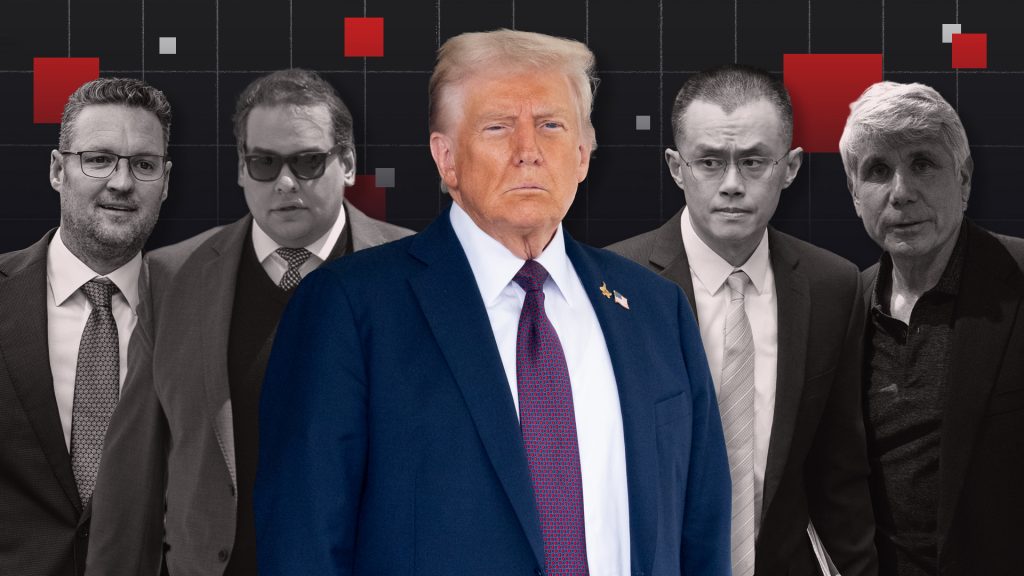
Some of the cast:
- George Santos, the former congressman and vocal Trump ally, pleaded guilty to wire fraud and identity theft. He received a commutation in October 2025.
- Rod Blagojevich, the former Illinois governor convicted on federal corruption charges, including attempting to sell former President Barack Obama’s vacated U.S. Senate seat. He was pardoned in February 2025.
- Trevor Milton, founder of an electric truck company, was convicted of securities and wire fraud. He received a full pardon from Trump in March 2025.
The bulk of Trump’s pardons stem from the Jan. 6 attack on the Capitol, and the 2020 election. In early November, Trump pardoned 77 people who had been accused of assisting in the efforts to overturn the 2020 election. Though, most of the clemencies were symbolic since many of the cases are ongoing and do not apply to state convictions.
Pardoning allies-not unique to Trump

Trump is not the first president to issue a high volume of pardons. President Joe Biden granted more than 4,200 acts of clemency – more than any president before him in history. Trump would have to pardon or commute the sentences of more than two people a day for the rest of his term to meet that metric.
Prior to his departure from office, Biden pardoned his son, Hunter Biden.
President Bill Clinton’s controversial pardon of financier Marc Rich, whose ex-wife was a major donor, remains one of the most scrutinized in modern history.
But scholars say the selectivity of Trump’s pardons represent a shift, with clemency overwhelmingly benefiting political associates or those who are well-connected.
“Mercy is something we often grant to people we don’t know,” Osler said. “That’s not what’s happening right now.”
Trump bypasses vetting process?
According to Department of Justice guidelines, a petitioner must wait a minimum of five years after conviction or release before filing an application for pardon.
Part of the requirement is that petitioners must demonstrate good conduct and remorse. The application also needs to be submitted through the Office of the Pardon Attorney.
Bernadette Meyler, a Stanford University law professor who specializes in constitutional law, said Trump has largely circumvented the traditional pardon-vetting process conducted by the Office of the Pardon Attorney, which implements systems designed to evaluate pardons based on merit.
“There are a bunch of criteria that the Office of the Pardon Attorney used to employ in terms of thinking about the sentence,” Meyler told SAN. “The traditional vetting process looked at acceptance of responsibility. It looks at a sense of reparation, whether people had reformed in some way.”
Meyler said the shift undermines the idea that pardons can be earned through merit or rehabilitation.
“Trump has moved much more towards a personal model, and a model where kind of personal affiliations are more significant,” Meyler said.
Of the more than 1,600 people granted clemency by Trump, only a small fraction of those applications were filed through the Office of the Pardon Attorney, according to a recent report by ProPublica.
SAN reached out to the Office of the Pardon Attorney for clarity on its processes under Trump’s second term, but did not receive a response.
White House won’t answer questions
The White House declined to take a phone call from SAN about this story. Instead, White House spokeswoman Abigail Jackson asked for a list of questions via email. SAN does not typically provide questions in advance, but made an exception in this case.
The White House did not answer SAN’s questions, including whether the administration would take a closer look at granting clemency in the future based on merit and mercy.
The statement Jackson provided instead focused on the White House’s critique of the scholars cited in this story.
“Nothing they say should be taken seriously and neither should a publication that tries to conceal their political activism. President Trump has exercised his constitutional authority to issue pardons and commutations for a variety of individuals,” Jackson wrote to SAN in a Friday afternoon email. “And the only pardons anyone should be critical of are from President Autopen, who pardoned and commuted sentences of violent criminals, including child killers and mass murderers – and that’s not to mention the proactive pardons he ‘signed’ for his family members like Hunter on his way out the door.”
A need for limits on pardoning power?
Kobil is currently drafting a scholarly article that proposes a constitutional amendment restricting a president’s pardoning powers.
“The one I’m particularly concerned about is the ability to pardon people who have essentially committed treason against the United States, that’s what we see in authoritarians in other countries,” he said.
Though no one connected to the Jan. 6 Capitol attack was charged with treason, several were convicted of “seditious conspiracy.”
“Depending on how you would define treason, you would try to limit the ability of presidents to overthrow the government to keep themselves in power,” Kobil said.
At the moment, the limits on presidential pardoning power are being pushed and tested.
“I think the message is that he as president has complete control over the entirety of the executive branch and that it’s all within his power,” Meyler said.
The White House did not respond to SAN’s question about the president’s messaging.
The post Loyalty over mercy: Straight Arrow News examines Trump’s use of clemency appeared first on Straight Arrow News.
Ella Rae Greene, Editor In Chief