Judges reject GOP challenge to California’s new congressional map
A federal court in California allowed the state to move forward with its voter-approved congressional map just one month before the state’s candidate filing deadline for the midterm election. The ruling is a loss for both President Donald Trump and the Justice Department, who accused California Democrats of using race to redraw boundaries.
The three-judge panel rejected the DOJ and California Republicans’ challenge to the state’s congressional map, writing that they abandoned their argument that the map was a political power grab. The two judges — Josephine Staton and Wesley Hsu — said that at no point did either claim the map was racially gerrymandered, which is illegal. Instead, both used politics as a reason for the map and redistricting fight.
“Nor have Challengers offered alternative maps that would prove otherwise,” the judges wrote. “Significantly, they provide no alternative map for any congressional district except one: District 13. And as to that district, the alternative maps they do offer are either materially indistinguishable from the Proposition 50 Map or do not meet other redistricting goals.”
They did, however, acknowledge that the map is “overwhelmingly” partisan. Judge Kenneth Lee, whom Trump appointed in 2019, disagreed with the ruling. Lee said that remarks from the mapmaker about creating a strong Latino district ran afoul of the 14th Amendment, which guarantees equal protection under the law.
The new map created five congressional districts that favored Democrats ahead of the November midterms. The map is temporary, unless voters decide to later make them permanent.
The ballot question allowed for the map to be in place only for the 2026 midterm elections as a way to equalize Texas’ map, which gave Republicans a five-seat advantage. The map would then be redrawn after the 2030 Decennial Census by the state’s independent commission.
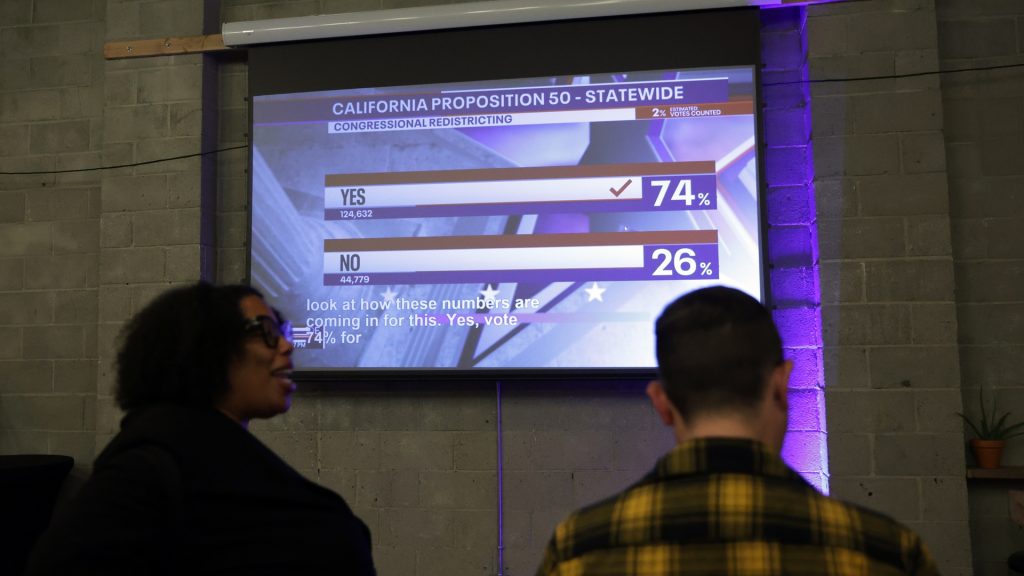
About 7.4 million Californians voted in favor of Proposition 50 this past November, according to official election results from the California Secretary of State. Just over 4.1 million Californians voted against it.
“Republicans’ weak attempt to silence voters failed,” California Gov. Gavin Newsom, a Democrat, wrote on X Wednesday.
Louisiana’s map central to voting rights battle
Trump ignited a national push from states to prematurely redraw congressional boundaries as he sought Republicans to retain control of the House. A president’s party has typically lost seats in the House after he’s elected.
One state at the forefront of the fight is Louisiana. A Supreme Court case — Louisiana v. Callais — centers on the question if the state’s 2022 redrawn boundaries only needs one Black majority district or two.
Residents are pitted against one another as some argued two Black majority districts are necessary as the state is 31% Black. Others argued that a second Black district would violate the 14th and 15th amendments.
The lawsuit focuses on a provision in the Voting Rights Act that gave Black Americans representation in Congress. No information was immediately available on when the Supreme Court will issue a decision on the case. Louisiana’s primary is still set for May 16.
Redistricting helped Republicans
Since Trump ignited the redistricting push, enacted maps across the country netted in Republicans likely securing four districts across the nation over Democrats. The breakdown is the following:
- California created five Democrat-leaning districts
- Ohio created two Republican-leaning districts
- Missouri created one Republican-leaning district
- North Carolina created two Republican-leaning districts
- Texas created five Republican-leaning districts
- Utah created one Democrat-leaning district
None of the districts are to be assumed full control of one party until Election Day. Instead, they are projected to favor one party due to historical election results.
The post Judges reject GOP challenge to California’s new congressional map appeared first on Straight Arrow News.
Ella Rae Greene, Editor In Chief