
Jesse Jackson, veteran civil rights leader and 2-time presidential candidate, dies at 84
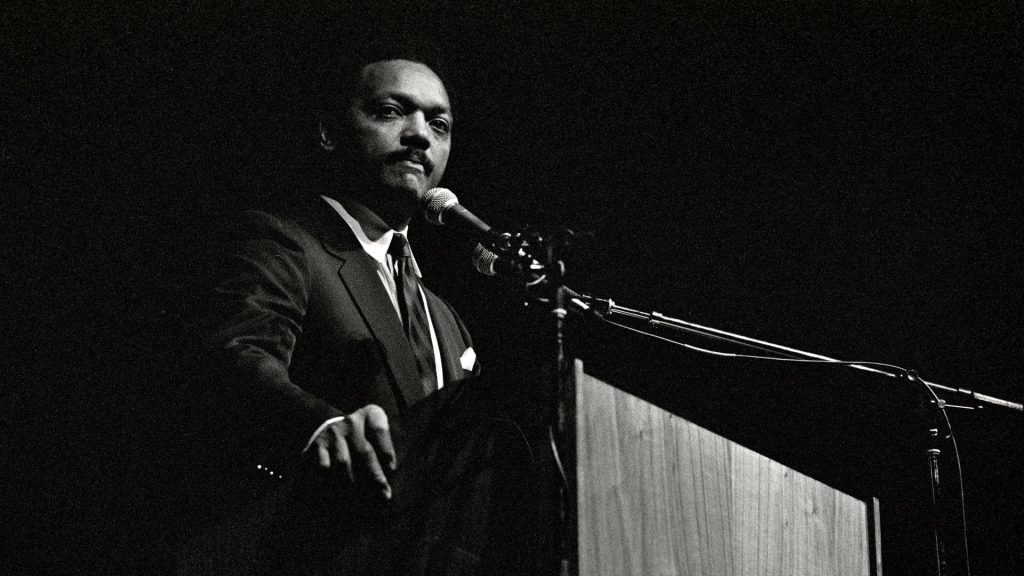
The Rev. Jesse Jackson, who marched alongside Dr. Martin Luther King, Jr., ran for president twice and preached about his vision for a “rainbow coalition” that would bridge racial divides, died early Tuesday. He was 84.
Jackson had been hospitalized since November after years of battling a rare neuromuscular disease.
In a statement, his family called Jackson “a servant leader — not only to our family, but to the oppressed, the voiceless, and the overlooked around the world.”
“His unwavering belief in justice, equality, and love uplifted millions,” the family added, “and we ask you to honor his memory by continuing the fight for the values he lived by.”
Jackson’s nonprofit, the Rainbow PUSH Coalition, said public observances will be held in Chicago but has not yet released any details.
Early life
Jackson was born in Greenville, South Carolina, as Jesse Louis Burns on Oct. 8, 1941. One year after his birth, his mother, Helen Burns, married Charles Henry Jackson and changed her son’s last name.
Unbiased. Straight Facts.TM
Rev. Jesse Jackson began his activism as a student in the summer of 1960, seeking to desegregate the local public library in Greenville, S.C.
Jackson lived under Jim Crow segregation laws during his childhood and attended Sterling High School, a segregated school. He became the class president, finished 10th in his class and played several sports, including football and baseball. After graduating, Jackson declined a contract from a minor league baseball team and attended the University of Illinois on a football scholarship.
He later transferred to North Carolina Agricultural and Technical State University, a historically Black university. Jackson said that he transferred after he experienced racial prejudice on the football team and limited his participation with the competitive public speaking team.
Jackson graduated from North Carolina A&T with a sociology degree in 1964 and attended Chicago Theological Seminary on a scholarship. However, he dropped out two years later to focus on the civil rights movement.


Connection to King
Jackson traveled to Selma, Alabama, in 1965 shortly after “Bloody Sunday,” when state troopers viciously attacked marchers as they crossed the Edmund Pettus Bridge on their way to Montgomery, the state capital, to demand voting rights. He participated in a second march weeks later, and King asked him to open a Chicago office for his civil rights organization, the Southern Christian Leadership Conference.
Jackson became one of King’s most trusted lieutenants, often traveling with him during a volatile and often dangerous period of the civil rights movement. He was in Memphis, Tennessee, on April 4, 1968, when King was struck down by an assassin’s bullet on a motel balcony. Jackson was among the aides who rushed toward King, and he later claimed he was the last person to speak to him. Others disputed that account, suggesting that Jackson exaggerated his role in the immediate aftermath of the shooting.
The following morning, Jackson appeared on NBC’s “Today” show, still wearing the bloodied shirt he had on the day before. At a memorial in Chicago the same day, he said, “I come here with a heavy heart because on my chest is the stain of blood from Dr. King’s head.”
Jackson became involved in an internal struggle for leadership of the SCLC after King’s death. He eventually left the organization and created People United to Save Humanity, or PUSH. Jackson planned to position PUSH toward politics, pressuring politicians to work to improve economic conditions for Black and poor people.


Jackson’s move into politics
After campaigning for others, including President Jimmy Carter, Jackson chose to run for office himself, beginning at the top. In 1983, he said he would run for president the following year, becoming just the second Black person, after Shirley Chisholm, to seek a major party’s nomination.
“My constituency is the desperate, the damned, the disinherited, the disrespected and the despised,” Jackson said in 1984. “They are restless and seek relief.”
His campaign stumbled, however, after The Washington Post reported that he had used the offensive terms “Hymie” and “Hymietown” in reference to Jews and New York City. He apologized, but finished third in primary voting behind Sen. Gary Hart and former Vice President Walter Mondale. As the Democratic nominee, Mondale lost in a landslide to President Ronald Reagan.


Jackson tried again in the 1988 presidential election. He won or placed second in several primaries, but fell short of winning the nomination. The eventual nominee, Massachusetts Gov. Michael Dukakis lost to Vice President George Bush.
It would be Jackson’s last meaningful run for office, although he served a single term as “shadow senator” for the District of Columbia between 1991 and 1997. Shadow senators are unpaid and do not vote on congressional issues. The Washington shadow senator primarily advocates for D.C. statehood.
Later life
Following his political career, Jackson continued to advocate for racial equality, even after announcing in 2017 that he had been diagnosed with Parkinson’s disease. He called the diagnosis a “physical challenge,” It was later revealed that he had a rare disorder known as progressive supranuclear palsy, which presents with symptoms similar to Parkinson’s.
He was arrested twice in 2021 over his objection to the Senate filibuster rule. Also in 2021, he and his wife Jacqueline were hospitalized with COVID-19 complications in Chicago.
Reactions
On social media Tuesday, President Donald Trump praised Jackson, calling him a “force of nature.”
“I knew him well, long before becoming President,” Trump wrote. “He was a good man, with lots of personality, grit, and ‘street smarts.’ He was very gregarious — Someone who truly loved people! Despite the fact that I am falsely and consistently called a Racist by the Scoundrels and Lunatics of the Radical Left, Democrats ALL, it was always my pleasure to help Jesse along the way.”
Jackson’s protege, civil rights leader Rev. Al Sharpton, called Jackson “a consequential and transformative leader who changed this nation and the world.”
“He shaped public policy and changed laws,” Sharpton added. “He kept the dream alive and taught young children from broken homes, like me, that we don’t have broken spirits.”
MLK Jr.’s daughter, Bernice King, also shared a statement, saying Jackson “devoted his life to lifting people in poverty, the marginalized, and those pushed to society’s edges.”
“My family shares a long and meaningful history with him, rooted in a shared commitment to justice and love,” she wrote. “As we grieve, we give thanks for a life that pushed hope into weary places.”
The post Jesse Jackson, veteran civil rights leader and 2-time presidential candidate, dies at 84 appeared first on Straight Arrow News.
Ella Rae Greene, Editor In Chief