Iran war intensifies, Khamenei son emerges; Talarico wins Texas primary

Israel expands strikes across Iran overnight as Tehran prepares to choose a new supreme leader, with Ayatollah Khamenei’s son emerging as a possible successor.
Plus, the Trump administration’s rationale for striking Iran keeps shifting. The president now says Tehran was preparing to attack first — contradicting earlier claims the U.S. acted ahead of an Israeli strike.
And Texas kicks off the 2026 midterm season with a major Senate primary. Democrats choose a nominee while Republicans head to a runoff.
These stories and more highlight your Unbiased Updates for Wednesday, March 4, 2026.
Israel expands strikes across Iran saying it struck missile sites and factories
The war between Israel and Iran is intensifying, with new strikes across Iran overnight and fresh attacks spreading across the region. Israel said it targeted Iranian missile launchers and weapons factories, including a missile storage and production facility in the city of Isfahan.
The Israeli military also reported what it calls “broad-scale strikes” across Tehran. Explosions were reported overnight in northwestern Iran.
The strikes come as Iran begins mourning for its late supreme leader, Ayatollah Ali Khamenei, who was killed in a joint U.S.–Israeli strike last weekend.
Israel’s defense minister is now warning that whoever replaces Khamenei could also become a target. Reuters reported Khamenei’s son survived Saturday’s attack and is being discussed as a possible successor.

Meanwhile, the Israeli military said one of its F-35 fighter jets shot down a manned Iranian warplane over Tehran, which, if confirmed, would mark the first time such a shootdown has occurred.
Israel has also widened the fight beyond Iran. The Israeli military said it launched new strikes in Beirut, targeting infrastructure used by the Iranian-backed militia Hezbollah.
Iran is continuing to strike back.
Saudi Arabia’s defense ministry said another attack targeted the Ras Tanura oil refinery, which was hit earlier this week. Kuwait’s military said the country faced another wave of Iranian missiles and drones overnight.
Meanwhile, the United States identified four of the six American service members killed in the initial strikes on Iran over the weekend.

They include 35-year-old Captain Cody Khork of Florida, 42-year-old Sergeant First Class Noah Tietjens of Nebraska, 39-year-old Sergeant First Class Nicole Amor of White Bear Lake, Minnesota, and 20-year-old Sergeant Declan Coady of Iowa.
Trump defends war in Iran as he shifts strike rationale
President Donald Trump has offered a new explanation for why the United States launched strikes on Iran. It’s one that differs from his own administration just a day earlier.
In the Oval Office on Tuesday, the president pushed back on the idea that Israel forced his hand and offered his own justification for the timing of the strikes.
“I might have forced their hand. You see, we were having negotiations with these lunatics [Iran], and it was my opinion that they were going to attack first. They were going to attack,” Trump said. “If we didn’t do it, they were going to attack first. I felt strongly about that.”
That framing contrasts with what Secretary of State Marco Rubio told lawmakers, and later reporters, on Monday, when he laid out the administration’s initial rationale for acting when it did.
“We knew that there was going to be an Israeli action,” Rubio previously stated. “We knew that that would precipitate an attack against American forces, and we knew that if we didn’t preemptively go after them before they launched those attacks, we would suffer higher casualties, perhaps higher than those killed.”
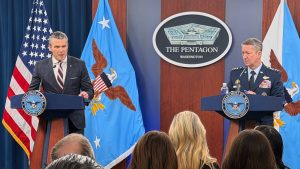
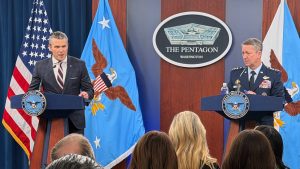
After the president’s remarks, Defense Secretary Pete Hegseth weighed in on social media, backing the president’s explanation, saying he was 100% correct.
Later Tuesday, Rubio pushed back on the idea that his earlier comments conflicted with the president’s, insisting he was talking about timing, not intent.
“This was a question of timing, of why this had to happen as a joint operation, not the question of the intent. Once the president made a decision that negotiations were not going to work, that they were playing us on the negotiations and that this was a threat that was untenable, the decision was made to strike them,” Rubio said. “That’s what I said yesterday. And you guys need to play it. And if you’re going to play these statements, you need to play the whole statement, not clip it to reach a narrative that you want to do, all right?”
Meanwhile, the administration’s formal letter to Congress cites broader national security interests, including protecting American forces and advancing American strategic objectives in the region.
Democrats say the shifting explanations are raising concerns.
“The American people do not want an endless war. The administration doesn’t seem to know what it’s doing,” Senate minority leader Chuck Schumer said. “Every hour, there’s a different rationale as to why we’re doing this. And America wants this president to pay attention to the problems at home, not the problems overseas, particularly when no one has any idea of what the real rationale is, it changes every hour.”
All of this is unfolding as the conflict widens and Congress prepares to vote on whether the president needs authorization to continue military action.
James Talarico defeats Rep. Jasmine Crockett in Texas Democratic primary
The 2026 election season is officially underway after primary races on Tuesday in Texas, North Carolina and Arkansas. The biggest action and the most-watched contests were in Texas.
State Representative James Talarico defeated U.S. Rep. Jasmine Crockett to win the Democratic nomination for U.S. Senate.
Talarico addressed supporters Tuesday night, saying, “The number of young people who showed up to vote in this election is unprecedented. The number, the number of Texans who have never voted before but showed up in this election, is unprecedented.”

But it’s still unclear who he will face in November.
Republican incumbent Sen. John Cornyn had the most votes but failed to reach the 50% threshold to clear the field Tuesday and will now head to a May runoff against Texas Attorney General Ken Paxton, the MAGA candidate who finished second.
“I’ve worked for decades to build the Republican party, both here in Texas and nationally,” Cornyn said.”I refuse to allow a flawed, self-centered, and shameless candidate like Ken Paxton risk everything we’ve worked so hard to build over these many years.”

In North Carolina, one of the year’s most consequential Senate races was essentially set heading into the primary.
Democrat Roy Cooper will face Republican Michael Whatley in November, a contest expected to play a major role in determining which party controls the Senate next year. Republicans currently have a 53-47 advantage. Democrats need to flip four seats.
And in Arkansas, Republican Sen. Tom Cotton easily secured his party’s nomination.
He will face Democrat Hallie Shoffner in the general election this fall.
Noem defends DHS amid funding battle, Tillis sharply criticizes leadership
Homeland Security Secretary Kristi Noem faced sharp questions on Capitol Hill Tuesday, beginning her testimony by blaming Democrats for the ongoing funding fight over her department.
Noem told the Senate Judiciary Committee the dispute over DHS funding is harming national security, arguing the department is being disrupted even as the administration boasts about what it calls major immigration enforcement gains.

“The latest Democrat-led shutdown of DHS is reckless, it’s unnecessary, and it undermines the American national security, and it harms the men and women who work at DHS and their families,” Noem said. “At a time when we produced the most secure border in history and removed nearly three million illegal aliens from our country, disrupting the department responsible for those gains is indefensible.”
But the harshest criticism didn’t come from Democrats.
Republican Sen. Thom Tillis of North Carolina sharply criticized Noem’s leadership, accusing her department of detaining American citizens and stating that immigration enforcement under her watch has been, in his words, “a disaster.”
“We just want numbers. We want 1,000 a day, 6,000 a day, 9,000 a day because numbers matter, right? No, they don’t matter. Quality matters, not quantity — quality. And what we’ve seen is a disaster. Under your leadership, Miss Noem, a disaster.
What we’ve seen is innocent people getting detained who turn out to be American citizens. I could talk about the culture that’s been created here, with Stephen Miller aiding and abetting.”
— Sen. Thom Tillis, R-N.C.
And in one of the most memorable moments of the hearing, the Republican senator referenced a controversial story from Noem’s memoir where she described killing her 14-month-old dog after calling it untrainable.
Tillis used Noem’s own story to challenge her judgment.
“I trained dogs, alright? And you are a farmer. You should know better. You should know that if you’re going out to a hunting lodge, and you’re putting pheasants out, and you put dogs out. You don’t take a puppy out there.
A 14-month-old dog is basically a teenager in dog years. You decided to kill that dog because you had not invested the appropriate time in training, and then you have the audacity to go into a book and say it’s a leadership lesson about tough choices.”
— Sen. Thom Tillis, R-N.C.
The tense exchange underscores growing frustration with Noem’s leadership, even among some of her own party members, as Congress continues to scrutinize immigration enforcement and the Minneapolis shootings that resulted in the deaths of two Americans.
US, Ecuador launch joint drug crackdown on groups labeled terrorist organizations
The Trump administration has expanded its campaign against what it calls “narco-terrorism” in Latin America. The U.S. military has initiated a new round of joint operations with Ecuador, targeting major drug trafficking groups — including organizations Washington has now designated as “terrorist groups.”
U.S. Southern Command announced the effort Tuesday, describing it as a coordinated move by regional allies to take “decisive action” against what it calls the scourge of narco-terrorism.
The announcement follows comments Monday from Ecuador’s president, who said the country is entering “a new phase” in the fight against narco-terrorism and illegal mining.

Ecuador’s defense ministry said the military will take on an “offensive” role, although officials said details of the missions remain classified.
The Pentagon has not outlined what the operations will involve or which groups will be targeted.
Last year, the U.S. State Department officially designated two major Ecuadorian criminal groups — Los Lobos and Los Choneros — as foreign terrorist organizations.
Rare Yellowstone geyser erupts after six years of dormancy
An attraction at Yellowstone National Park is back in action just in time for the busy spring and summer tourist season. It’s the largest acidic geyser in the world — located in the hottest part of Yellowstone’s vast thermal area.

The geyser had been dormant since 2020, but last month it started erupting again, doing so every 2 to 5 hours. Most eruptions last just a few minutes, sending water about 30 feet into the air.
The Echinus Geyser pool measures approximately 66 feet in diameter. It was once a major crowd-pleaser during the 1970s, ’80s and ’90s, according to the National Park Service, but activity started declining in the early 2000s.

Scientists say the water’s acidity is comparable to that of orange juice or vinegar. Acidic geysers are extremely rare because that acidity can actually dissolve the surrounding rock in what scientists refer to as the geyser’s plumbing system.
By the way, most of the world’s known acidic geysers are located right there in Yellowstone.
More from Straight Arrow News:

Can NASA still do the impossible? The struggle to rediscover the moon
For more than 50 years, the moon has lingered just out of reach — a gray, cratered world visible through spacecraft windows and helmet visors.
No boots have unsettled its dust.
No human hands have thrust new flags into the surface.
No voices have crackled through radios, disrupting its eerie silence.
That was supposed to change soon.
But NASA’s long-awaited Artemis II mission — set to be the first crewed flight around the moon since 1972 and a critical precursor to returning U.S. astronauts to the lunar surface — has been delayed yet again. Read the full story now>
Ella Rae Greene, Editor In Chief