Holy Fire ceremony returns to Church of the Holy Sepulchre after access dispute
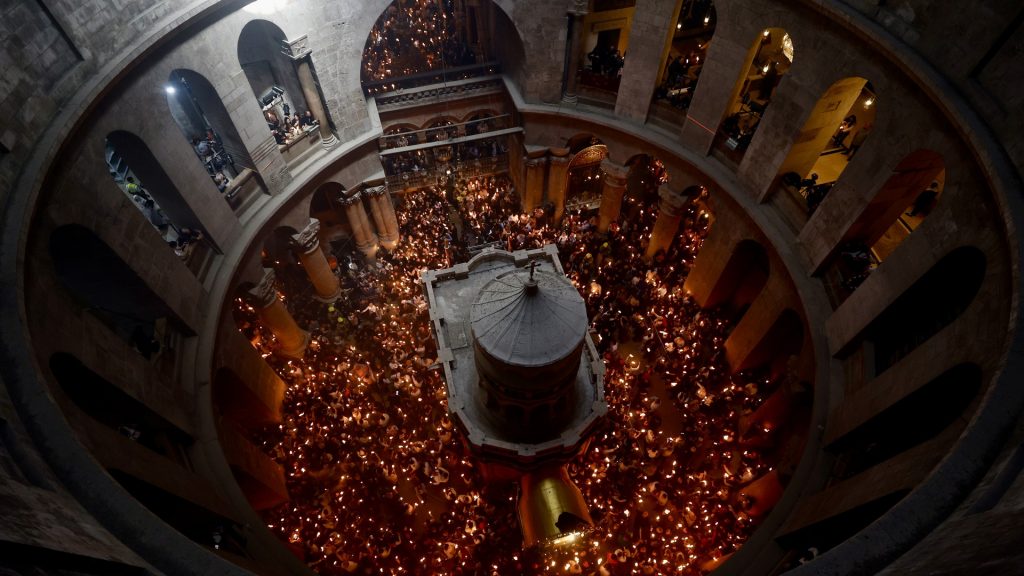
The Holy Fire ceremony took place Saturday at the Church of the Holy Sepulchre, as Israeli authorities and Christian leaders sought to ease tensions ahead of Orthodox Easter following a dispute over access during Palm Sunday.
The ceremony, central to Orthodox Christian Easter observances, is held annually on Holy Saturday and is believed by the faithful to mark the miraculous appearance of a flame inside the tomb of Jesus. The fire is then passed from candle to candle among worshippers and later carried to Orthodox communities around the world.
Patriarch Theophilos III emerged from the church holding torches bearing 33 candles, distributing the Holy Fire to worshippers and delivering a message of hope and the Resurrection.
-

Orthodox Christian worshippers attend the Holy Fire ceremony at the Church of the Holy Sepulchre, in Jerusalem’s Old City, April 11, 2026. REUTERS/Florion Goga TPX IMAGES OF THE DAY -

Metropolitan Vindictus, Patriarchal Representative for the Greek Orthodox in Bethlehem, leads the Holy Fire ceremony in Bethlehem’s Church of the Nativity in the Israeli-occupied West Bank. -

Metropolitan Vindictus, Patriarchal Representative for the Greek Orthodox in Bethlehem, leads the Holy Fire ceremony in Bethlehem’s Church of the Nativity in the Israeli-occupied West Bank.
The church reopened two days earlier after a 40-day closure imposed under wartime restrictions.
Tensions flared on Palm Sunday, when Cardinal Pierbattista Pizzaballa was briefly blocked from entering Jerusalem’s Old City to celebrate Mass, despite prior understandings that senior clergy would be granted access for Holy Week services. The Vatican said he was accompanied by a senior Franciscan official.
By Sunday evening, Israeli Prime Minister Benjamin Netanyahu ordered authorities to allow access.
“Even though I understand this concern, as soon as I learned about the incident with Cardinal Pizzaballa, I instructed the authorities to enable the Patriarch to hold services as he wishes,” Netanyahu said.
Israeli police defended the restrictions, citing security concerns linked to the conflict with Iran. In a statement, police warned of a “real and present danger” from missile fire and falling debris in the Old City, where many buildings lack bomb shelters.
Under directives from the military’s Home Front Command, police said restrictions applied to all holy sites in the Old City “for Jews, Christians, and Muslims alike.”
Police added that the area has been targeted by missiles multiple times in recent weeks and said the threats “do not discriminate between religions.”
Church leaders described the disruption as unprecedented, saying it was the first time in centuries that Palm Sunday Mass had effectively been halted under the patriarch’s leadership. They said churches had acted “with full responsibility” since the war began, canceling public gatherings and broadcasting services globally.
Authorities said major holy sites, including the Western Wall, the Church of the Holy Sepulchre and the Temple Mount, have reopened following updated defense guidance after a ceasefire with Iran.
For Saturday’s ceremony, Israeli police deployed hundreds of officers, border guards and volunteers across Jerusalem, particularly in the Old City, citing expectations of large crowds.
In a social media statement, police said forces had been deployed since early morning to ensure a safe environment for the thousands of Christian worshippers attending the ceremony.
Officials said the measures are intended to safeguard public order while preserving freedom of worship amid ongoing regional tensions.
Ella Rae Greene, Editor In Chief