Gov. Wes Moore ended local, state partnerships with ICE. Sheriffs call it a ‘recipe for disaster’
A new law that terminated agreements between sheriff’s departments and U.S. Immigration and Customs Enforcement has left top cops in Maryland frustrated, as they said partnerships with federal agencies help their officers understand the law.
Sheriffs across Maryland have fought back against Gov. Wes Moore, a Democrat, and state legislators after a bill barring future 287(g) agreements with ICE became law on Tuesday. The law voided all nine existing contracts throughout the state for both jail enforcement and warrant services.
“I think that when politicians and legislators get involved in public safety and don’t take in input, it’s a recipe for disaster,” Washington County Sheriff Brian Albert, a Republican, told Straight Arrow News. “I, by no means, appoint myself as an expert, but I do have 30-plus years of law enforcement experience.”
Sheriffs in Maryland run in partisan elections and serve in four-year terms.
The 287(g) program is voluntary and gives ICE several ways to work with local and tribal police departments to detain and locate unauthorized immigrants. It exists in four formats: jail enforcement, task force, tribal task force and warrant service officer. Program scrutiny escalated after President Donald Trump said he wanted to ramp up deportations and Congress passed his One Big Beautiful Bill, which gave ICE $75 billion in supplemental funding over four years.
Albert said the jail and warrant models were used in Maryland. His department signed an agreement on March 10 last year.
Unbiased. Straight Facts.TM
Maryland became the eighth state to bar 287(g) agreements with U.S. Immigration and Customs Enforcement on Feb. 17.

The legislation passed both chambers of Maryland’s General Assembly. Two bills were introduced in the state Senate and House of Delegates as companion legislation. We Are Casa advocated for the law, as they said the program fueled racial profiling, separated families and withered “the trust that is essential for true community safety.”
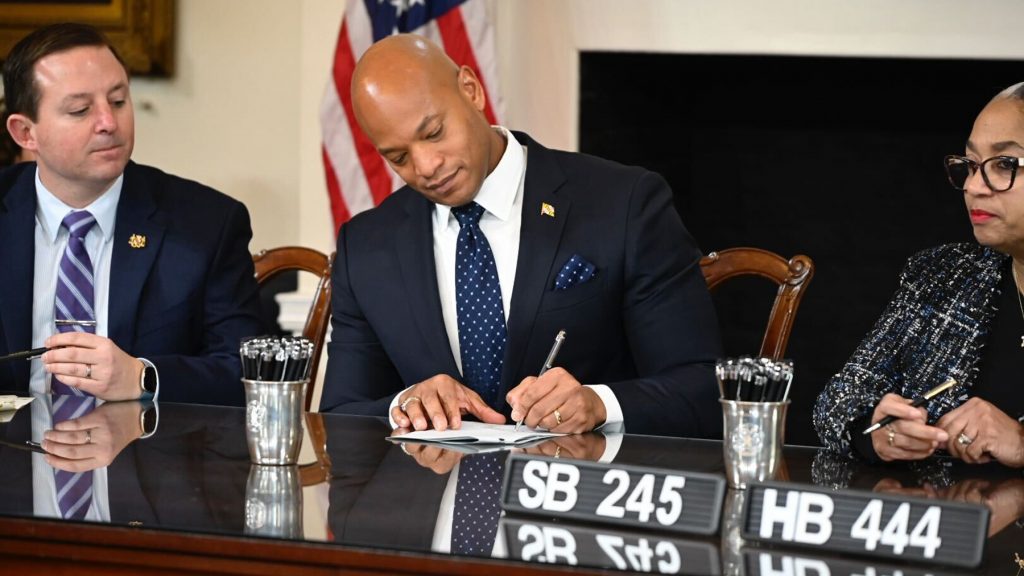
“This bill draws a clear line: we will continue to work with federal partners to hold violent offenders accountable,” Moore said at the signing, “but we refuse to blur the lines between state and federal authority in ways that undermine the trust between law enforcement and the communities they serve.”
Harford County Sheriff Jeff Gahler wrote that large-scale immigration will flood into Maryland as a result of the bill. He made the post on Jan. 20 after advocating for legislators to vote against the bill. His office signed an agreement in June 2020, according to Department of Homeland Security records.
“And this will occur because ICE will no longer be able to partner with detention centers to remove criminals,” he wrote.
Agreement helped officers understand immigration laws
Albert said the partnership with ICE was needed for his officers to help with “gray areas” they didn’t understand when it came to immigration. He said his officers underwent an eight-hour training that gave them guidance on how to deal with people who have immigration detainers.
According to ICE, detainers are a request the agency makes to federal, state and local law enforcement to get earliest possible notification before an immigrant with removal orders is released from their custody and to hold the person for up to 48 hours so the Department of Homeland Security can take custody in accordance with federal immigration laws.
“When jails, prisons or other confinement facilities agree to honor immigration detainers, ICE officers can take custody of removable aliens in a safe, controlled environment instead of at-large in the community,” the agency said.
Albert said that, through the partnership, his officers were able to notify ICE if a person is arrested and the agency has a detainer out on them. He said that not everyone would get immediately deported, as it depends on the severity of their crimes. Most of the people who would get flagged were unauthorized immigrants, and ICE allowed them to complete due process and incarceration before they’re turned over.
Moore’s office said the bill doesn’t authorize releases of criminals, affect any state policies and practices in responding to ICE detainers, nor does it prevent agencies from continued work with the federal government or notifying ICE about impending releases of immigrants.
“State and local law enforcement will also maintain the ability to work with the federal government on criminal investigations and joint task forces unrelated to civil immigration enforcement,” according to the office.
Albert used outstanding warrants as an analogy, saying that if a person who had a warrant for their arrest in California was detained in Maryland, that information would come up and agencies would then figure out the best course of action.
“The reason that sheriffs like it is because everything is controlled and things are safer with no one going into homes,” Albert said.
Sheriffs seek out other options
In the absence of a formal agreement, Albert is looking at crafting internal policies that would replicate some parts of the 287(g) agreement, something he said other sheriffs are doing.
“It’s building those relationships before we need them,” he said. “I don’t know if they think we’re trying to get something passed underneath them, but it’s a very hot topic along party lines.”
He noted that his officers are flexible with changes in the law, but they’ll take the necessary steps to adhere to the law. He expressed disappointment more with lawmakers whom he said didn’t want to listen.
ALisa Casas, public information officer for the St. Mary’s County Sheriff’s Office, echoed Albert’s sentiments in an email to Straight Arrow News. Her department signed an agreement in March 2025.
“Their minds were made up when the bill was dropped,” Albert said.
The post Gov. Wes Moore ended local, state partnerships with ICE. Sheriffs call it a ‘recipe for disaster’ appeared first on Straight Arrow News.
Ella Rae Greene, Editor In Chief