Double-tap to briefing: A timeline of the US’ strikes on ‘narco-terrorists’
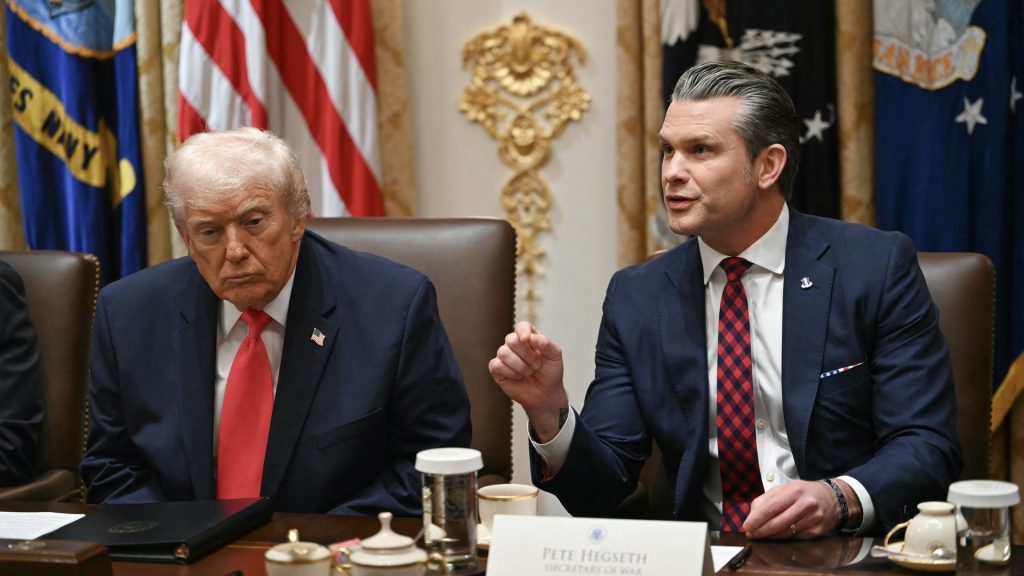
President Donald Trump and Defense Secretary Pete Hegseth have kept their sights set on ridding the U.S. of narcotics shipments and holding gangs accountable for proliferating the country’s opioid epidemic. That zeal for eradication developed into military action in international waters, killing at least 80 people while drawing bipartisan criticism.
The two initiated what is now known as Operation Southern Spear on Sept. 2 with the first “kinetic strike,” killing 11 people whom Trump said on Truth Social were part of Tren de Aragua, a Venezuelan gang. Despite their assertions the mission targets traffickers, multiple lawmakers have criticized them for violating Department of Defense policy and international law.
Members from the Armed Services and Intelligence Committee from both chambers held a closed-door meeting Thursday to drill down details of the double-tap Sept. 2 strike, which left a lawmaker shocked over military footage he saw. Navy Adm. Frank Bradley and Joint Chiefs of Staff Chairman Gen. Dan Caine were both present.
So how did the military and Trump get to this point?
September: Drone strikes kill 14 in Caribbean Sea
Trump took to his Truth Social account on Sept. 2 to announce the fatal drone strike on a vessel he claimed was transporting drugs from Tren de Aragua, which he’s targeted since returning to office in January.
“The strike occurred while the terrorists were at sea in International waters transporting illegal narcotics, heading to the United States,” Trump wrote. “The strike resulted in 11 terrorists killed in action. No U.S. Forces were harmed in this strike.”
Five days later, Venezuelan Defense Minister Vladimir Padrino said he’s deploying 25,000 troops to the country’s coastal and land border regions to fight drug trafficking.
Nearly a week after the drone strike, reports came out people on the boat spotted military aircraft and turned around prior to the attack. Vice President JD Vance justified the attack on X as being the “best of our military.” The comments drew sharp criticism from Sen. Rand Paul, R-Ky., who replied the accused people should not have been killed without a trial or representation.
The operation’s optics became more complicated after Venezuelan Interior Minister Diosdado Cabello announced that investigations pointed to all 11 victims being civilians, not drug traffickers, according Venezuelan state television.
Two weeks following the first strike, Trump announced on Sept. 15 the military conducted another attack that he said on Truth Social targeted drug traffickers, killing three men. He shared an unclassified video of the attack, which appeared to show the boat at rest in the water before being hit by an object and exploding.
He later told reporters that the U.S. had “proof” the vessel was transporting drugs.
“All you have to do is look at the cargo that was spattered all over the ocean — big bags of cocaine and fentanyl all over the place,” Trump said.
The administration formally notified Congress that it had entered into “armed conflict” with unspecified drug cartels.
Trump’s quest to quell drug traffickers succeeded in a joint strike with the Dominican Republic on Sept. 21 that destroyed a speedboat carrying more than 2,200 pounds of cocaine. Officials didn’t immediately provide information about possible casualties aboard the speedboat.
Officials from the Dominican Republic said people aboard the vessel planned to use the nation as a transit point, then move cocaine to the U.S. About 377 packages of cocaine were seized while 60 others were destroyed in the strike.
October: Boat strikes kill 29 in Caribbean Sea, Pacific Ocean
The Trump administration conducted several boat strikes in October, targeting what they claimed to be drug traffickers near Venezuela’s coast and in the eastern Pacific Ocean near the northwest area of South America.
Those strikes started on Oct. 3 just off the coast of Venezuela, where Hegseth said on X the military killed four alleged “narco-terrorists.” The boat was supposedly heading toward the U.S. with “substantial amounts” of narcotics, Hegseth added.
He didn’t provide further details on how the determination was made that the vessel had narcotics, or about the victims’ connection to drug trafficking.
The new strikes angered some in Congress, and Venezuela’s ambassador to the United Nations, who requested an emergency session on the Trump administration’s military actions. In Congress, Republicans blocked a Democrat-supported resolution that sought to assert the body’s war powers over Trump to halt further strikes.
Drone strikes continued with Trump announcing another fatal attack on Truth Social that occurred on Oct. 14. He said the operation killed six “narco-terrorists” who sailed on a vessel affiliated with a terrorist organization.
“Intelligence confirmed the vessel was trafficking narcotics, was associated with illicit narcoterrorist networks, and was transiting along a known DTO route,” Trump wrote. “The strike was conducted in International Waters, and six male narcoterrorists aboard the vessel were killed in the strike.”
Days later, another “kinetic strike” hit what officials believed was a drug boat in the eastern Pacific Ocean and killed two, Hegseth shared on X. The secretary claimed the boat was known to be involved in trafficking, but provided no evidence of such.
Several lawmakers criticized administration officials for the strikes. They said the Trump administration was circumventing Congress in conducting such extreme military action. Democratic senators introduced a resolution to prohibit further action unless approved by Congress. The move failed.
Thirty-two people died in the 12 drone strikes the military conducted in October in the Pacific Ocean and Caribbean Sea. Hegseth justified all strikes to either target narco-terrorists or vessels associated with gangs.
November: Nine boat strikes kills 48 in Pacific Ocean
The Trump administration continued its military campaign against drug trafficking, targeting the Pacific Ocean and area near Venezuela’s coast in November, which has drawn ire from several lawmakers and Trump’s own allies. Hegseth several times more said the operations hit boats that allegedly either carried narcotics, or were associated with a gang.
Tensions escalated between the administration and Congress after an investigation from The Washington Post raised concerns about how Hegseth was proceeding with the operations. The newspaper cited unnamed sources who attested to hearing Hegseth give a verbal “kill them all” directive for the Sept. 2 strike that killed 11 people.
That same report accused Bradley of ordering a second strike on the disabled boat, killing two survivors who were reportedly later captured on video floating in the waters as they clung to their destroyed boat.
Current and former representatives chastised Hegseth for the alleged order, vowing to hold him accountable for what they said was an “illegal order.” Former Rep. Elaine Luria, D-Va., had more sharp words for Hegseth, accusing him of violating the Department of Defense’s policy and the Geneva Convention — an international treaty that governed nations’ conduct in wartime.
December: Strike kills four, military faces congressional hearing
The bicameral meeting Thursday left Rep. Jim Himes, D-Conn., shocked after he reviewed military footage of the Sept. 2 attack. In it, The Associated Press reported, the survivors were seen clinging to fragments of their boat the U.S. destroyed and had no means to move.
That same meeting, Bradley refuted claims Hegseth gave a “kill everybody” directive, Sen. Tom Cotton, R-Ark., told reporters. Cotton heads the Senate Intelligence Committee.
Hegseth and Trump distanced themselves from the double-tap strike but justified it in a Cabinet meeting Tuesday.
“He sunk the boat and eliminated the threat. And it was the right call,” Hegseth said. “We have his back.”
Hours later, the U.S. Southern Command carried out a drone strike in the eastern Pacific Ocean, killing four people accused of drug trafficking. The command said the Southern Spear unit conducted the attack in international waters on a boat believed to be associated with a gang.
The post Double-tap to briefing: A timeline of the US’ strikes on ‘narco-terrorists’ appeared first on Straight Arrow News.
Ella Rae Greene, Editor In Chief