Court says judge didn’t have jurisdiction to order Mahmoud Khalil’s release
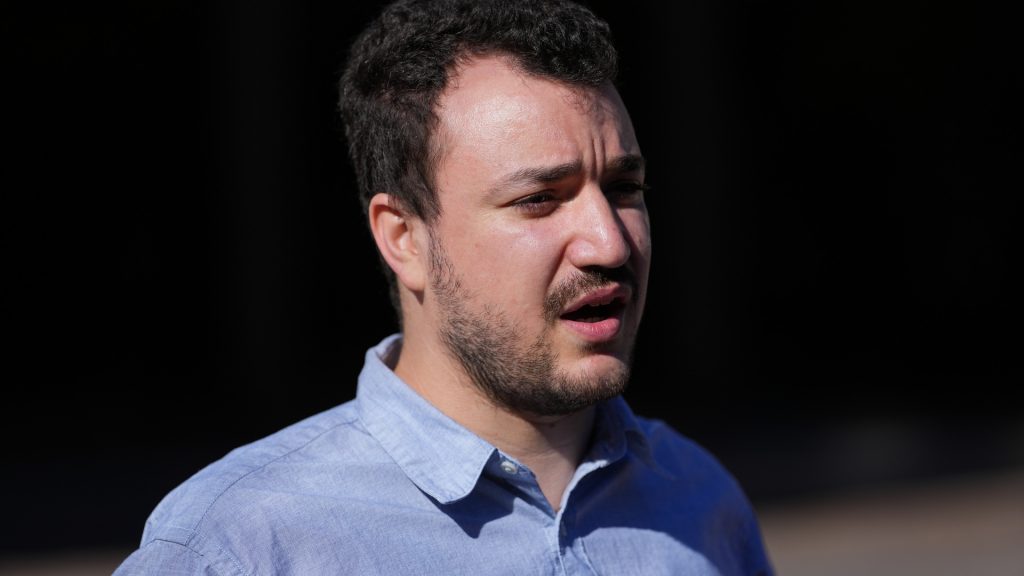
An appeals court on Thursday overturned a lower court’s decision to release former Columbia University student Mahmoud Khalil from immigration detention. While the panel of judges did not rule on the merits of the case, it did state that a judge in New Jersey does not have jurisdiction over it.
Federal laws require Khalil to challenge his case in immigration court first, the judges said in a 2-1 ruling. Then, he can appeal.
“That scheme ensures that petitioners get just one bite at the apple — not zero or two. But it also means that some petitioners, like Khalil, will have to wait to seek relief for allegedly unlawful government conduct,” judges Thomas Hardiman and Stephanos Bibas said in their ruling. “Because Khalil raises legal questions that a PFR (petition for review) court can meaningfully review later on, the INA (Immigration and Nationality Act) bars him from attacking his detention and removal in a habeas petition.”
Judge Arianna Freeman dissented, writing that “Khalil’s case requires us to tease these strands apart,” and that it can be decided by the district court.
“Khalil says his claims are now-or-never ones because his injuries are ongoing and his rights are ‘being violated, now,’” Freeman wrote. “But his claims raise legal questions challenging the government’s very basis for trying to remove (and thus detaining) him.”
Khalil, in a statement, said the ruling is “deeply disappointing, but it does not break our resolve.”
“The door may have been opened for potential re-detainment down the line, but it has not closed our commitment to Palestine and to justice and accountability,” he wrote. “I will continue to fight, through every legal avenue and with every ounce of determination, until my rights, and the rights of others like me, are fully protected.”
Department of Homeland Security spokesperson Tricia McLaughlin called the ruling a “vindication of the rule of law and the simple truth that DHS has argued from the beginning: an immigration judge, not a district judge, has the authority to decide if Mr. Khalil should have been released.”
She maintained that the Trump administration “acted well within its statutory and constitutional authority to detain Khalil” and said “DHS will work to enforce his lawful removal order.”
The American Civil Liberties Union of New Jersey said the Trump administration cannot re-detain Khalil until the order officially takes effect, which will not happen while he can still appeal. This can mean having the case reviewed by all judges on the Third Circuit Court of Appeals, or even the U.S. Supreme Court.
“The Trump administration violated the Constitution by targeting Mahmoud Khalil, detaining him thousands of miles from home, and retaliating against him for his speech,” Bobby Hodgson, deputy legal director at the New York Civil Liberties Union, said. “Dissent is not grounds for detention or deportation, and we will continue to pursue all legal options to ensure Mahmoud’s rights are vindicated.”
Khalil’s cases
Immigration officials arrested Khalil, a legal resident in the U.S., last March at his apartment in Manhattan. Khalil participated in pro-Palestinian protests and campus encampments at Columbia in 2024.
The Trump administration accused the 30-year-old of being a “pro-Hamas sympathizer,” without providing evidence to support the claim.
In a two-page memo obtained by The Associated Press, Secretary of State Marco Rubio argued that Khalil could be expelled because of his beliefs, and accused him of antisemitic conduct and participating in disruptive protests. Khalil has denied these allegations of antisemitism, saying that he was criticizing Israel and the United States over what is happening in Gaza, and that the federal government is trying to suppress this speech.
After being detained for more than 100 days, Khalil was released in June when U.S. District Judge Michael E. Farbiarz ruled that it was likely that Rubio’s attempted deportation on foreign policy grounds would be ruled unconstitutional. In a separate order, Farbiarz declared that Khalil was neither a danger nor a flight risk.
Department of Homeland Security officials also alleged Khalil failed to disclose information on his green card application.
In September, a U.S. immigration judge denied Khalil’s motion for a waiver preventing his removal from the U.S. and ordered that he be deported to either Algeria or his native Syria.
Prosecutors have yet to charge Khalil with a crime in either case.
Deportations challenged in court
Four other student activists, Rumeysa Ozturk, Mohsen Mahdawi, Badar Khan Suri and Yunseo Chung, were similarly accused by the Trump administration of being a threat to U.S. foreign policy interests.
The New York Times reported that these students challenged their own deportations or detainments in separate, individual lawsuits. Those who were detained, the outlet wrote, were later ordered to be released.
Massachusetts Federal District Judge William G. Young ruled in September that the Trump administration chilled these students’ speech with arrests he said were aimed at striking fear to those critical of Israel.
At a Thursday hearing in Boston federal court, Young said he would issue an order to prevent the federal government from retaliating against academics who challenged its arrests and deportations of non-citizen, pro-Palestinian activists on college campuses, Reuters wrote.
The post Court says judge didn’t have jurisdiction to order Mahmoud Khalil’s release appeared first on Straight Arrow News.
Ella Rae Greene, Editor In Chief