Castro’s Cuba survived nearly 70 years. Could Trump be the one to take it down?
With a U.S. blockade of Cuba, talks of forced regime change and increasing tensions between the two countries, this could be 1962. History doesn’t always repeat itself, but often it rhymes.
Sixty-seven years after Fidel Castro’s Communist government took hold just 90 miles south of Florida, the Trump administration is trying what so many other administrations have failed to do before: oust the island nation’s leaders. What an attempted invasion, CIA-sponsored assassination attempts and economic embargoes couldn’t accomplish, a failing economy might, as officials say the Cuban government appears to be on the verge of finally collapsing.
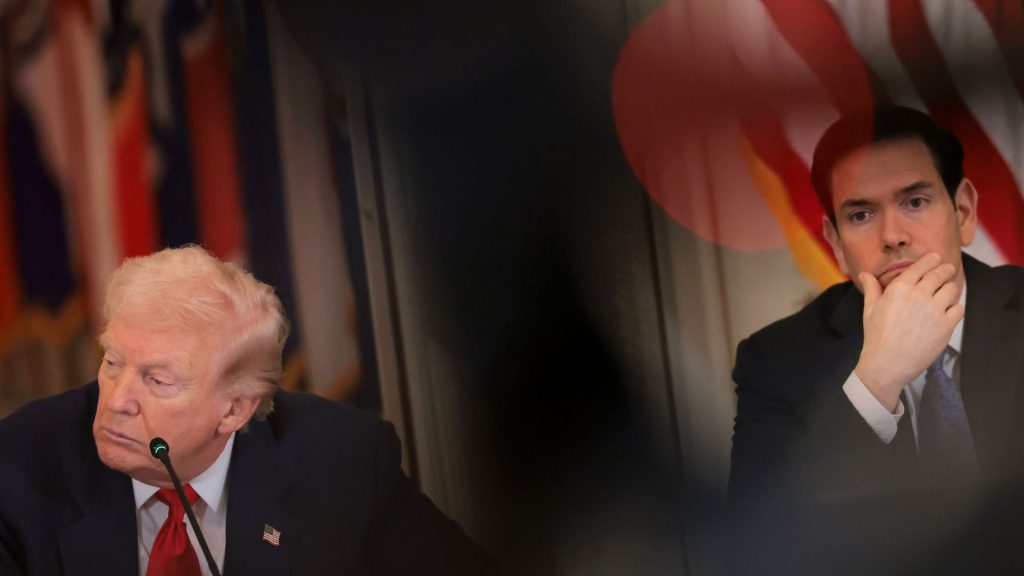
On Tuesday, Secretary of State Marco Rubio emphasized the administration’s desire for a Cuban regime change.
“So they have to change dramatically,” Rubio said during a Cabinet meeting. “What they announced yesterday is not dramatic enough. It’s not going to fix it.”
Rubio was referring to an announcement by Cuba’s deputy prime minister, Oscar Pérez-Oliva Fraga, who said Monday that the Cuban government would start the process of allowing foreign investments.
As officials report that protests over economic conditions in Cuba are beginning to get violent, some analysts said the cracks in the Cuban government are appearing.
Sebastián Arcos, interim director of the Cuban Research Institute at Florida International University, told Straight Arrow News that the Trump administration has had the most direct approach to Cuba in decades. He also agreed that regime change could happen now if that is what Trump and Rubio are looking for.
“The internal situation is ripe for regime change,” he said. “The political legitimacy of the regime is at its lowest point in history, and average Cubans are exhausted of facing scarcity and more calls for further sacrifices.”
How did we get here?
The U.S. and Cuba have had an often-tense relationship since the middle of the 20th century.
In 1959, Castro seized power after years of guerrilla fighting against the U.S.-backed government of dictator Fulgencio Batista. Initially, the U.S. recognized Castro’s new government. But the relations soon soured after Cuba began nationalizing U.S.-owned farmland on the island and increased trade with the Soviet Union.
In response, the U.S. began imposing economic penalties on Cuba. The economic penalties quickly escalated into a full embargo, including strict travel restrictions.
Two years after Castro took power, the U.S. severed diplomatic ties with Cuba and began to launch covert operations to overthrow the Castro government, including multiple attempts on Castro’s life. One of the biggest covert operations was the Bay of Pigs invasion.
The operation was a failed attempt at a military landing on the Cuban coast. The CIA, along with U.S. special forces, trained Cuban exiles to land on the beaches of the southwest part of the island. However, it was a failure, with Cuban forces killing more than 110 Cuban exiles and capturing about 1,200 others. Cuban exiles for decades have blamed the Kennedy administration for not providing promised air support to the operation.
Following the botched invasion, the Soviet Union and Cuba entered into an agreement allowing the Soviets to store nuclear weapons in Cuba. A U.S. surveillance aircraft spotted the nuclear installation in October 1962.
The discovery set off a nearly two-week standoff between President John F. Kennedy and Soviet leader Nikita Khrushchev that almost kicked off a nuclear war. Kennedy demanded the Soviets remove their missiles and ordered the U.S. Navy to quarantine the island, preventing any additional weapons from entering the country.
In the end, Khrushchev agreed to remove his country’s weapons, and the U.S. agreed to remove theirs from Turkey and promised not to invade Cuba. But a U.S. embargo remained.
Twenty years later, President Ronald Reagan labeled Cuba a state sponsor of terrorism after the Cuban government supported leftist militant groups in Africa and Central America.
In 1991, when the Soviet Union collapsed, Cuba lost its annual subsidies of about $6 billion, threatening its economic survival. Cuba survived by pivoting into tourism and using its new relationship with Venezuelan President Hugo Chavez.
During the 1990s, Congress passed two laws that strengthened U.S. sanctions against Cuba and stated that the embargo would remain in place until Cuba transitioned into a democracy without the influence of the Castro family.
Modern-day American politics invades Cuba
In 2004, the Bush administration concluded that Castro’s government was nearing collapse and that one more shove may send it over the edge. However, that assessment was wrong, as the Cuban economy grew at about 8% annually between 2004 and 2006.
By the mid-2000s, Castro was nearing his 80s, and his health was beginning to fail. By 2006, he had given most of his power to his brother Raúl. Two years later, he announced his resignation.
During the Obama administration, America’s attitude towards Cuba was warmer. In 2014, President Barack Obama and the Castro regime announced that the two countries were setting aside more than 50 years of tensions that had almost led to nuclear war and restoring full diplomatic ties.
The Obama administration would later loosen restrictions on travel, trade and financial services, while rescinding Cuba’s designation as a state sponsor of terrorism. Obama also became the first president since President Calvin Coolidge in 1928 to travel to Cuba on an official visit.
During Trump’s first administration, he reversed many of Obama’s Cuban policies, imposing an array of new sanctions and redesignating Cuba as a state sponsor of terrorism.
President Joe Biden reversed some of Trump’s policies, but did not return to full normalization of relations. Days before he left office, he rescinded Cuba’s designation as a state sponsor of terrorism — which Trump restored on his first day back in office.
Philip Brenner, an emeritus professor of international relations and history at American University, told SAN the designation, known as SSOT, is unjustified.
“This prevents banks from handling Cuban international transactions,” he said.
That includes food.
“Cuba imports 70% of its food; last year it actually imported $500 million of agricultural products from the United States,” Brenner said. “The inability to pay for food because of the SSOT list is a major source of Cuba’s difficulties.”
Days after reinstating the terrorism designation, Trump invoked the International Emergency Economic Powers Act and signed an executive order declaring Cuba “an unusual and extraordinary threat” to the U.S.
In February, the U.S. began blocking oil tankers bound for Cuba and threatened countries that import oil to Cuba with tariffs. The New York Times reported this as the “first effective blockade [of Cuba] since the Cuban Missile Crisis.”
The United Nations Human Rights Office said the blockade and fuel shortage have threatened Cuba’s food supply and disrupted Cuba’s water system and hospitals. Brenner agreed, saying it could lead to humanitarian issues.
“The current pressure on and U.S. sanctions against Cuba are unprecedented in that they directly affect the lives of all Cubans in what should be recognized as a major human rights violation,” he told SAN.
What’s next?
While some believe the Cuban government is crumbling, others don’t.
“Regime change is not imminent, but the possibility is closer than ever,” Arcos told SAN. ”Unlike previous cycles of economic crisis, this time there is no patron willing to come to the rescue and sustain the regime.”
However, Arcos said the Cuban public is upset, citing the 2021 protests that led to the death of one protester and the arrest of hundreds.
“Despite the brutal repression against protesters, there are growing public demonstrations taking place today,” he said. “Another episode like July 2021 today would place the regime in an extremely difficult position.”
However, some believe the Trump administration may force regime change rather than wait for it to happen. “I think I can do anything I want with it,” Trump said Monday.
William LeoGrande, an associate vice provost for academic affairs and government at American University, believes Trump is serious.
“No doubt the economic coercion being used against Cuba is pressure to try to force Cuba to agree to U.S. terms, but Trump is not bluffing,” LeoGrande told SAN. “When talks with Venezuela and Iran failed, Trump resorted to military force.”
Ella Rae Greene, Editor In Chief