Canada tightened gun laws after tragedy. The results are mixed
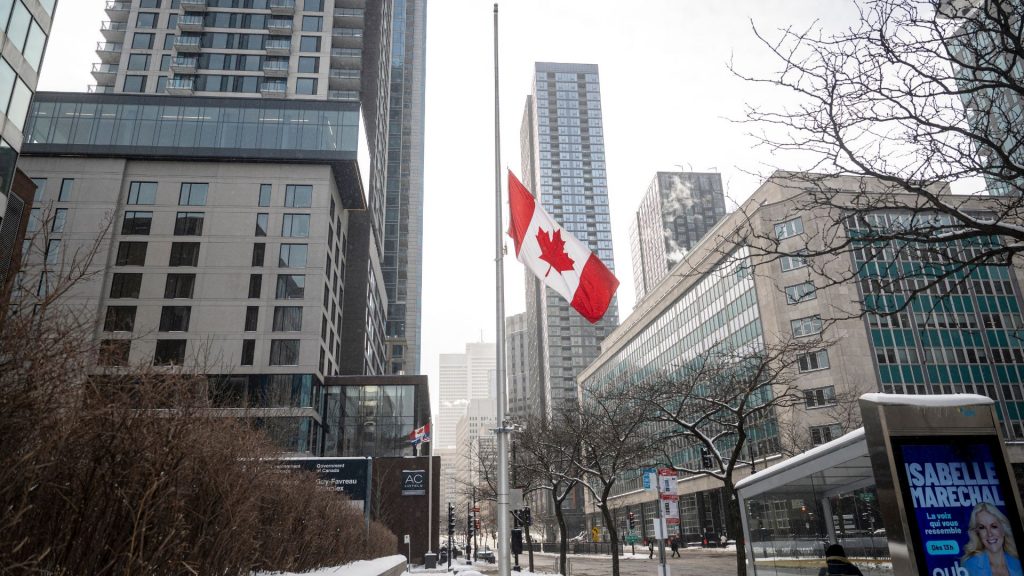
The quiet, Canadian hunting town of Tumbler Ridge, British Columbia, about 600 miles north of Vancouver, has been pulled into national headlines after one of the country’s worst mass shootings. The shooting, which ended in the deaths of 10 people, including the shooter, has also pulled the topic of Canadian gun laws back into public discussion.
On Tuesday, authorities said a woman opened fire at a secondary school in the remote British Columbia town. Investigators said seven died at the school, but they also found two more bodies at a nearby home. The shooting injured another 25 people, with at least two suffering from life-threatening injuries.
What are Canada’s gun laws?
Mass shootings in Canada are rare. The country has strict gun regulations, much stricter than even the most progressive states in the U.S.
First, Canadians must obtain a Possession and Acquisition License, which allows them to own and purchase firearms. Applicants must be 18 years old, pass a background check and complete the Canadian Firearms Safety Course.
The eight-hour course trains people to handle, operate, and store firearms, and to learn about gun laws and ammunition. There are additional courses, such as the Canadian Restricted Firearms Safety Course, which teach people about restricted firearms, including handguns and certain rifles.
License holders typically need to renew their licenses every five years. Those under 18 can receive a minor’s license, which allows them to use non-restricted guns under supervision.
In Canada, firearms are classified into three categories: non-restricted, restricted and prohibited. The Royal Canadian Mounted Police say non-restricted firearms include most common rifles and shotguns, but there are exceptions.
Restricted firearms are typically considered handguns and semiautomatic firearms with a barrel length of less than 18.5 inches. However, Canadians have not been able to buy a handgun since 2022 because of a national freeze on all handgun purchases, but some exceptions do apply.
Finally, there are prohibited guns, which civilians cannot own under any circumstances in Canada. These include semiautomatic rifles like AR and AK-style guns.
When did Canada last update its gun laws?
Canada experienced the deadliest mass shooting in the country’s history in 2020, which left 23 dead, including the shooter. Following the shooting, the government added about 1,500 makes and models of semiautomatic “assault-style” firearms to the prohibited list.
The ban prohibits people from buying, selling, importing or transporting these firearms in Canada, except in limited cases.
Canada’s modern firearm regulations came after the 1989 École Polytechnique massacre, which killed 14 women. Lawmakers passed the Firearms Act in 1995, requiring licenses of all gun owners, firearm registration, safety training and regulations on how to store and transport guns.
How does Canada compare to the US?
Tracking mass shootings is tricky. For one, the definition of a mass shooting changes depending on who you ask. The FBI doesn’t track mass shootings but mass killings, which it defines as four or more deaths.
Canadian federal statistics agencies don’t even track that. Instead, researchers use the data that those groups provide and analyze it to see if there were multiple victims.
Researchers also have their own definitions of what a mass shooting is. Some, like the U.S.-based Gun Violence Archive, define it as four or more people shot, excluding the shooter.
However, it’s much easier to compare gun deaths as a whole instead of mass shootings. According to Our World in Data, the U.S. had 4.4 gun deaths per 100,000 people compared to Canada’s 0.7 deaths per 100,000.
Americans also have far more guns in circulation than almost any other country. Conversely, higher gun ownership in the U.S. doesn’t match the higher gun deaths.
According to the World Population Review, the U.S. has about 120 guns per 100 people, while Canada has about 35 per 100 people. So, the U.S. has about four times more guns than Canada but more than six times the amount of gun deaths.
Have Canada’s gun laws worked?
It’s hard to say if Canada’s gun laws worked. Large studies, including one published in the National Institute of Health, found that after the 1995 gun restriction law, firearm suicides decreased. But, the data was inconclusive regarding homicides and accidental deaths.
The Canadian ban on “assault-style” also showed mixed results. After lawmakers passed the bill in 2020, gun homicides continued to rise for two years. However, gun homicides dropped in 2023 and again in 2024.
The U.S. similarly saw a rise and fall in violent crime, including gun homicides, during that same period. Homicides in the U.S. alone jumped 30% in 2020, according to data. It’s notable that the COVID-19 pandemic and subsequent economic shutdowns have skewed many sociological data points.
It’s unclear what Canadian lawmakers may pass following the recent mass shooting. Before the shooting happened, the government had just opened an “assault-style” firearms compensation program. The program allows gun owners to sell their banned weapons to the government.
“Assault-style firearms do not belong in our communities,” Gary Anandasangaree, minister of public safety, wrote in a press release. “Prohibiting and removing them from our communities is an important part of our government’s commitment to tackling gun violence and keeping Canadians safe.”
The post Canada tightened gun laws after tragedy. The results are mixed appeared first on Straight Arrow News.
Ella Rae Greene, Editor In Chief