Can giving kids bikes help them learn to read? In this city, it works
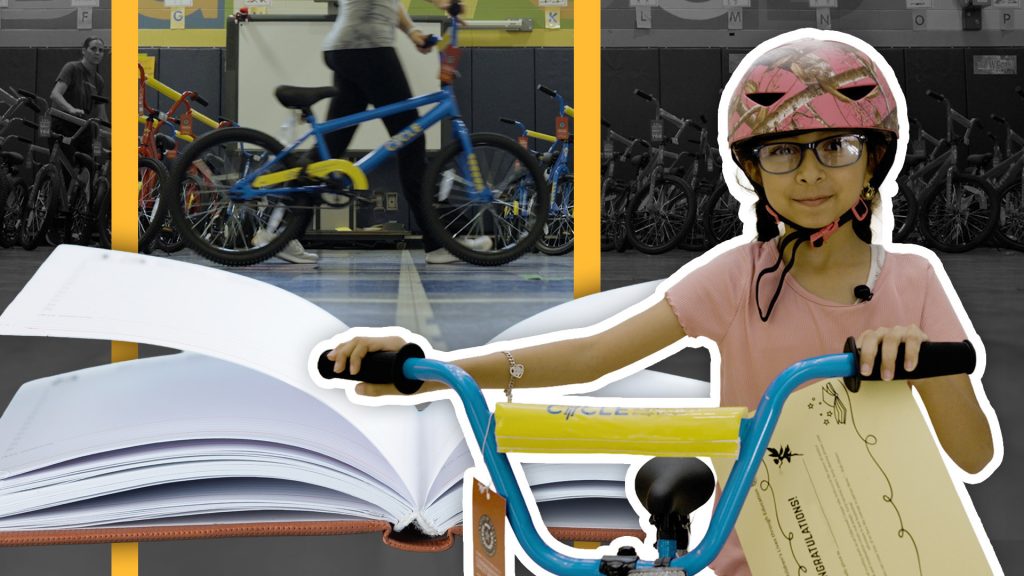
HOUSTON — Lizbeth Miranda loves to read. But that hasn’t always been the case. For the first seven years of her life, she found reading difficult. There were so many words that felt like roadblocks on the pages of the books in front of her.
Earlier this year, something changed — something big, blue and shiny. Lizbeth, who is 8, began associating reading with joy when she learned she could earn a bicycle if she hit her reading goals.
That was 100 books ago.
How big is America’s literacy crisis?
Too few American children read at grade level. That isn’t new or controversial: It’s a fact that has remained stubbornly proven over decades’ worth of standardized tests. In Texas, only 50% of students are on grade level in reading when they take their first (of many) state tests in third grade.
Children in the Houston area lag even further. According to data from the local nonprofit organization Good Reason Houston, only 45% of Houston-area kids hit that mark in third grade. It’s a sobering stat when shown on its own, but Good Reason Houston CEO Cary Wright pointed out that when taken alongside similar national figures, the weight of the rate gets lost in the chorus.
“No, it’s not OK, and yes, we have accepted it,” says Wright. “My vision would be, every damn day the Houston Chronicle would lead with a banner headline about the fact that only one in two kids — fewer than one in two kids — are reading on grade level, and this is a societal crisis of epic proportions.”
The Chronicle, for its part, regularly positions education stories on its front page, especially in the two-plus years since the Houston Independent School District was taken over by the state. But Wright’s point is only partially about headlines; it’s also about society’s reaction — or lack thereof — to what is being reported.
Wright says he feels like he is constantly shouting from a silo: “Hey, does everybody know that only 45% of our region’s kids are reading on grade level? Like, do we all know that? Are we clear on that? Do we understand that to do something completely different, to get to a different future, requires changing the way we do things?”
He isn’t sure who — apart from educators and wonks — hears him.

The critical reason behind second-grade reading interventions
Rebecca Roberts isn’t sure who can hear her either. She has to raise her voice to talk above the clang and bang of wrenches on metal as she makes a critical point.
“Reading is very, very important,” says Roberts, executive director of the Houston-based nonprofit CYCLE, which stands for Changing Young Children’s Lives through Education. “Literacy is very, very important.”
It’s the Saturday after Thanksgiving, and over the course of the next few days, hundreds of volunteers will assemble thousands of bikes to give away to second-grade students who have met their reading goals — part of an annual tradition in Houston that has led to significant gains in children’s reading scores among participating schools.
Each fall, the folks at CYCLE pair up with dozens of local Title I schools — those campuses that receive extra federal funding to serve a disproportionately high number of children from low-income homes — to motivate children to improve their reading scores. School-based reading specialists and classroom teachers set individualized goals for each child, and ask the kids to sign a one-page contract in which they agree to meet or exceed the goals set by those educators. At the end, the children receive a new bicycle.
According to the organization’s financial documents, CYCLE distributed 7,476 bicycles in 2024. Roberts noted that CYCLE planned to give out about 8,000 this year, and recently gave away its 200,000th bike since the nonprofit’s official launch in 2004.
The stakes are high: “If we don’t get them by the time they’re going into third grade, we have one more touch point, and that would be in eighth grade,” says Roberts. “Can you imagine being in eighth grade and only being at a fourth-grade level? This gap is so huge then, whereas if you’re in second grade, and you’re maybe at a kindergarten level, you probably can make it up to the beginning of second grade, quite honestly, almost in one semester.”
That’s a big challenge, but it’s one that CYCLE has met with success. This year, 21% of students across participating schools were reading at grade level at the beginning of this semester. The rate more than doubled to 46% of students by the time contracts were handed in, according to data from CYCLE.
And making these gains in second grade is critical.
“In second grade, you still are learning how to read,” says Roberts. “When you move into third grade, you are reading to learn, and we tell the students, you have to be able to read if you want to do math, if you want to learn about art, if you want to learn our history.”
That context is important, but for many of the second-graders, it takes a back-bike-seat to the more pressing issue: The promise of a bike can inject joy into reading. And that’s something sorely missing in many children’s lives.
Across the nation, fewer kids are reading for fun. In 1984, 53% of 9-year-olds said they read for fun almost every day. By 2020, that share was down to 42%, according to the Pew Research Center. It’s not just that kids are choosing to read for fun less frequently: Fewer kids are choosing to read for fun at all.
In 1984, 9% of 9-year-olds said they never or hardly ever read for fun; by 2020, 16% said the same. And the numbers become starker as kids age: Among 17-year-olds, the share who never or hardly ever read for fun tripled from 9% in 1984 to 27% in 2020.

‘Slow and steady wins the race’
A wave of determination radiates off Edward Mena. Wrench in hand, the 10-year-old is focused as he works through the instructions his father gave him when they built their first bike together a few moments ago. Now, it’s his turn to do it alone. He remembers “righty-tighty-lefty-loosy,” and the caveat that a bike’s left pedal uses the opposite direction for tightening.
He can do this, he knows. He can build a bike. And he can have fun doing it. Hard things, he recently learned, can be fun.
Two years ago, when Edward was a second-grader at John R. Harris Elementary School in Houston’s East End, he signed a contract to read his way to a bike of his own.
“I had to read a lot,” he says. That was a big shift for Edward, who hadn’t always been interested in books. But the promise of the shiny blue bike he now uses to race with his friends and cousins helped keep him on track.
“It felt nice because we got a reward, which made me feel like I wanted to do more work,” says Edward. “And then more.”
He discovered what is now his favorite book, “The Three Little Pigs,” a story that, he says, aligns with some of the lessons he learned in his reading quest.
“I really like that book,” he says. “It inspired me to take my time and never finish quickly. Slow and steady wins the race.”
The moral of that story is as fitting for an 8-year-old charged with improving his reading as it is for a 10-year-old building his first bike. But both challenges matter to Edward.
“When I grow up,” he says, fidgeting with the wrench his father, Nelson Mena, handed over to him, “I want to be a mechanic or an engineer.”
Nelson smiles. “If you want to be a mechanic or an engineer, you can start by building bicycles,” he says, setting his son back on task.
Edward hopes the kids who receive the bikes he builds learn to love reading as much as he does.

‘No silver bullet’
There has long been a great debate over what can and must be done to increase children’s literacy scores. Yet there has been no universal answer. As a result, children taught in one American state or district are likely to have received different instruction than kids elsewhere. And reading rates vary. Kids, of course, are multifaceted — as are communities.
“We know there’s no silver bullet,” says Kentasha McMorris, manager of district partnerships at Good Reason Houston. “But with steady and intentional work and doing things with fidelity, it absolutely moves the needle.”
Before moving to the nonprofit world, McMorris was a classroom teacher, then an assistant principal and principal. She worked with CYCLE in her school, and found one key attribute that she believes contributes to the program’s success: “It does add something powerful to the early literacy platform,” she says. “There’s a sense of joy and intrinsic motivation for the students.”
Joy isn’t a key performance indicator on any state tests. But that doesn’t make it any less valuable, says McMorris.
“We’ve become so focused and granular on the academic piece that we take out the joy and we forget that in any learning, not just early learning, the ‘why’ is necessary, and I think the joy portion is where we explain the why or the how,” she says. “We have guidelines now in certain districts where the joy is the last thing on board. So if you can use something like CYCLE to supplement that joy, let’s go for it.”

The power of reading together
“My heart is racing because I’m really excited,” says Lizbeth Miranda, moments before heading into her school’s gymnasium to pick out a pink helmet and blue bike of her own. She’s worked hard to get to this moment. Though, to be fair, much of the work was fun.
Lizbeth says she read 100 books over the course of the few months she has been working toward this bike. One hundred is an easy number for a second grader to throw out there. It means “big” rather than the specific integer that comes after 99. But SAN fact checked Lizbeth’s claim with her mom, Elvira Zavala, who verified Lizbeth’s accounting.
And her mom would know: The pair regularly read together over these past few months, something that Lizbeth says made her reading time extra fun.
“I like spending time with my family,” she says. Research shows time reading together is especially well spent, and can help increase literacy scores.
But Lizbeth isn’t worried about her literacy scores. She reached her goal of earning at least an 89 out of 100 on a recent assessment and is ready to focus on her bike. She has plans, she says, just before being fitted for a pink helmet, to take her bike to a nearby park.
She chooses a blue frame with care. It looks just like the one assembled two weeks prior by a 10-year-old, two years removed from this very moment.
Hundreds of CYCLE volunteers assembled thousands of bikes over the course of a week. And of those, Edward and his dad only built a handful or so. So statistically speaking, the odds that Lizbeth’s bike was built by Edward — a little boy who received his very own first bike from CYCLE two years ago — are slim.
But if there’s one thing that CYCLE makes clear, it’s that in the face of daunting statistics, there is always room for hope.
The post Can giving kids bikes help them learn to read? In this city, it works appeared first on Straight Arrow News.
Ella Rae Greene, Editor In Chief