Californians could be forced to choose a Republican for governor this fall
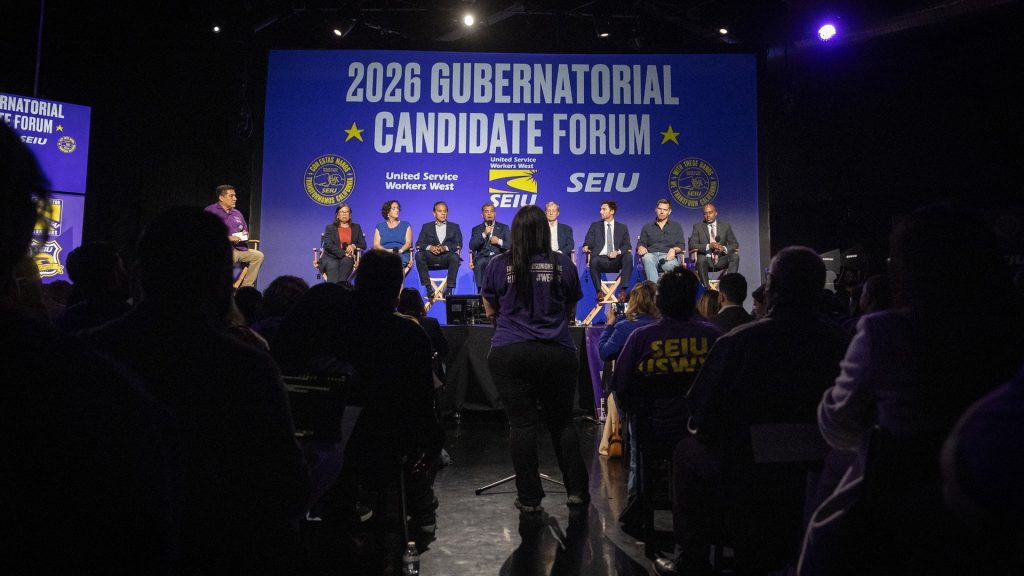
A flood of Democrats eyeing California Gov. Gavin Newsom’s office has members of their party worried that the state’s different primary election method will produce a MAGA-friendly Republican to govern one of the bluest states in America.
On Wednesday, Emerson College released the latest polling data in the California gubernatorial race. It’s the first set of numbers since the candidates in the crowded field became official last week, and the data has some Democratic leaders concerned that their candidates will be locked out of the general election.
Who’s leading this horse race?
The new poll shows most Californians remain undecided on the race three months before the primary.
However, it does show increased support for Rep. Eric Swalwell, D-Calif., who’s now leading the pack with 17% support.
“He seems to be the person who’s pulling ahead of the pack the most but, that’s at a pretty small rate,” Thad Kousser, professor of political science at UC-San Diego, told Straight Arrow News.

Following Swalwell, it’s the two major GOP candidates, with former Fox News host Steve Hilton polling at 13% and Riverside Co. Sheriff Chad Bianco at 11%.
The next-highest polling candidate is billionaire Tom Steyer, who’s funding his own campaign and has already made a large TV, social and radio push.
He’s followed by three candidates with significant political experience, including former Congresswoman Katie Porter, former Speaker of the California State Assembly Antonio Villaraigosa and former U.S. Secretary of Health and Human Services Xavier Becerra.

California uses a jungle primary system. That means whichever two candidates, regardless of party, who get the most votes in the primary will face off in the November general election.
Democratic primary concerns
California is overwhelmingly a Democratic state, with the number of registered Democrats nearly doubling Republican voters, and has not elected a Republican governor since Arnold Schwarzenegger in 2011, a recall election with different rules.
However, because of that jungle primary system, some Democratic party leaders are concerned their candidates could be locked out of the general election because the field is so crowded with no real frontrunner.
If Democratic voters spread out too evenly amongst their candidates and Bianco and Hilton end up receiving the top two vote totals, it’ll be the two GOP candidates facing off in November.

“Mathematically, the possibility that the two-Republican outcome could be the result of the primary is more than zero,” Darry Sragow, longtime California political consultant and Democratic strategist, told SAN. “So, I guess I’m paying attention. But do I think it’s likely? No, I think it’s highly unlikely.”
The math seems to be on Sragow’s side.
“The formula there is you have to have, you have to keep both Bianco and Hilton about even and getting 20% each, right?” Kousser said. “And then you’d have to have four Democrats getting 15% each, or thereabouts, in order to lock out a Democrat.”
Some of those concerns stem from the lack of a major frontrunner like former Vice President Kamala Harris and Sen. Alex Padilla, D-Calif., would’ve been.
“Certainly, Kamala Harris would have been the candidate who could come in with a name recognition that would have both sort of sent other candidates looking towards more favorable statewide offices, and also coalesced voter support in a way that that would have made them the immediate front runner, and at least guaranteed that some Democrat was going to make it through to November,” Kousser said.
Current Gov. Gavin Newsom has also stayed far away from the race, an issue Kousser said is happening to voters as well.
“The worry here for Democrats is that less than three months to go with this election, nobody’s paying attention to it,” Kousser said. “Even Gavin Newsom said he wasn’t paying attention to it. All eyes are focused on Washington, D.C., and what President Trump is doing in the broader world.”
Breaking out of the pack
There are many important factors in American elections, but none more so than money.
“Who breaks out of the pack is, to a very significant degree, a function of who has enough money to buy enough ads to gain enough exposure to enough California primary voters,” Sragow said. “Campaigning is not a very complicated business at one level. Either you have enough money to put yourself before the eyes and ears of a sufficient number of California voters, or you don’t.”
Steyer, whose net worth hovers over $2 billion, clearly has the financial capabilities to remain competitive in the race.

Who else could have the money to keep up?
“Katie Porter, Xavier Becerra, Antonio Villaraigosa, all along have been possible serious contenders because they’re well-known, long-timers in California and national politics,” Sragow said. “They have a funding base and it’s entirely conceivable that one, two or all three of those could have enough money to be serious contenders.”
Among the relative dark horses is San Jose Mayor Matt Mahan. He has very little name recognition, but his more moderate approach appears to have made him some friends in Silicon Valley, where there’s no shortage of cash.

“There’s some possibility that if he gets enough money to get onto people’s screens and phones, that his candidacy can make an impact,” Kousser said.
It can be tougher to tell where California billionaires are directing their election endorsement money because of how campaign law is written in the state. They’re limited to donating just $39,200 to a gubernatorial candidate, but there are other ways they can back their chosen horse.
“They have to put their substantial resources to work through independent expenditures on behalf of their favorite candidate,” Sragow said.
Other than tech billionaires, other major financial backers in California politics usually come in the form of labor unions like the SEIU and California Federation of Labor Unions.
“The deep pockets in a California governor’s race are pretty predictable and certainly that includes some labor unions,” Sragow said. “It includes the teachers. It includes business interests like real estate and health care and energy, and those have always been substantial money sources for California candidates.”
Who breaks out?
As an established politician with a national presence, Swalwell also has significant fundraising capabilities and has already taken a polling lead despite a late entry into the race.
“He’s in the mid-teens, so it’s not predestined that he’ll be the candidate who catches fire,” Kousser said.
While money is the mother’s milk of politics, there are other important moves for the candidates to make as well.
“If candidates get a strong endorsement from a Nancy Pelosi,” Kousser said. “But more importantly, one of the major labor unions in California that has both the boots on the ground, the money to pay for advertisement, and a name brand that could help sway a lot of voters.”
So far, major endorsements have not come.
“There are some key unions that haven’t made an endorsement and spent the money that comes with it,” Kousser said.
Kousser said Newsom weighing in on the race could also be a major turning point.
“The biggest potential kingmaker in California, the functional leader of the party, Gavin Newsom, has remained on the sidelines in this race,” he said. “And so, without that person in that organization tabbing one candidate, it means that support is split.”

But with three months to go, a very crowded field, and a lot up in the air, making a prediction at this point is just not possible.
“As long as I’ve been running campaigns and now observing campaigns, I am loath to make predictions,” Sragow said. “But I always like to remind everybody who talks about these things that at the end of the day, these candidates are human beings. They are people and the voters have to like you. It’s that simple.”
The MAGA effect
Trump and his MAGA movement have had a major impact on American politics over the last decade, but could they have any impact on this race? Seven in 10 Californians disapprove of the job the president is doing.
“The president is very widely and deeply unpopular in California,” Sragow said. “Obviously, he has a support base here, but his support base is relatively small on a percentage basis, so I suppose that if Donald Trump wanted to help pick the Democratic nominee for governor, he would deliberately attack that candidate.”
However, the two Republican candidates do more closely represent the MAGA movement.
“In this time when California politics has been really defined by opposition to Donald Trump, and every candidate is a fierce critic of the President, the irony is that this state that has set itself as the island of opposition to Donald Trump could end up being governed by one of his close allies,” Kousser said.
Trump has not yet made an official endorsement of any candidate.
Ella Rae Greene, Editor In Chief