California wildlife crossing is latest in over-budget, overdue public projects
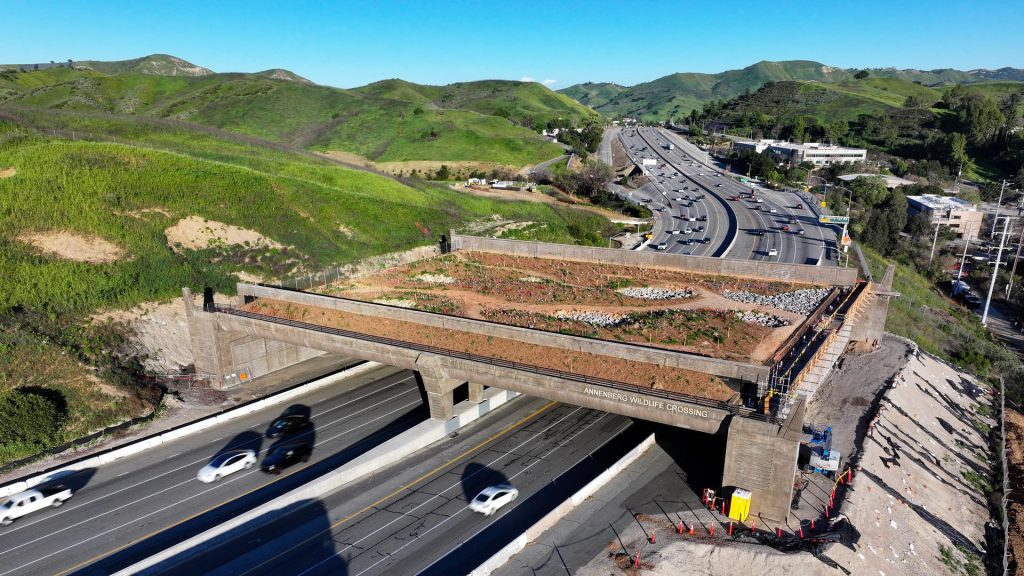
California is set to complete the world’s largest crossing for wildlife, but the price tag has gone up significantly. Originally budgeted at around $92 million, it’s running at least $21 million over budget.
Why do city and state projects continuously go over budget? There are a variety of reasons for that.
Wildlife crossing
The Wallis Annenberg Wildlife Crossing will span the 101 freeway just west of Liberty Canyon Road in Agoura Hills, which is about 35 miles west of Los Angeles.
It’s designed to allow wildlife, including mountain lions and more, to safely cross between the Santa Monica Mountains and the Santa Susana Mountains.
The overpass has been a highly publicized project with Gov. Gavin Newsom even joining the groundbreaking in 2022.

Those behind the initiative said they felt it was important to find a way to connect the Santa Monica Mountains to other ecosystems, and an overpass was the best way to do it.
“But, then they were kind of stumped,” Fraser Shilling, director of the Road Ecology Center at UC Davis, told Straight Arrow News. “They were stuck. And nobody had done anything like this before, and the price tag was going to be huge, because the 101 is so wide right there. So, it really stalled things out.”
Much of that changed in 2021 when Beverly Hills philanthropist Wallis Annenberg pledged $25 million for the overpass if other money could be raised.

The state pitched in another $60 million and eventually that number ballooned to the original $92 million projection from Caltrans, which is overseeing the project.
Along with connection ecosystems, safety was also part of the pitch, with leaders claiming animals having a place to cross the freeway will prevent collisions. That’s only true if other measures are involved.
“The only thing that reduces roadkill is fencing, and so a way that wildlife crossings can indirectly result in less roadkill is because they almost always have fencing associated with them,” Shilling said. “But it’s really the fencing, because animals don’t selectively go towards a crossing. If you don’t have fencing, they don’t know it’s there.”
This project does involve significant fencing.
Overdue and overbudget
The overpass is set to open later this year despite an original goal of 2025. Then, two months ago, project spokeswoman and California’s regional director for the National Wildlife Foundation, Beth Pratt, also announced the crossing would be about $21 million over budget.
How does that happen?
According to Pratt, it’s President Donald Trump’s fault.
“Costs increased because of tariffs, inflation, labor problems, and we were no exception,” Pratt said.

The weather also took the blame for the delay. California got hit with significant rainfall following the groundbreaking, which Pratt said forced workers to redo some of the work they’d already done.
“Contractors were constructing the massive supports and doing the groundwork around them, which required much soil compaction,” Pratt told KTLA. “They had to redo this multiple times because of the muddy mess.”
To fill the gap, much of the money will come from the California Transportation Commission, according to Newsom’s office.
Not alone
Another reason that causes many government and state projects to get delayed or end up well over budget; too many cooks in the kitchen.
“You’ve got the general contractor,” Shilling said. “If they’re keeping it all in house, they have control over things like that and going over budget. So, you can directly blame them.”
On projects like this overpass, many subcontractors are involved.
“Basically, it all comes back to the California system for bidding is that the low, feasible, sounding bid wins if there’s no reason that you think there it’s a bad bid,” Shilling said.

Shilling added it’s the same issues that come up with nearly every construction or transportation project.
“They will change orders during the construction, and then they’ll say, ‘well, we need to do this,’” Shilling said. “We didn’t anticipate that the prices have gone up, and eventually you can end up with something as much as twice as much as the original bid. So, they’ll get the bid based on low bidding, but then they’ll end up charging way more.”
Shilling said there’s no way to track those changes either.
”It’s an incredible weakness in the contracting system that somebody can be a repeat offender, like every time.”
Is there anything a state government can do?
“There’s 100% of something the state can do,” Shilling said. “The state could pass a law that says you can’t do that, and track these offenders, track the system, and prevent that kind of stuff from happening.”
Changing a system like that never comes easy.
“It goes back to lobbyists and how all these kinds of things get done in the first place,” Shilling said. “There’s the revolving door between the agencies and the engineering firms. You know, there’s a whole system built in there.”
Until that happens, ballooning costs may prevent other projects like this from coming to fruition.
“If you go to Siskiyou County, where I work a lot, and other places, they can’t afford a $100 million overcrossing,” Shilling said. “I feel like the price tag ended up being a huge environmental mistake, because it puts it out of reach for other places.”
Ella Rae Greene, Editor In Chief