Australia has strict gun laws. Why they didn’t prevent the Bondi Beach massacre
It was a “delightful” day at the Port Arthur Historical Site, according to people who were there on April 28, 1996. But at about 1:30 that afternoon, the popular tourist center in Tasmania, Australia, became the site of the deadliest mass shooting in the country’s history.
The shooting left 35 dead and led to extensive new gun control laws. Afterward, gun homicides dropped from 2.9 per 100,000 population in 1996 to about 0.6 per 100,000 in 2023. By contrast, the U.S. reported 5.6 per 100,000 in 2023.
These tough gun laws, however, did not stop two armed men using legally purchased weapons from opening fire on a group of people celebrating Hanukkah in Bondi Beach on Dec. 14. The shooting at the popular beach town in the suburbs of Sydney left 15 dead.
The Bondi Beach shooting raised the stakes for gun control laws in Australia and beyond. To one side, the massacre is proof that tough gun laws don’t work, while to the other, it demonstrates that the laws need to go further.
What are Australia’s gun laws?
Australia recorded 12 mass shootings before it restricted gun ownership after the Port Arthur episode — and, according to USA Today, four since then. From 1996 to August 2025, the U.S. has had 135 mass shootings, according to Statista.
Unbiased. Straight Facts.TM
Following the 1996 gun restrictions, Australia bought back 650,000 now-prohibited firearms from the public.

In Australia, a person must obtain a license to own firearms and must be able to show one “genuine reason” — excluding self-defense — they need them.
Some of these “genuine reasons” include hunting, sport shooting, pest control and farm work.
The country also has a license category system that restricts holders to specific types of firearms. A handgun, for instance, requires a Category H license.
According to investigators, one of the suspects in the Bondi Beach shooting, Sajid Akram, had an AB firearm license. They said he legally owned six firearms, and video of the shooting shows Sajid Akram and his son Naveed Akram using at least three weapons during the attack.
What guns did the Bondi Beach shooters use?
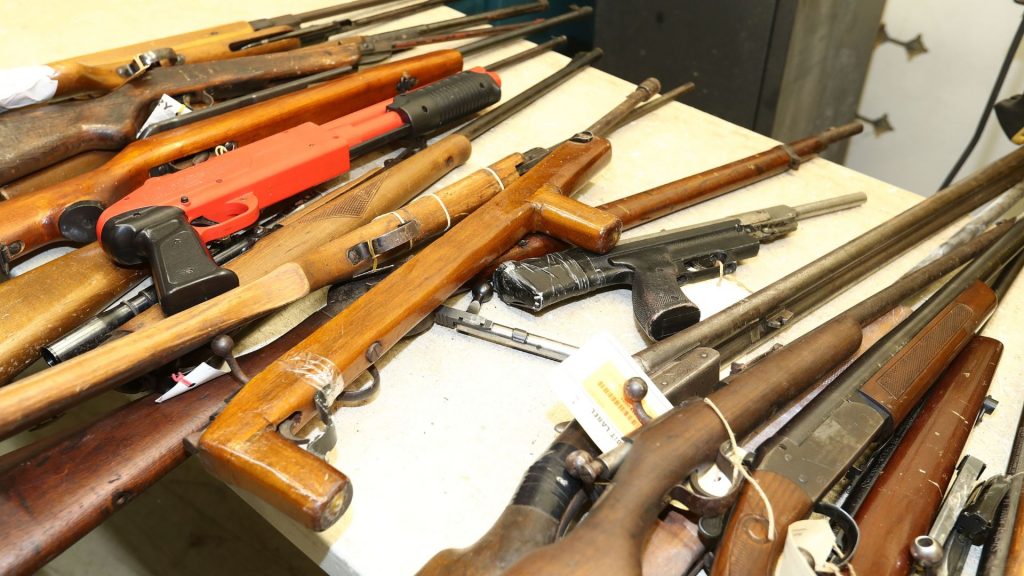
The guns used in the Bondi Beach shooting reflect Australia’s gun laws. Early reporting inaccurately stated that the gunmen used “pump-action shotguns.” However, videos show the shooters using a gun mechanism similar to a bolt action, called a straight-pull firearm.
Investigators discovered at least one straight-pull rifle and two straight-pull shotguns after the shooting. These types of firearms began appearing in Australia in 2018, according to ABC News. These firearms are limited to five rounds, and the user has to chamber each round. Any firearm that carries more than five rounds requires a much more restrictive and hard-to-get license.
Because of the manual charging mechanism, these guns fire slower than a semi-automatic AR or AK-style rifle, similar to those used in many U.S. mass shootings. However, with proper training, a shooter can learn to shoot quickly.
Investigators said both men had trained with the guns several times before the shooting. Videos found on Naveed Akram’s phone show him and his father “firing shotguns and moving in a tactical manner,” according to court documents, while videos of the shooting show one of the gunmen quickly rechambering a round on a straight-pull rifle.
Are lawmakers expected to enact more laws?
Australian lawmakers have already begun discussing changes to the country’s firearms restrictions. At a Dec. 15 meeting, Prime Minister Anthony Albanese and regional leaders agreed to work toward new gun measures.
The plans would include speeding up the creation of a national firearms database, using more “criminal intelligence” in the licensing process, limiting the types of guns and modifications that are legal and restricting gun ownership to only Australian citizens. Sajid Akram was not an Australian citizen.
Lawmakers are also looking into creating further custom restrictions on firearms and related equipment. These could include limiting imports of items involving 3D printing or accessories that hold large amounts of ammunition.
Discussions on stricter gun laws come at a time of high Australian gun ownership. The Australia Institute, a public policy research group, reported there are more than 4 million guns in the country, 25% more than in 1996.
Despite the uptick in gun ownership, most Australians favored stricter gun laws even before the Bondi Beach shooting. A January poll by The Australian Institute found that 64% of Australians supported tougher restrictions, while only about 6% said they believe lawmakers should roll back restrictions.
The post Australia has strict gun laws. Why they didn’t prevent the Bondi Beach massacre appeared first on Straight Arrow News.
Ella Rae Greene, Editor In Chief