Artemis II launches astronauts toward the moon and into history
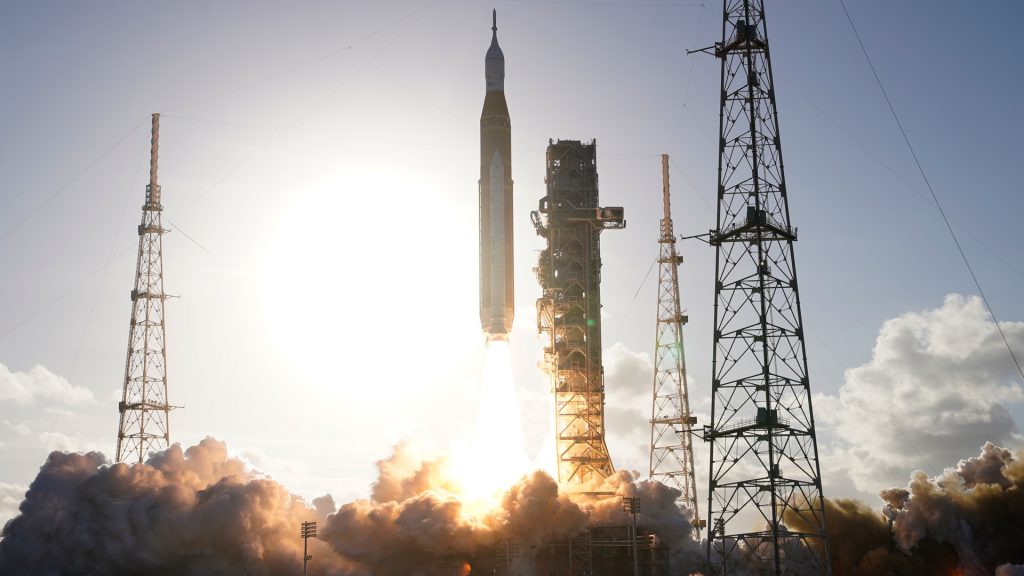
“Humanity’s next great voyage begins.”
Launched from Earth today was the Artemis II. Its 10-day mission: to explore the dark side of the moon, to seek out new data for future civilizations and to boldly go where no American has gone in more than 50 years.
The rocket successfully lifted off from its launchpad at NASA’s Kennedy Space Center in Merritt Island, Florida, at 6:35 pm Eastern Time on Wednesday. It’s carrying the Orion shuttle, which is scheduled to reach the moon’s orbit in roughly five days.
Aboard are NASA astronauts Reid Wiseman, Victor Glover and Christina Koch, along with Canadian Space Agency astronaut Jeremy Hansen. A successful, as-planned orbit will place these four farther from Earth than any in human history.

None of the astronauts will plant flags or hit golf balls from the lunar surface. Instead, the Orion spacecraft will conduct a quick flyby around the moon and head back. The shuttle will make a figure-8 loop to return, taking advantage of the moon and Earth’s gravity to travel with minimal fuel use. The same “slingshot” method gained fame for its use in the Apollo 13 mission.
The total mission is expected to take roughly 10 days before Orion lands in the Pacific Ocean.
Why are we going back to the moon?
Think of Artemis II as a scouting expedition to build infrastructure on the moon that would make for a future launchpad to Mars.
NASA is eyeing nine potential landing zones near the lunar south pole, namely the Shackleton crater, that could hold frozen water. Not just for drinking, the water would serve as rocket fuel, theoretically propelling future missions farther into space.
The Shackleton crater also sits in a position near the pole that’s shielded from the sun’s damaging rays. This gives an additional chance for a sustainable lunar base.
Not without difficulties
The Artemis program as a whole is running at least four years behind schedule. Many policymakers believe the holdups put the U.S. in a too-close-for-comfort race with China to be the first nation to set foot on the moon this century.

NASA’s 322-foot-tall Space Launch System (SLS) is smaller than the Saturn V rocket that propelled Apollo program astronauts into space, but it packs a stronger punch thanks to additional side boosters. The SLS and shuttle both run on liquid hydrogen, which has become a source of technical failures affecting operations. Hydrogen leaks grounded multiple practice launch attempts in 2022.
The same issue reared its head earlier this year, causing the program to miss its first launch window.
Now what?
After rescheduling, NASA says Artemis III will test one or both commercial landers from SpaceX and Blue Origin. Artemis IV is now the mission NASA plans to send astronauts to the lunar surface in early 2028.
Ella Rae Greene, Editor In Chief