A Texas refinery explosion reignites debate over EPA’s chemical safety rules
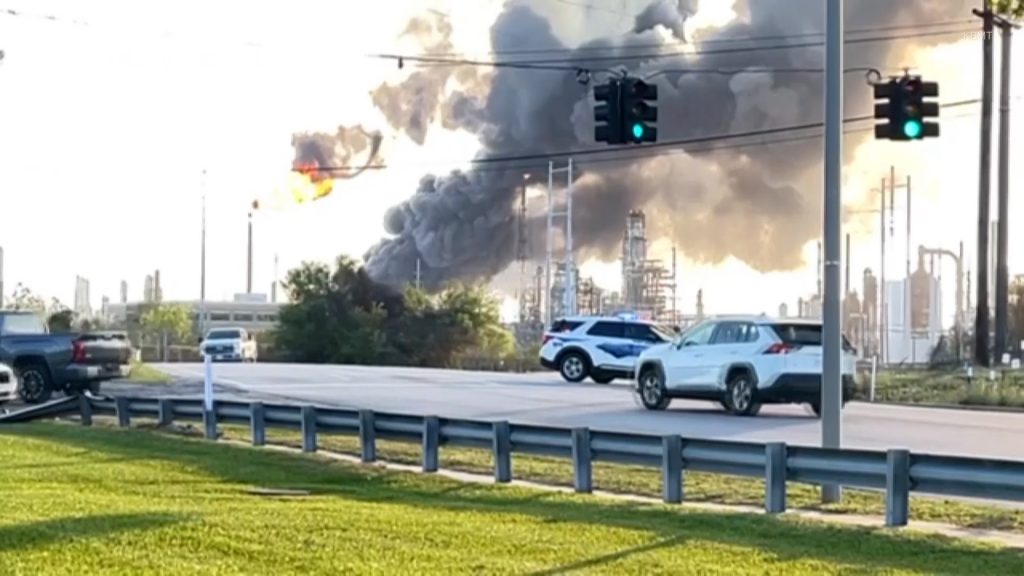
First responders fought back flames through the night after a Monday evening explosion at the Valero oil refinery in Port Arthur, Texas, triggered a 12-hour shelter-in-place order. The plume of gray smoke rose over Texas as the U.S. Environmental Protection Agency considers eliminating recent changes to safety practices at refineries and chemical plants.
No injuries were reported. Port Arthur Mayor Charlotte M. Moses said the shelter-in-place covered parts of the city’s west side and was lifted by Tuesday morning after firefighters brought the blaze under control. The refinery, located about 90 miles east of Houston, employs roughly 770 workers and processes 435,000 barrels of oil per day. The cause of the explosion was still under investigation Tuesday afternoon, according to Valero.
The Texas Commission on Environmental Quality has deployed air monitoring equipment to the scene, the Houston Chronicle reported.
The explosion occurred in the midst of a public comment period as the EPA weighs rolling back updates to chemical accident prevention rules finalized during the Biden administration. The rules were intended to enhance safety systems and provide greater transparency to neighboring communities, but critics argued the requirements duplicated existing federal workplace safety standards and imposed unnecessary costs on industry. The Trump administration paused implementation while beginning a process to eliminate the rule.
Environmental advocates have warned that without the rules, accidents like the explosion in Port Arthur are more likely to occur.
“The regulation overseeing the safety of those facilities has been lacking for years,” said Jennifer Hadayia, executive director of the nonprofit Air Alliance Houston.
What changes did the Biden administration make?
The EPA’s Risk Management Program has required facilities handling hazardous chemicals to develop safety plans since the 1990s. About 12,000 facilities nationwide are subject to the rules, including oil refineries, chemical manufacturers, water treatment plants and food processors.
The Biden administration’s updates in the 2024 Safer Communities by Chemical Accident Prevention rule mandated that certain high-risk facilities assess whether safer technologies could replace more dangerous processes. The rule also required facilities to evaluate their vulnerability to natural disasters and plan how to manage power loss, gave workers the authority to stop operations they believed were unsafe and required facilities to provide chemical hazard information to community members living within 6 miles.
“It was a much-welcomed step in the right direction,” said Darya Minovi, a senior analyst at the Union of Concerned Scientists.
The rule also required third-party safety audits for facilities with a history of accidents — a provision Hadayia said would have made a difference in the Houston region.
Similar rules were proposed by President Barack Obama but rolled back during Trump’s first term.
What is the Trump EPA proposing?
In late February, the Trump administration began the process of rolling back the rules, framing the changes as a way to eliminate requirements that duplicate Occupational Safety and Health Administration (OSHA) workplace standards.
The EPA’s latest proposal would rescind third-party audits for facilities with a history of accidents, eliminate requirements to test less dangerous technologies and scale back workers’ rights to stop working in situations they believe to be dangerous. It would also end the public’s right to request chemical hazard information from nearby facilities and the requirement for facilities to have a natural disaster response plan.
To justify the rollback, the EPA pointed to its own accident data, noting that the number of incidents at facilities that use hazardous chemicals fell from 147 in 2014 to 81 in 2023. The agency argued that the decline showed facilities were already running effective safety programs before the 2024 rule. The EPA estimates the rollbacks will save industry roughly $235 million annually, including $168 million for scrapping the safer technology assessment requirement.
The EPA has opened a 45-day public comment period ending April 10 — a window critics say is far too short. A coalition of labor, environmental and public health groups, including the United Steelworkers and the UAW, sent a letter to EPA Administrator Lee Zeldin requesting at least two public hearings and a 60-day extension of the comment period.
“It is really just cutting the public out of the process,” Minovi told SAN.
The Union of Concerned Scientists also signed the letter to Zeldin.
After six years of working on the rules, Minovi said she is frustrated by the “ping pong” between presidential administrations.
“What’s lost in this terrible political game is threats to workers, threats to communities and threats to first responders,” she said.
What impact do chemical accidents have in Houston?
The Valero explosion was the second industrial fire in the Houston area in less than two weeks, after a fire broke out on March 12 at a LyondellBasell chemical plant in Pasadena.
Houston has long been a hot spot for such incidents due to many petrochemical facilities that line the Houston Ship Channel and surrounding areas. A 2016 investigation from the Houston Chronicle found that an accident occurred every six weeks.
Notable disasters have shaken the region since. Hadayia pointed to a 2019 fire at the ITC tank farm in Deer Park and a 2021 explosion at an ExxonMobil refinery in Baytown as examples of a pattern that stronger federal rules could help address.
“It’s hard to grasp unless you are living in it day to day,” Hadayia told SAN. “I wish that our policymakers were prioritizing public health and safety as much as they are prioritizing industry convenience.”
The Chemical Safety and Hazard Investigation Board, an independent agency that investigates the root causes of major chemical accidents, is also at risk of elimination. The Trump administration’s fiscal year 2026 budget proposes shutting down the board entirely, calling it duplicative of other EPA and OSHA capabilities. Congress blocked similar proposals during Trump’s first term, but Republicans now control both chambers.
“We are seeing a third-party system being defunded and perhaps eliminated, and now we are seeing more and more of these upset events,” Hadayia said. “It’s a perfect storm.”
Ella Rae Greene, Editor In Chief