A TBI retired his football dreams at 15. Inside youth sports’ pervasive problem
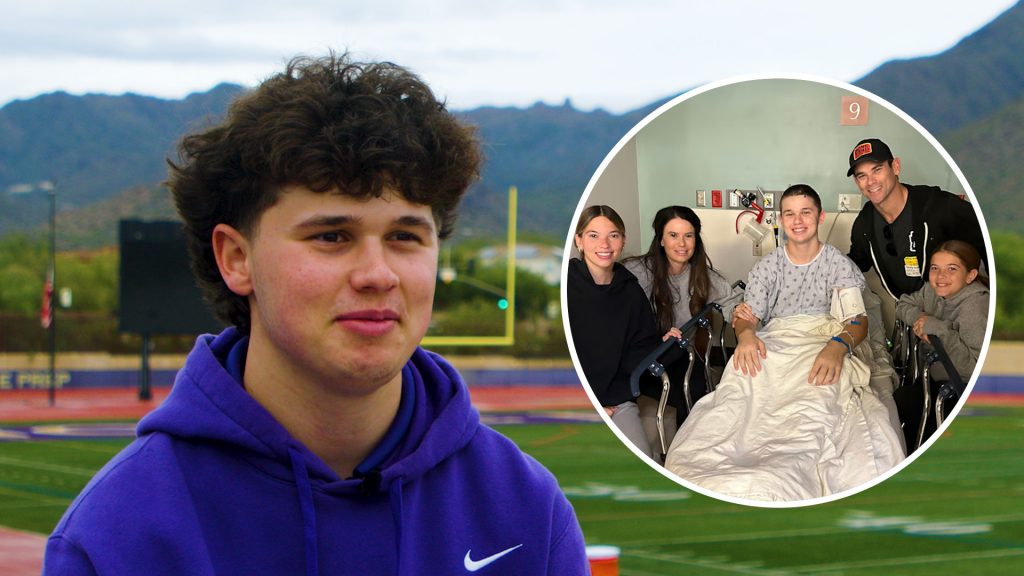
SCOTTSDALE, Ariz. — It was a simple, routine tackle — the kind Clayton Liebman, then 15 years old, had powered through dozens of times during his sophomore season. But this one was different. In a split second, that routine play turned catastrophic, leaving him with a life-altering injury.
Clayton was a budding star on the Notre Dame Prep JV team in 2024. The running back from Scottsdale, Arizona, was building a reputation for being tough to tackle. He quickly became the centerpiece of the Saints’ offense and appeared to have a bright future in the game.
Then, on Oct. 24, 2024, Clayton was hit during a third-quarter running play. He didn’t get up. He remained unresponsive on the ground and began convulsing. An ER doctor in the stands ran to the field to help team trainers treat him, and Clayton was rushed to the hospital.
His injury is a severe example of a sports-related traumatic brain injury — a remarkably frequent injury. Millions of U.S. kids suffer TBIs each year, including 1.9 million kids who are affected by concussions. The Centers for Disease Control and Prevention estimates that seven out of 10 emergency room visits for sports-related concussions are among children ages 17 and under.
High school football dream cut short
It became clear early on that Clayton had a remarkable talent for football.
“I was just hoping to have a decent role in the team,” Clayton told Straight Arrow News. “Then my coach found out how good I was. And next thing you know, I was getting 30 carries a game, 250 yards, a couple touchdowns.”
Like many kids, Clayton was “all in” on his sport. He began suiting up and winning trophies in tackle football in the fifth grade.
Football was a central focus in his life. But that third-quarter hit was a knockout blow.
“I went down (to the field), but I had to kind of stay back,” said Clayton’s mother, Korine Liebman. “They did not want me to see what condition he was in.”
Clayton suffered a brain bleed. Doctors performed a craniotomy, removing a fist-sized part of his skull, to relieve pressure. He spent nearly two weeks in intensive care, much of it on a ventilator. He still doesn’t remember what happened on the field.
“There’s one memory I can think of,” Clayton said. “I was in the hospital. I don’t think I was talking, I was throwing the football with my uncle, and I was doing it left-handed because the right side of my body was shut down.”
The number one medical issue in high school sports
Traumatic brain injuries are the No. 1 medical issue in high school sports, according to Dr. Karissa Niehoff of the National Federation of State High School Associations (NFHS).
“The issue’s always there,” Niehoff told SAN. “Sports come with inherent risks. And it’s not just football. It’s soccer. It’s baseball. It’s any sport, really. I mean, our bodies are active, and there’s a risk that we’re going to hurt our heads.”
All 50 states have enacted laws to help protect kids playing organized sports from head injuries. Several states, along with the NFHS, specifically track concussions. Yet even though youth sports have tackled the concussion protocol head-on for more than a decade, traumatic brain injuries still occur. Dr. Niehoff noted that nationwide, numbers remain steady or are declining.
Concussions account for roughly 15% of all high school sports injuries, according to the CDC. To further lower that rate, it is essential for athletes, coaches and parents to be vigilant and speak up if something doesn’t look or feel right.
“So when the kids don’t self-report, and somebody may not have seen a play or a situation happen, we may never know until later, and then they go home, and they have these symptoms, and then the parents don’t know,” Niehoff said. “So it can quickly slip through your fingers. Concussions are like snowflake injuries. Every person who sustains a concussion might experience it a little differently.”
How are concussions diagnosed and treated?
In the past, concussion diagnoses were graded on a scale using indicators like the type of impact suffered and whether someone lost consciousness, but that approach is now outdated. The American Academy of Neurology published revised guidelines in 2013 emphasizing a patient-specific approach.
Unbiased. Straight Facts.TM
Concussions account for roughly 15% of all high school sports injuries, according to the CDC.

While symptoms and recovery time vary by patient, concussions are now diagnosed and treated on an all-or-nothing model. Either a patient has experienced enough force to trigger a concussion, or they haven’t.
The most important thing a coach or parent can do if they suspect a child has sustained a concussion is to keep them on the sidelines, said Dr. Ginger Yang, a principal investigator at the Center for Injury Research at Nationwide Children’s Hospital in Columbus, Ohio. Athletes who have suffered a concussion are four to six times more likely to suffer a second one, said Yang, who specializes in youth concussion diagnosis.
“When you have a concussion (the key is) seeking care right away so you can recover sooner,” Yang told SAN. “Also, get enough rest before you go back and wait until you fully recover before going back, so you will not have an additional concussion.”
Youth sports ‘specialization’ can contribute to injury
Specializing in just one sport at a young age can also contribute to a child’s rate of injuries, including concussions, according to Yang. The heightened competition and pressure to perform that can sometimes come from specialization can lead young athletes and their parents to try to do too much.
“Athletes are supposedly tough,” Yang told SAN. “You never say you’re tired or whatever because you are tough. So sometimes kids push too hard. That could have an impact on the athletes, not only physically but mentally.”
Niehoff agreed that is often the toughest part: Kids and coaches want to “push through” to reach a goal or win a game. This, Niehoff said, is why education about the symptoms and signs of concussions becomes so important.
“Especially with the student athletes themselves,” Niehoff said. “They should know, hey, if you get dinged, it’s okay to say, time out for me. ‘My head got banged, and I’m not feeling right.’”
The inherent risk of youth sports
NFHS guidelines stress minimizing the risk of head injuries by using protocols and protections before kids even play a game, in every practice.
“We got rid of the bull in the ring drill,” Niehoff said. “We got rid of some of the named drills that used to be central to football — not heading the ball so much in soccer, wearing helmets in baseball and softball. Lacrosse for boys. Just looking at better protective ways to approach practice and play.”
Yet even with those precautions, a life-threatening injury like Clayton’s can occur without warning. Doctors told Korine Liebman that what happened to Clayton was a “freak accident”. Other than a couple of requests to come out of the game because he was tired, Clayton’s performance during that Thursday night game had appeared to be business as usual until the third-quarter hit.
“They think this potentially had been happening in the whole game,” Korine told SAN. “He was tired, but he still felt like he could still play. So there wasn’t really any other symptoms.”
Community support is essential
After his hospital stay, Clayton completed over six months of intensive rehab to restore his speech and many of his motor skills. He had to strengthen the right side of his body and learn to walk again. His recovery continues, and he is currently repeating the 10th grade.
“Before my injury, I was a straight-A student taking honors and AP classes,” Clayton told SAN. “I had to get rid of some of those classes. But I’m still doing pretty good. I’m getting better and better.”
Still, the 16-year-old has never expressed a “why me?” moment during his recovery – even as he has learned to accept that he is no longer able to play the sport he pushed himself so hard to excel at.
He still loves the game and became wistful when asked what he’ll miss most.
“Just playing on a team, supporting my teammates, scoring touchdowns,” Clayton said. “It was just a good camaraderie we had.”
The family is thankful the entire community rallied behind them. Clayton heard from professional athletes Larry Fitzgerald and Trey McBride of the Arizona Cardinals, Arizona State running back Cam Skattebo, and NBA Hall of Famer Steve Nash.
His high school teammates visited every day during his recovery, and still wear “Clayton Strong” bracelets. This football season, he returned the favor by helping to coach during JV games.
Clayton has another big goal on the horizon: His 17th birthday is in December, and he’s hoping to get his driver’s license soon after.
The post A TBI retired his football dreams at 15. Inside youth sports’ pervasive problem appeared first on Straight Arrow News.
Ella Rae Greene, Editor In Chief