Abdul El-Sayed wins Michigan’s Senate primary by razor-thin margin
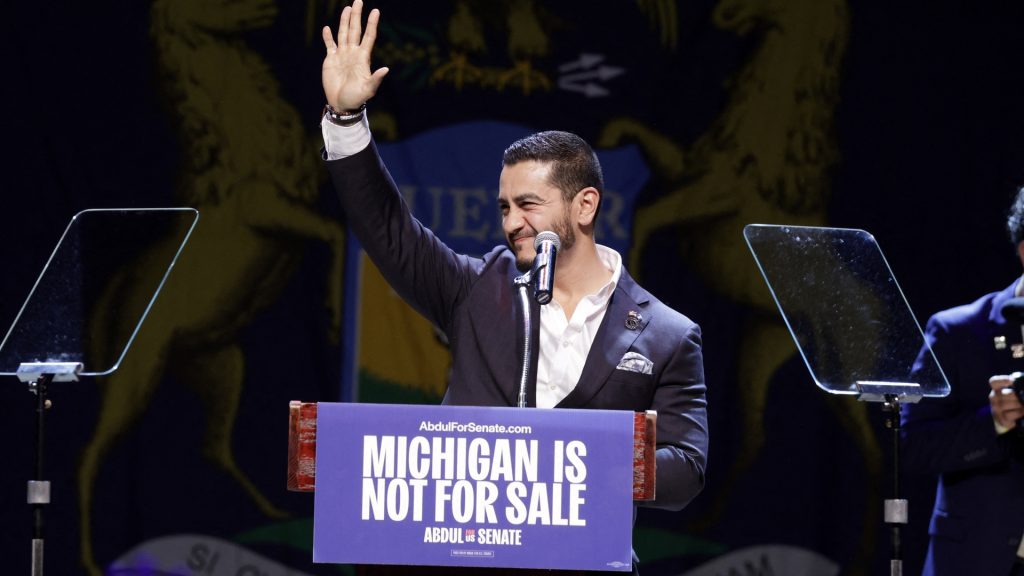
Former health official Abdul el-Sayed has won Michigan’s closely watched senatorial primary, defeating Rep. Haley Stevens. The Associated Press, NBC News and CNN all called the race Monday, saying el-Sayed won by just one percentage point.
Just hours earlier, before the race was called, el-Sayed wrote on X, “We won. I am so proud to be your Democratic nominee for US Senate. Let’s win in November.”
El-Sayed, who was endorsed by prominent progressives like Sen. Bernie Sanders (I-Vt.) and Rep. Alexandria Ocasio-Cortez (D-N.Y.), led public polling going into the race. He stopped short of claiming victory, but told supporters they had built a lasting movement.
“We are on track to vastly outvote the historic numbers that we should have expected,” he said in a speech after polls closed. Referring to millions of dollars in outside spending to oppose his candidacy, he said, “we are still standing.”
Stevens also struck an optimistic tone, telling supporters, “We knew that this was going to be a close race and that’s exactly what we’ve got: a close race.”
After the race was called, she shared a statement, saying, “I love Michigan and am so proud to have put up my hand to serve. I spoke with Abdul a few moments ago to offer him my full support as we work to defeat Mike Rogers this November.”
Looking ahead
El-Sayed will face former Republican congressman Mike Rogers, who was uncontested for the GOP senatorial nomination. Rogers, who has been endorsed by President Donald Trump, narrowly lost a race for Michigan’s other senate seat two years earlier.
Democrats are looking to hold onto the seat being vacated by retiring Sen. Gary Peters, who announced in January he would not seek a third term. Democrats are looking to pick up four seats in the midterms to take the majority in the Senate.
“Tomorrow,” El-Sayed said, “we begin to mend fences,” and “whatever happens tonight we have a responsibility … to unite.”
Michigan and the direction for Democrats
El-Sayed’s showing marks a dramatic turnaround after his unsuccessful run for governor in 2018, the same year Stevens won a House seat previously held by a Republican.
El-Sayed’s strong showing Tuesday is the latest advancement for the progressive faction of Democrats this year, which defeated more moderate candidates in New York City and Colorado and appears poised to capture the party’s gubernatorial nomination in Wisconsin. The race exposed deep fissures between the base and leadership of the Democratic Party, still smarting from losing to the Trump-led Republican Party in 2024.
Moderates argue el-Sayad’s embrace of left-wing media personality Hassan Piker and past support for defunding the police could make him too progressive to win a general election in Michigan, which narrowly went for Joe Biden in 2020 and by a narrower margin went for Donald Trump in 2024.
Whether Senate Minority Leader Chuck Schumer of New York and other party leaders embrace el-Sayed as the party’s nominee is unclear. Schumer supports the U.S. maintaining a close relationship with Israel and has received financial support from Wall Street. He did not endorse Zohran Mamdani in 2025 after the self-described democratic socialist won the New York City Democratic mayoral primary.
Ten years after Trump’s surprise victory sparked a backlash among Democrats, voters now say the economy and U.S. support for Israel are among their top concerns.
Affordability
In recent years, members of the Democratic Party increasingly identified as liberal, embracing issues such as universal healthcare, abortion rights and higher taxes on wealthy Americans, according to a Reuters/Ipsos poll published Tuesday.
Last month, data from the Pew Research Center showed, by a wide margin, that the economy and cost of living are the top concern for voters, regardless of party. The survey also found no party has a clear lead with voters on economic issues. But the economy has galvanized Democrats and worried Republicans in Congress, who have largely stood by Trump as he enacted global tariffs, military strikes in the Middle East and brushed aside questions about his family’s lucrative business dealings.
Trump, like President Joe Biden before him, has also been slow to acknowledge the pain voters feel as the price of gas, rent and housing have increased. Trump told a crowd in Georgia last month that the word “affordability” was “made up by the Democrats.” Last year he called affordability a “hoax.”
Israel and the Middle East
Israel’s deadly military campaign in Gaza and continued violence in the West Bank have eroded the country’s long-standing support among American lawmakers and the public. According to an NBC poll published in March, support for Israel among U.S. voters has dropped in recent years. Voters are now nearly split evenly when asked if their sympathies are more with Israelis or Palestinians, according to the poll.
Heavy spending by groups linked to the American Israel Public Affairs Committee, or AIPAC, has also made Israel a central issue for some voters. One of those groups, the United Democracy Project, spent more than $30,620,000 on the Michigan Senate race, according to the latest online campaign disclosure records.
According to Al-Jazeera, the total spending by AIPAC’s affiliated groups in this race could exceed $60 million. The New York Times reported on Tuesday that AIPAC funded 109 television and digital ads since April 22, but only 9 made reference to Israel. The Times wrote that the strategy, also used by other organizations, has allowed AIPAC to keep its role in the campaign largely out of sight.
A weakened GOP
Democratic voters said they are less enthusiastic about the party than before Donald Trump’s return to the White House in 2024, according to a poll in February from the Associated Press-NORC Center for Public Affairs Research.
But Democrats are expected to build on a historic strong midterm showing for the party that does not control the White House, owing to Trump’s unpopular war in Iran and push to build data centers to help AI companies that voters are resisting. And Trump’s successful push to rid the GOP of his high-profile critics has strengthened his hand with the GOP base, but may have shrunk his appeal to persuadable voters.
Round out your reading
- Why Gen Z is staying home on the weekends.
- Autism research is entering a new era. Here’s what scientists are learning.
- The big reason small cities want data centers. Hint: It’s not permanent jobs.
- High school teacher arrested at city meeting after clapping for anti-data center speech.
- Off Script: Everyone’s watching Michigan. Our reporter explains why the race just changed.
Ella Rae Greene, Editor In Chief