Google disputes report it shielded Abdul El-Sayed from critical news stories
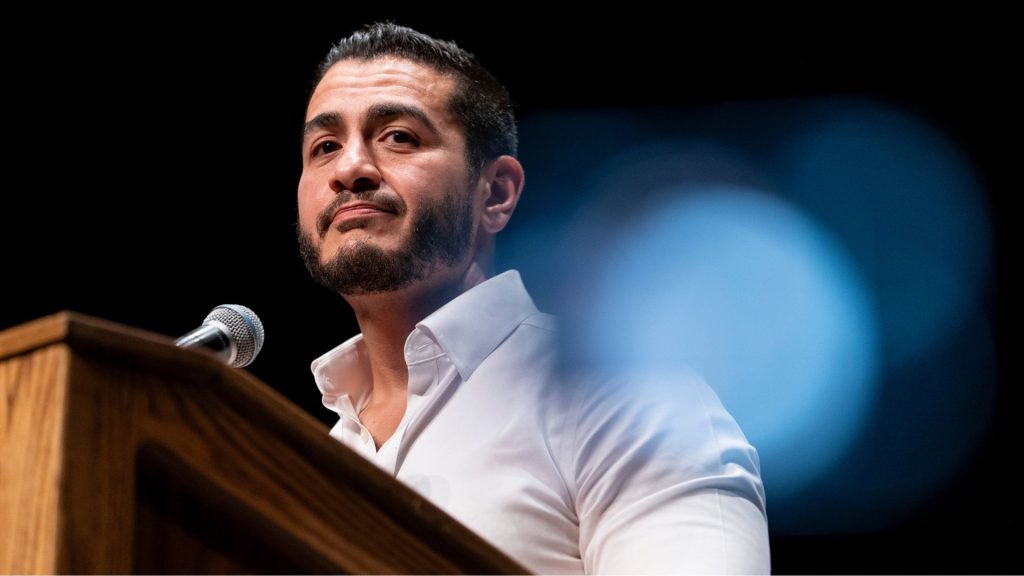
Michigan’s Democratic Senate primary between Rep. Haley Stevens and Abdul El-Sayed is one of the most closely watched races of the midterm, with Democrats viewing the seat as critical to retaking the Senate. Polling is mixed, with some showing Stevens with a seven-point lead, while others call it a statistical tie.
A new report from the Media Research Center, a conservative group that calls itself an “unrelenting counterforce to leftist bias in America’s newsrooms,” claims Apple News and Google News kept more than 100 critical stories about El-Sayed from right-leaning outlets, and another dozen from left-leaning ones, out of their top feeds. It’s MRC’s second such report this month. An earlier one made the same claim about Graham Platner, who withdrew his candidacy in early July after multiple women accused him of sexual assault. Google disputed that report’s methodology as flawed, a criticism it has since repeated to Straight Arrow about this report as well.
El-Sayed’s campaign hasn’t been without controversy of its own. He’s faced scrutiny over his use of the title “physician” despite never holding a medical license, his alliance with left-wing streamer Hasan Piker and a string of other flashpoints tied to his rhetoric on Israel and policing.
MRC isn’t alone in flagging aggregator bias. AllSides, a media bias tracker, found Google News curated 73% of its top articles from left-leaning outlets and just 1% from right-leaning ones in 2025, a share that’s climbed every year since 2022. That lends outside credibility to the general claim, but not to MRC’s more specific claim that Apple and Google actively shielded this candidate during a live election.
That leaves a real question: not whether aggregators lean left, but whether that changed what Michigan voters got to see about the candidate leading in the polls.
Who’s behind the report?
The MRC was founded in 1987 by L. Brent Bozell III to document liberal media bias and encourage more balanced reporting. InfluenceWatch, a project of the conservative-leaning Capital Research Center, and SourceWatch, run by the left-leaning Center for Media and Democracy, both independently describe MRC as a right-of-center or right-wing watchdog group.
MRC is now led by David Bozell, who succeeded his father after the elder Bozell stepped down to become U.S. Ambassador to South Africa in 2025. David Bozell also currently leads ForAmerica, a digital conservative advocacy group founded in 2010 by his father. The New York Times credited ForAmerica as “one of the great unexpected influences” of the 2016 election, which the group now features on its website.
MRC draws much of its funding from right-of-center and right-wing foundations, according to Influence Watch. Republican donor Robert Mercer has given the group at least $20.4 million since 2008 through his Mercer Family Foundation. While some online commentary following the report’s release has claimed MRC’s funding traces back to the American Israel Public Affairs Committee, Straight Arrow could not find any documented connection between the two groups.
What did the report find?
MRC found no negatively framed headlines about El-Sayed across Apple News and Google News’ top-20 morning feeds between November 2025 and July 21, identifying at least 104 critical stories from right-leaning outlets and 13 from left-leaning ones that neither aggregator surfaced. The group calls it a “news blackout” that coincided with a Feb. 10 poll showing the primary narrowing to a two-person race and said that pattern held as El-Sayed became the frontrunner.
MRC pointed to an Apple-promoted Detroit Free Press article on Michigan state Sen. Mallory McMorrow’s withdrawal from the Democratic primary as one example. The story referenced El-Sayed’s controversies in the body of the article but not the headline.
This isn’t MRC’s first report alleging aggregator bias. A February report claiming Apple News didn’t feature any right-leaning outlets among its top stories was shared by President Donald Trump and prompted a formal warning from the Federal Trade Commission to Apple CEO Tim Cook over possible ideological suppression of content.
In its latest report, MRC manually checked each aggregator’s top 20 stories each morning, then applied its own sentiment analysis to rate headlines. Dan Schneider, the group’s vice president of Free Speech America, defended the process.
“This is a valid and appropriate way to do a study,” Schneider told Straight Arrow. “If somebody’s going to get tested to see what their iron levels are in their body, they’re not on a continuous drift. They get tested, say once a week.”
He also confirmed that MRC didn’t contact Google or Apple before publishing, telling Straight Arrow that “Google stopped responding to us.”
Google disputes the findings outright.
“These claims are totally false and based on a completely flawed methodology,” a Google spokesperson told Straight Arrow. “The study checked Google News once a day from a single account, ignoring the fact that Google News automatically updates throughout the day, and shows news personalized to your interests and location.”
Neither MRC’s report nor Schneider’s interview shows Apple or Google specifically reviewed and declined any individual story, only that stories didn’t appear in MRC’s sample.
What is the controversy behind El-Sayed?
MRC claimed that news aggregators were shielding El-Sayed from two controversies they say he’s been embroiled in. The first deals with his self-proclaimed title as a physician.
Politico reported in May that El-Sayed repeatedly touted his credentials as a physician. The outlet pointed to two instances, including in an April interview and in comments to a group of Teamsters nurses in March, when he said he’d “been in enough codes to watch who really does the work.”
But that’s misleading. El-Sayed holds both an M.D. and a PhD but was never licensed to practice medicine in the two states he has worked in, Michigan and New York, Politico reported. Both states require a doctor to hold a medical license to practice in the state.
The other controversy MRC points to is his relationship with left-wing influencer Hasan Piker, whom they accuse of saying antisemitic and anti-American rhetoric. While MRC doesn’t state specific instances of Piker’s rhetoric, Rep. Mike Lawler, R-N.Y., along with Rep. Josh Gottheimer, D-N.J., formally condemned him in a bipartisan resolution.
“Piker has openly applauded Hamas’ terrorism, downplayed the mass rape of civilians on October 7th, and dehumanized Orthodox Jews as ‘inbred,’” Lawler wrote in April.
When asked in April if he would disavow Piker’s past statements, El-Sayed didn’t dispute the criticism of Piker directly. Instead, he defended his choice to campaign alongside him, calling the effort to hold him responsible for Piker’s views a “gotcha game,” Politico reported.
“I’m not here to disavow people’s views,” El-Sayed said. “This whole gotcha game, platform policing, cancel culture — I thought we were over it.”
Where does this leave readers?
What’s not in dispute is that El-Sayed has faced real, well-documented criticism from outlets across the political spectrum, from questions about his medical credentials to his continued alliance with Piker. That record exists whether MRC’s suppression claim holds up, and voters can weigh that claim on its own.
What remains contested is whether Apple News and Google News kept that criticism from voters specifically. MRC’s own testing offers a partial defense of its methodology. Schneider says researchers found no meaningful change checking the feeds at different times of day. But its choice to test from a single, fixed location doesn’t address Google’s core objection that results are personalized by user and geography, not uniform across the country.
Google, for its part, maintains its results are generated automatically by its systems rather than curated by editors, and that MRC’s analysis mistakes sheer volume of coverage for evidence of bias.
That leaves millions of Michigan voters, and millions more nationally, relying on two platforms whose curation choices remain genuinely disputed by the people who study them most closely. Outside research, including AllSides’ own aggregator audits, lends some independent support to the broader claim that these platforms skew left in what they surface. But no outside party has yet tested MRC’s central claim that Apple and Google suppressed negative coverage of this particular candidate in this particular race.
Round out your reading
- From Obama to Trump to Biden: When networks said ‘no’ to presidential speeches.
- ‘The end of American science as we know it.’ White House funding plan sparks alarm.
- AI data centers are popping up everywhere. What exactly do they do?
- The Trump administration is accused of breaking a law built to target the KKK.
- One Republican senator is dead, another is still alive. Both are the center of conspiracy theories.
Ella Rae Greene, Editor In Chief