How one small city built a second act as a bio hub inside empty cigarette factories
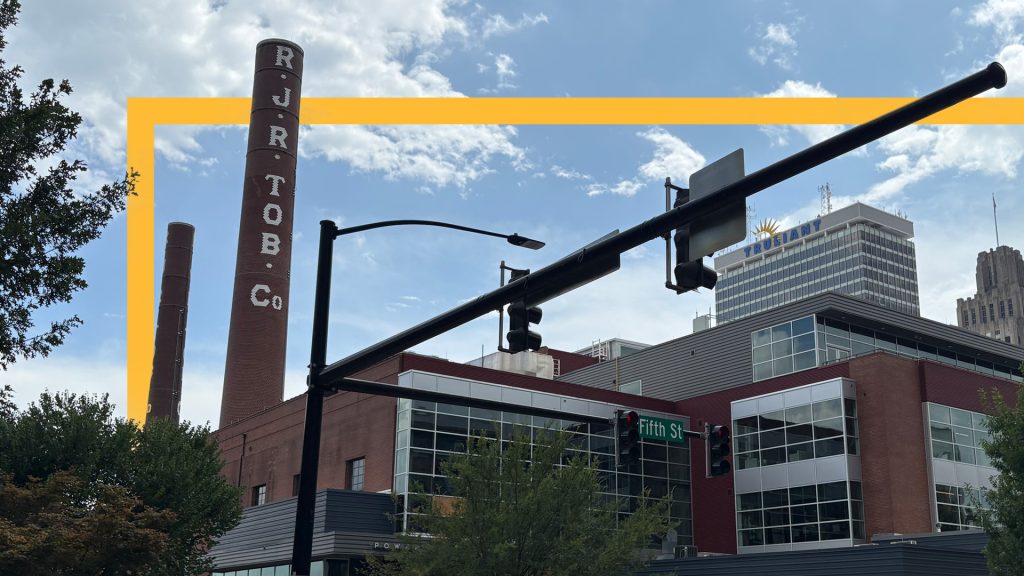
Winston-Salem Mayor Allen Joines once described the city’s downtown as a “war zone.”
In the early 1990s, Winston-Salem faced an identity crisis. When R.J. Reynolds, the tobacco giant that had defined the city for more than a century, shifted its manufacturing elsewhere, it left behind vacant factories, aging buildings and thousands of lost jobs. Large stretches of downtown sat empty. Homelessness grew rampant.
“There was concertina wire all around,” said Joines, those coiled rows of barbed wire often associated with prisons. “Water was dripping through” factory ceilings and bunkers peppered the streets.
Hundreds of acres “needed serious investment and attention,” said Ellis Keifer, vice president of economic development at the city’s chamber of commerce.
Three decades later, researchers in Winston-Salem are growing human bladders and heart valves using patients’ own cells.
READ MORE: Move fast and heal things? AI tests regulation and medicine’s cautious culture
The city has reemerged as one of the South’s leading biotechnology hubs, demonstrating how communities can repurpose infrastructure to attract new industries.
Unlike North Carolina’s nearby Research Triangle, which grew organically around major research universities, Winston-Salem’s success emerged from a deliberate effort to revive a struggling downtown.
But the transformation was neither quick nor easy.
“This transformation took decades, not just a handful of years,” Keifer said.

From tobacco town to blank slate
Winston-Salem was founded by Moravians, an early colonial religious group known for innovation and collaboration. Their early water system was so advanced for its time that George Washington reportedly had to see it in person during his presidency.
Keifer believes that spirit still endures:
“We’re a community of innovators and leaders and entrepreneurs,” she told Straight Arrow. While Winston-Salem’s transformation is often associated with the major institutions in the district, much of the work was carried out by people who saw what the vacant buildings and surrounding blocks could become, she said.
Part of the groundwork had already been laid. R.J. Reynolds sold a portion of its former downtown property to Wake Forest Baptist Medical Center (WFBMC) in the 1980s, now part of Advocate Health. Wake Forest School of Medicine was also interested in expanding its research footprint downtown, helping push forward what would eventually become the Innovation Quarter (iQ).
Still, transforming 300 acres of downtown required a monumental effort.
Joines, the former mayor, remembers touring one of the abandoned metal-and-brick structures, the former Bailey Power Plant, in the early 2000s, where three large turbine engines sat inside the wide interior that had once powered the complex.
“How in the world can this be made into anything?” he asked himself then.
He joined a group of community leaders who met with then-R.J. Reynolds CEO Andrew Schindler. Their plan: Ask the company to donate one of the buildings to WFBMC.
“I was a little nervous,” Joines said.
Schindler surprised them by offering all the land and buildings, plus $2 million in environmental abatement funds for remediation, repairs and cleanup, along with another $2 million in unrestricted funding to support the project.
“We said, ‘Oh, we weren’t quite prepared for that. But yes, we would like them all,'” Joines told Straight Arrow. “So sort of like the dog chasing the bus or the car, we caught it. Now what are we going to do?”
Quite a lot, it turns out.

Building an ecosystem, not just lab space
The unexpected donation multiplied what leaders believed possible.
In 2010, the city partnered with WFBMC and Wexford Science & Technology, a developer specializing in innovation districts. At least $89 million in federal and state historic rehabilitation tax credits helped finance the initial phase of development. The former tobacco and textile buildings were stripped down to their structural shells and rebuilt into modern research and office spaces. The work was massive, spanning new HVAC systems and window openings to asbestos and lead abatement, all with the goal of creating an ecosystem where startups, researchers, investors and entrepreneurs could work alongside one another.
By 2012, part of the district had become Biotech Place, the flagship building of the emerging iQ, where more than 450 scientists and researchers established labs.
“Thank goodness for smart people, innovative people, architects and engineers,” Joines said.
Joines estimates that roughly $900 million has flowed into the iQ and related development efforts, transforming former manufacturing facilities into research, office, residential and community spaces.
The initial $89 million of tax credits grew into a larger investment in the downtown’s revitalization. According to state preservation records, developers spent an estimated $394 million restoring three completed iQ projects, making them eligible for roughly $197 million in state and historic tax credits.
Additional state and local support also helped. North Carolina invested broadly in life sciences through organizations such as the North Carolina Biotechnology Center, while also establishing a 2% flat corporate income tax rate, the lowest top rate among states that levy the tax.
Local leaders at Greater Winston-Salem, Inc. (GWSI) created the BioNest Fund to support life science companies, such as last fall’s recipient, Ricoh 3D, now Myrava, Inc., which designs models that help surgeons prepare for surgery by providing patient-specific anatomy for procedural planning, study and patient education. There’s also the Winston-Salem Partners (WSPR), an investment capital group “supporting promising early-stage companies,” according to the iQ, and the Tech Talent Recruitment Fund.
But the “Innovation Quarter wasn’t just about creating lab space,” Keifer said. “It was about creating a thriving downtown that consequently attracts people and talent and investment.”
What was once an abandoned industrial district now includes restaurants, apartments and offices. A mishmash of students from Wake Forest, Winston-Salem State University and Salem College walk the streets, go to class and grab coffee near the redeveloped Bailey Power Plant, as scientists, entrepreneurs and business professionals stroll from work to dinner in the same space.
On one of the lots sits Bailey Park, an open green space where employees and residents lounge at lunch or gather for events. Residents stream in and out of the apartment buildings, which sit across from research companies and other businesses. The iQ was intentionally designed as a mixed-use district rather than an isolated office park.
Advocate Health, one of the nation’s largest health systems, also has roots in the city, to the benefit of businesses as well as residents. Isaac Perry, head of biotech and life science ecosystem development at the iQ, said the network gives researchers access to a massive patient population through a single institutional review board. This one-stop shop for the ethical review process required for human research makes it easier to run studies through a large patient network, allowing faster, cheaper studies.
“The way that we can leverage the ecosystem to reduce risk only helps increase those chances of success,” Perry said.

Why researchers are looking beyond traditional biotech hubs
One of the district’s biggest success stories helped draw international attention.
Dr. Tony Atala arrived from the Laboratory for Tissue Engineering and Cellular Therapeutics at Boston Children’s Hospital and Harvard Medical School in 2004 with a team of researchers and expanded what would become the Wake Forest Institute for Regenerative Medicine. His work developing tissues and organs from patients’ own cells brought researchers from dozens of countries, establishing Winston-Salem as a serious player in biotechnology and demonstrating that world-class medical research could thrive outside traditional hubs.
Employment in healthcare and social assistance in Forsyth County grew nearly 19% between 2013 and 2024, according to data from the iQ.
READ MORE: Affordability crisis becomes rare point of agreement in divided America
At the same time, Winston-Salem remains significantly more affordable than many established biotech centers. The city’s cost of living is roughly 10% below the national average, while costs in places such as Boston can run about 50% higher. Census data shows the median gross rent at $1,087 in Winston-Salem, compared with $2,147 in Boston, while median household income is $59,268 in Winston-Salem and $97,344 in Boston.
In other words, median gross rent is nearly twice as high in Boston, but median household income is only about 64% higher.
Eva Mueller traded in the large, established biotech hub of Toronto to move to Winston-Salem for an opportunity in healthcare research and development in 2023. The experience allowed her to expand her leadership skills while working with researchers focused on improving patient outcomes.
“I would not be where I am today without the incredible network I built in the Winston-Salem community,” said Mueller, who is now a senior manager of research and development at Myrava.
While she recently had to move back to Hamilton, about an hour’s drive from Toronto, to be with her husband and their families, she misses the city that helped her expand her career. And the cheaper apartment and groceries.
The area now hosts concerts, festivals and community events. Keifer said one of the clearest measures of success is the number of new residents coming to the city.
Population growth, private investment and migration patterns suggest the strategy is working. One notable source of incoming residents is the Boston-Cambridge region, one of the country’s most established biotech hubs.
Chris Ashmore, a real estate broker with experience in Carolina markets, said that kind of economic reinvention usually shows up later in the housing market as demand grows and higher-income workers move in.
“Winston-Salem is likely in the middle of that repricing right now,” Ashmore said.
While biotechnology sparked the transformation, Winston-Salem has also experienced growth in advanced manufacturing and aviation. Regional leaders helped recruit companies including Boom Supersonic and JetZero, while Piedmont Triad International Airport is undergoing a major expansion.
Today, the iQ is home to more than 150 companies, roughly a third of which operate in biotech, medtech or life sciences. Perry said the district is operating at roughly 90% to 95% capacity, with a second phase of development expected to add approximately 2.7 million square feet — more than doubling its current size of 2.1 million square feet.

Lessons for other cities
Winston-Salem’s transformation took decades, hundreds of millions of dollars and collaboration among public institutions, private investors and community leaders.
But the lesson is for mid-size cities everywhere.
Leaders spent decades creating partnerships among universities, government agencies, investors and private developers while building a downtown designed to attract talent.
For biotechnology companies, emerging markets like Winston-Salem can offer something difficult to find in traditional hubs: accessibility, room to grow and lower costs.
These communities do not have to become the next Boston to compete in biotech. Sometimes, they simply have to reimagine what already exists.
Round out your reading
- From Obama to Trump to Biden: When networks said ‘no’ to presidential speeches.
- ‘The end of American science as we know it.’ White House funding plan sparks alarm.
- AI data centers are popping up everywhere. What exactly do they do?
- The Trump administration is accused of breaking a law built to target the KKK.
- One Republican senator is dead, another is still alive. Both are the center of conspiracy theories.
Ella Rae Greene, Editor In Chief