Trump weighs ‘massive attack’ on Iran; Tariffs return after Supreme Court setback
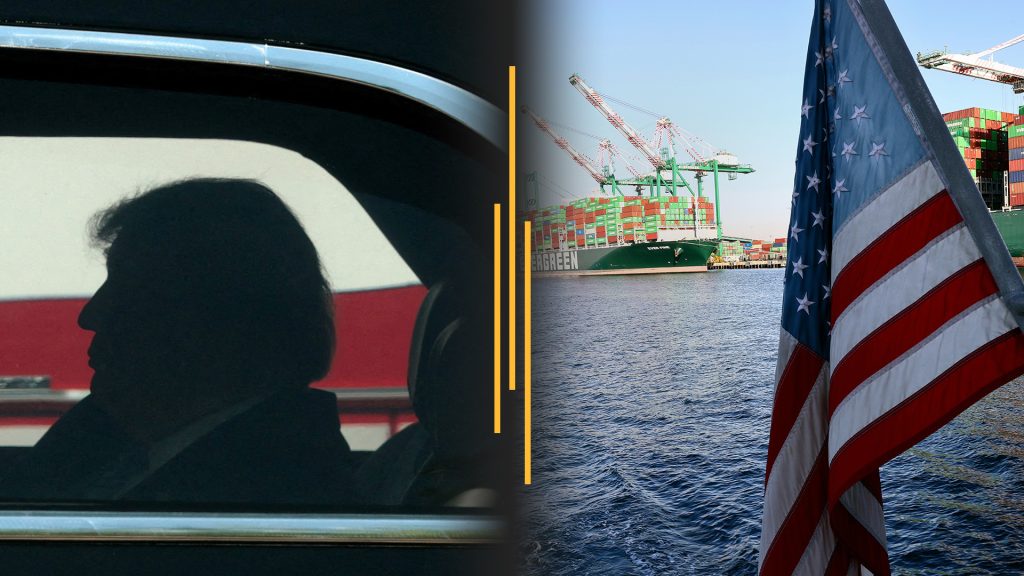
President Donald Trump says he’s close to deciding on a “massive attack” against Iran as the two sides exchange fresh strikes.
Plus, Trump’s tariffs are back, but under a different legal strategy after his first one failed in court.
And a deadly police shooting in Madison sparks protests and a state investigation. A tense showdown at a police briefing raises the stakes even further.
These stories and more highlight your Unbiased Updates for Friday, July 24, 2026.
Trump weighs ‘massive attack’ on Iran as countries continue to exchange strikes
President Donald Trump said he’s close to deciding whether to launch what he calls a “massive attack” on Iran as the two sides trade another round of strikes across the region.
Iran launched a wave of drone attacks targeting U.S. assets in Kuwait, Bahrain and Jordan after American forces carried out strikes against Iran for a 13th consecutive night.
Iranian state media said the overnight U.S. offensive killed at least four people and wounded several others in southern Iran.
U.S. Central Command said the latest strikes targeted Iranian drone sites, command centers and other military targets in an effort to further reduce the threat to commercial shipping in the Strait of Hormuz.
It comes after Trump told Axios he is “considering a massive attack” on Iran, is “close to making a decision” and that “they haven’t received enough pain yet.” Trump also said the U.S. will use Iranian funds in its possession to compensate ships or cargo damaged in Iranian attacks.
Meanwhile, Iran’s foreign minister warned any country that assists U.S. attacks could also become a target.
Trump issues new tariffs on 60 trade partners, ranging from 10% to 12.5%
A new round of Trump tariffs officially took effect overnight. The administration began imposing new import taxes of 10% to 12.5% on goods from 60 trading partners, replacing the temporary tariffs that expired at midnight.
The new levies target countries the administration says are not doing enough to keep goods made with forced labor out of global supply chains.
Trade representative Jamieson Greer said the goal is to pressure those countries to crack down on forced labor while protecting American workers.
In a statement, Greer said, “Today’s action will begin to correct what is both a human rights abuse and distortive trade practice to improve the welfare of workers everywhere.”

After the Supreme Court struck down his earlier tariff strategy, ruling he lacked the authority to impose broad import taxes under emergency powers, Trump is using a different section of federal trade law this time.
Hours before these new tariffs were announced Thursday, Justice Elena Kagan pointed to the court’s earlier tariff ruling as an example of the judiciary checking presidential power.
“You know, tariffs is probably the key policy issue for this president,” Kagan said. “I mean, something he campaigned on, he ran on, he cared an enormous amount about. I don’t think that there are all that many decisions in the recent, in recent times, where a court strikes down such an important policy to a sitting president.”
This latest round of tariffs uses a different trade law than the one the Supreme Court rejected earlier this year, setting up the next legal battle over Trump’s tariff strategy.
Police shooting in Madison sparks protests as state investigators review the deadly encounter
The mayor of Madison, Wisconsin, has urged calm after a deadly police shooting sparked protests and a state investigation.
Protests broke out after bystander video captured the fatal police shooting of 38-year-old Corey Ruiz during a confrontation with officers Wednesday. Ruiz has been identified as Hispanic or Latino in Wisconsin court records.

Police said he pulled a knife during a struggle with officers, injuring one of them before an officer opened fire. Officers responded after reports of a man trying to open the doors of parked cars.
On Thursday, about 20 protesters interrupted a police news conference, with one taking the microphone from Chief John Patterson and clashing with others who wanted to hear details about the investigation.
Madison Mayor Satya Rhodes-Conway said the shooting will receive a full, independent review.
“This is an incredibly difficult moment for the Madison community, and I understand the very strong emotions that people are feeling,” Conway said. “I am feeling them, too. As a city, as a community, as society, we have to do better. I want to be clear: it does not matter who you are or what your past is. You should not lose your life as a result of an encounter with law enforcement.”
The department has placed the four officers involved on administrative leave while the Wisconsin Department of Justice’s Division of Criminal Investigation leads the shooting investigation.
DOJ drops subpoenas against New York Times reporters
The Justice Department announced it’s dropping subpoenas seeking phone records and grand jury testimony from three New York Times journalists. The move comes after a federal judge sharply criticized the Trump administration’s approach to the case.
The subpoenas stemmed from The Times’ reporting on Trump’s Qatari-gifted Air Force One jet, including stories about its security features.

During a hearing Thursday, the judge said the government appeared to have ignored rules requiring subpoenas targeting journalists to be a last resort. He also cited what he called sloppy legal work, accusing federal attorneys of misleading the court in signed filings and said he would normally consider sanctions in a civil case.
The administration has also withdrawn similar subpoenas seeking testimony from Washington Post and Wall Street Journal reporters in separate national security leak investigations.
Floods sweep through West Virginia, more than 100 rescued as communities begin recovery
West Virginia has shifted from rescue to recovery Friday morning after days of devastating flash floods left at least two people dead, destroyed homes and forced more than 100 water rescues.
The rain has finally let up, but for many communities, the hardest part is just beginning.
A family in Buckhannon had just enough time to reach higher ground before floodwaters submerged their yard. Minutes later, they watched an entire house break free and float down the creek, along with an ATV and piles of debris.


Across northern West Virginia, streets turned into rivers. Cars, school buses and parking lots disappeared under muddy water as first responders used boats to rescue stranded residents.
Gov. Patrick Morrisey deployed 500 National Guard members. Rescuers have saved more than 100 people, and search crews continue searching for anyone who might still be missing. Officials said some communities received as much as 7 inches of rain, with nearly 4.5 inches falling in just 37 minutes. Wow.
The rain has eased, giving crews a chance to clear roads, assess the damage and begin what officials said will be a long recovery.
Spider-Man costume and all, good Samaritan saves the day
Sometimes a little help goes a long way. In Little Rock, Arkansas, a man in a wheelchair received help from an unexpected good Samaritan.
The man in a wheelchair was trying to cross six lanes of traffic at a red light, but wasn’t going to make it before the light changed.
That’s when Christopher Hellenthal sprang into action. He was sitting at the light in his Jeep, dressed as Spider-Man after attending a superhero-themed event.
He hopped out, ran into the intersection and gave the man a running push, helping him reach the other side before traffic started moving.
Hellenthal said he didn’t think twice. He just saw someone who needed help.
More from Straight Arrow:

How one small city built a second act as a bio hub inside empty cigarette factories
Winston-Salem Mayor Allen Joines once described the city’s downtown as a “war zone.”
In the early 1990s, Winston-Salem faced an identity crisis. When R.J. Reynolds, the tobacco giant that had defined the city for more than a century, shifted its manufacturing elsewhere, it left behind vacant factories, aging buildings and thousands of lost jobs. Large stretches of downtown sat empty. Homelessness grew rampant.
“There was concertina wire all around,” said Joines, those coiled rows of barbed wire often associated with prisons. “Water was dripping through” factory ceilings and bunkers peppered the streets.
Hundreds of acres “needed serious investment and attention,” said Ellis Keifer, vice president of economic development at the city’s chamber of commerce.
Three decades later, researchers in Winston-Salem are growing human bladders and heart valves using patients’ own cells.
Ella Rae Greene, Editor In Chief