US service member killed in northern Iraq, unidentified remains found in Jordan
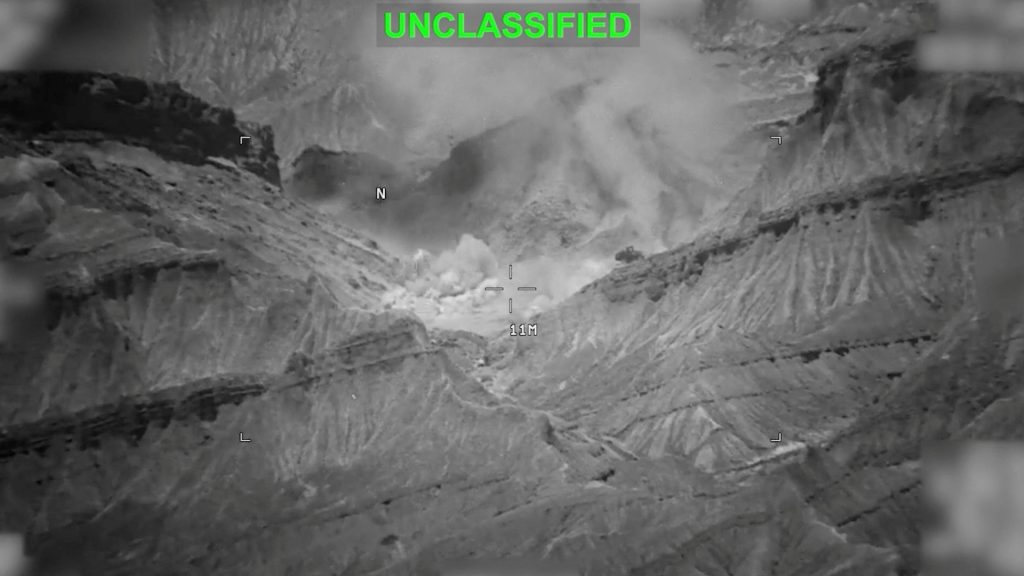
A U.S. service member was killed in northern Iraq Saturday “during a controlled detonation of unexploded ordnance from a downed Iranian one-way attack drone,” U.S. Central Command said.
A second service member was injured and is receiving medical treatment, CENTCOM said Sunday.
This comes after an attack by Tehran that killed two U.S. service members in Jordan on Friday. CENTCOM said Sunday that after a “thorough search,” U.S. military personnel found unidentified remains at the location of the attack.
“An examination process to verify the remains is ongoing,” CENTCOM said.
Later on Sunday, CENTCOM said it started conducting a ninth consecutive wave of strikes against Iran at 7 p.m. ET.
The night before, U.S. Central Command launched an eighth round of strikes following the attacks in Jordan.
These strikes, which ended at 11:30 p.m. ET Saturday, hit “Iranian military coastal surveillance and air defense facilities, maritime capabilities and missile and drone storage sites,” U.S. Central Command said.
In addition, U.S. troops also targeted Islamic Revolutionary Guard Corps that conducted attacks on a U.S. military base at Al Azraq, CENTCOM said. Along with the two who died, one person is missing after that attack. Four other American service members were taken to Jordanian hospitals and later discharged. U.S. officials have not yet named those killed in the attack.
Iran’s Atomic Energy Organization said U.S. forces hit a nuclear power plant site in Darkhovin, Iran, which is still under construction.
“This aggression will only strengthen the resolve of Iran’s nuclear industry experts to continue the path of advancement,” the organization said.
The International Atomic Energy Agency said it’s looking into reports about an overnight attack on the planned nuclear plant.
“The facility is in the very early stages of construction and contained no nuclear material when last visited by the IAEA,” the agency said.
Even though the attack is not believed to pose a radiological risk, the IAEA said Director General Rafael Mariano Grossi still “reiterates call for military restraint in the vicinity of all nuclear-related sites.”
Iran, meanwhile, conducted drone strikes against two U.S. military facilities in Kuwait, semi-official Tasnim News Agency reported Sunday. These strikes targeted ammunition depots, radar systems and logistics infrastructure, the Iranian Army said, in response to “repeated U.S. aggression against Iran,” the killing of Iranian civilians and attacks on bridges, infrastructure, and non-military areas.
The Kuwait Foreign Ministry condemned the attacks, which they said struck a power generation and water desalination station, facilities affiliated with the oil sector, and a number of vital installations. This caused fires to break out, as well as severe damage to the installations, civilian facilities, and residential buildings, Kuwait’s Foreign Ministry said.
This marks the second time in as many days that a water desalination station in Kuwait was hit by Iran. A majority, or about 90%, of Kuwait’s drinking water comes from desalination.
Jordan’s military also reported shooting down Iranian missiles, though these did not cause casualties or damage, according to The Associated Press.
Experts have said both the U.S. and Iran could be guilty of war crimes for their attacks on civilian infrastructure, including bridges and power plants. Both sides have also accused the other of violating a memorandum of understanding agreed to in June, which included the opening of the Strait of Hormuz and a temporary ceasefire.
Following a week of strikes exchanged between the two countries, though, Iran Deputy Foreign Minister Kazem Gharibabadi said Saturday that the country is suspending its commitments under the memorandum.
When asked by a NewsNation correspondent for a response to this, U.S. President Donald Trump replied: “I couldn’t care less.”
At least 50 people have been killed and 517 wounded in recent U.S. strikes, Iranian authorities quoted by the AP said, while 17 U.S. service members have been killed, and more than 430 injured, since Feb. 28, when the war began.
Rubio meets with Lebanese president
On Sunday, U.S. Secretary of State Marco Rubio met with Lebanese President Joseph Aoun. State Department spokesperson Tommy Pigott said the two talked about the implementation of the Trilateral Framework between Israel and Lebanon.
“The Secretary reaffirmed the commitment of the United States to supporting the successful implementation of the Trilateral Framework and to backing the Government of Lebanon’s efforts to deliver peace, economic recovery, and a better future for the Lebanese people,” Pigott said.
In his own statement, Aoun stressed the importance of implementing the framework, “beginning with securing the first Israeli withdrawal from the first model area,” CNN reported.
The terms of the trilateral framework include Israel withdrawing forces from two areas in southern Lebanon, as well as the disarmament of Hezbollah.
Round out your reading
- From Obama to Trump to Biden: When networks said ‘no’ to presidential speeches.
- ‘The end of American science as we know it.’ White House funding plan sparks alarm.
- AI data centers are popping up everywhere. What exactly do they do?
- The Trump administration is accused of breaking a law built to target the KKK.
- One Republican senator is dead, another is still alive. Both are the center of conspiracy theories.
Ella Rae Greene, Editor In Chief