Which social media platforms act as ‘superspreaders’ of hate speech?
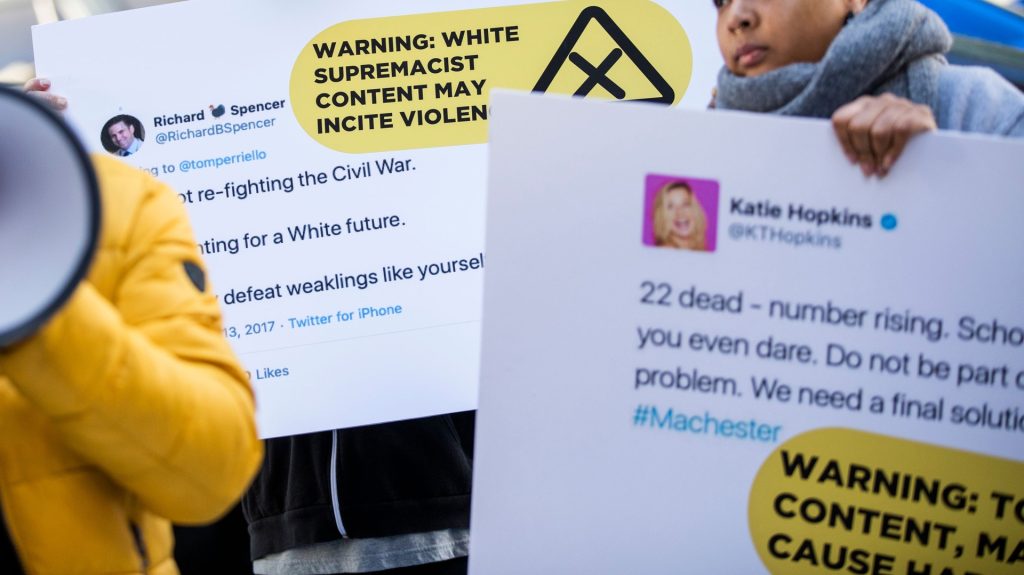
In the battle against extreme and hateful content, TikTok stands out as the most likely to take down top offenders, according to a report published this week by the Global Project Against Hate and Extremism.
The organization found last month that white supremacist accounts were increasingly spreading on TikTok, YouTube and Instagram. This week, the organization documented the platforms’ different responses to flagged content: TikTok had deplatformed some accounts, while YouTube and Instagram remained “superspreaders.”
“TikTok deplatformed 21 of 82 accounts; 13 out of 201 Instagram accounts became inaccessible; and three of 29 YouTube accounts disappeared,” the follow-up report said.
The accounts were linked to an extremist political movement called “Identitarianism” — a white nationalist ideology that suggests white people are being deliberately replaced across Europe. This is also known as the “Great Replacement” theory, and it has been linked to terror attacks in the U.S. and internationally.
“This is an extremely dangerous conspiracy theory, because it’s behind many mass shootings,” Heidi Beirich, co-founder of GPAHE, told Straight Arrow. “So you would think that this would be something that, because of the connection to violence and racism, that the platforms would de-platform under their terms of service.”
But, she said, mainstream platforms have become lax about enforcement.
Identitarianism has a growing influence online. According to GPAHE, the movement has increased its online presence by 70% — more than 3 million followers — in the last three years. They also found an additional 464 social media accounts across all platforms, with more than 11 million followers, in their most recent investigation.
“This rapid growth was enabled by social media platforms’ weakening of content moderation practices, largely an effort to appease the Trump administration,” the report said.
Beirich has certainly noticed a change over time.
“When we surfaced these kinds of accounts in 2020 to Twitter, back then, they de-platformed all of them,” she told Straight Arrow.
Hate speech detection online is an open challenge for AI models, which cannot always detect when words are being used in a hateful context.
What are the platforms’ policies?
The platforms involved have different policies that may explain their varying levels of responsiveness.
Meta changed its “hate speech” policy to a “hateful conduct” policy on Jan. 7, 2025.
It also removed several lines from the policy, including that hate speech “creates an environment of intimidation and exclusion, and in some cases may promote offline violence”, and also removed a previous policy against “statements of inferiority, expressions of contempt or disgust; cursing; and calls for exclusion or segregation.”


YouTube, which removed the fewest accounts, has a policy that specifically prohibits hate speech: “Hate speech is not allowed on YouTube. We don’t allow content that promotes violence or hatred against individuals or groups based on any of the following attributes, which indicate a protected group status under YouTube’s policy.”
Those categories include “caste, ethnicity or race,” immigration status, nationality and religion.
A spokesperson for YouTube responded to Straight Arrow’s request for comment and said they would take a closer look at the list of flagged accounts. “We are reviewing the examples raised in the study and will remove any content that violates our policies,” they said.
Beirich said that YouTube has tended to be the slowest to remove hateful content, in her experience.
“They have been reluctant going all the way back to 2020,” she told Straight Arrow. “They have at times, put disclaimers up” about white supremacist or conspiracist content. But, she added, YouTube has also monetized Identitarian content in the past.
TikTok’s policy tackles both hate speech and hateful behavior: “We do not allow hate speech and hateful ideologies, and will not recommend content that contains negative stereotypes about a person or group with a protected attribute. We use a combination of technology and human moderators to detect and remove accounts and content that break our rules.”
A ‘tragic situation’
Having a policy is not enough, according to GAPHE.
“The deplatforming of some Identitarian accounts is a positive step in curtailing the virality of ethnic cleansing calls,” the organization said. But it called for social media companies to do a better job of consistently and uniformly enforcing their terms of service.
“I just think it’s a tragic situation,” Beirich told Straight Arrow. “This is terrorist-inspiring content, which could be running rampant on these platforms, and have millions of viewers.”
Round out your reading
- With more prison space than prisoners, correctional facilities are shutting down.
- ‘Game changer’: New cancer treatment turns major surgery into an outpatient procedure.
- Viewers overwhelmingly support ‘The View’s’ fight against the FCC. Will that matter?
- Why an ICE shooting in Houston isn’t leading to mass protests.
- Milwaukee detective is the latest officer charged with misusing Flock cameras.
Ella Rae Greene, Editor In Chief