
The National Guard’s deployment in DC will continue until 2029, Pentagon says
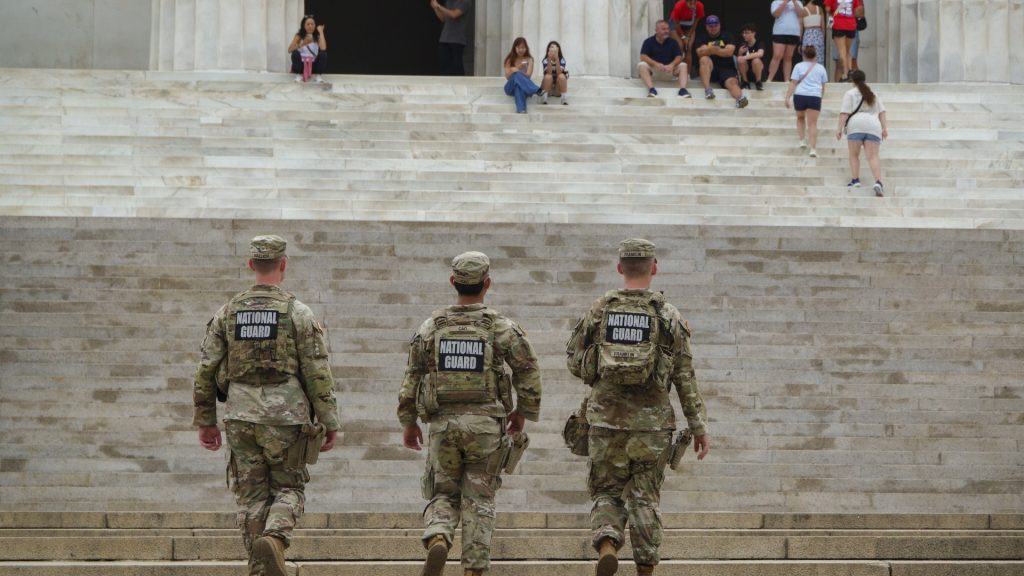
President Donald Trump’s deployment of the National Guard to Washington, D.C. will continue through Jan. 20, 2029, “or until terminated by the President,” a Pentagon official confirmed to Straight Arrow in an email Friday.
Trump first sent the National Guard to D.C. under an executive order in which he declared a “crime emergency” in the city.
But the choice to extend the National Guard’s presence in D.C. three years in the future shows that there isn’t an emergency, Alicia Yass, the policy advocacy director at the ACLU-D.C., said.
“You could not predict an emergency that far out. An emergency, by its nature, needs to be taken day by day,” Yass said in an interview with Straight Arrow.
What data analysis shows
Recent reports that came out this summer found that the National Guard being in D.C. and other cities did not have an impact on violent crime.
“Despite multiple tests using multiple data sources, measures, and windows of time, there is no compelling evidence that these deployments reduced homicides, violent crime, or gun violence,” the left-leaning Center for American Progress said in a July report.
White House spokesperson Abigail Jackson called the report “partisan hackery” in a statement to NPR.
The nonpartisan Niskanen Center, though, also had a similar finding. Although the National Guard deployment reduced crime by 24%, they wrote, this was concentrated almost entirely in “opportunistic property crimes.”
“What the Guard brought was a massive, sudden shock from the visible presence of uniformed military personnel on the streets of Washington almost overnight,” authors of the Niskanen Center’s report wrote. “For crimes driven by opportunistic calculation, that visibility appears to have mattered. For violent crime, which is less deterrable by patrol presence alone, it did not.”
The Guard’s deployment was, and remains, “a blunt and expensive instrument,” the Niskanen Center said. It argues that their cost-benefit analysis demonstrates that “a targeted, data-driven policing strategy optimized on where and when crime actually occurs” would get better results than the National Guard presence at “a fraction of the cost.”
Yass told Straight Arrow the federal government wants the military in D.C. as a show of force and power.
“The National Guard is not trained on local criminal law. They’re not trained on the skills and tactics that police officers are, such as de-escalation, community policing,” Yass said.
Since the National Guard was deployed around one year ago, she said, “the residents of D.C. have lived with a military occupation.”
National Guard members, Yass said, are not just at federal buildings. They are also outside homes, outside schools, and businesses — “making us feel like we’re living in a war zone,” she said.
A Straight Arrow reporter who spoke to residents when the National Guard was first deployed to D.C. got mixed responses about Trump’s actions and the state of crime and safety in the district. While some said there needed to be more pressure put on the issue, and officials needed to be stricter on crime, they also said the federal government should have worked more closely with their local counterparts to come up with a solution.
The choice to send the National Guard to the nation’s capital has been criticized by local officials, who said crime was already falling in D.C. and other cities where the soldiers were deployed by the Trump administration.
At the time Trump called in the Guard in August 2025, he cited data showing D.C. had 1,600 violent crimes committed year-to-date and the district’s murder rate, which was at 27.3 per 100,000 residents, was the fourth highest in the country. That said, it was decreasing from records set during the pandemic.
“Taxpayers are paying more than a million dollars a day to have them walk around,” Phil Mendelson, chairman of the District of Columbia Council, said in April about The Guard, according to The Associated Press. He added that “the presence of armed soldiers on American streets is not a good look.”
The Center for American Progress, in its report, said that if current National Guard deployments go through the end of 2026, they could cost American taxpayers more than $1.7 billion. That’s similar to findings by the Congressional Budget Office, which put the number at $1.1 billion.
NPR reported that the independent nonpartisan watchdog group Project on Government Oversight estimates the D.C. deployment, with the 2029 extension, will cost somewhere between $2.5 billion and $3.4 billion.
This depends on how many troops stay in the city, but Virginia Burger, senior defense policy analyst for the Project on Government Oversight, told NPR she sees “no indications that they are going to draw down at the end of this summer.”
Trump removed National Guard troops from California, Illinois and Oregon after legal challenges.
While other places were more successful at pushing back against the deployment, D.C. is in a unique position because it does not have statehood,, Yass said. D.C. is a federal district established by Congress.
“We don’t even have control of our own National Guard,” Yass said. “The D.C. National Guard, which is members of the National Guard who are residents of D.C., they do not report to the mayor or the council. They report directly to the president, and he has control over the D.C. National Guard.”
Although other cities might not have as much as a National Guard presence, Yass said they still have reason to be concerned about what’s happening in D.C.
“This is our country’s capital,” Yass said. “The city, in many ways, belongs to everybody, not just the residents of D.C.”
These residents, Yass continued, pride themselves on being welcoming to tourists.
“Welcoming them means smiling, giving them directions, helping them,” she said. “It does not mean having an armed military presence when you arrive in the city, and so all Americans should be concerned that that is happening here in our nation’s capital.”
Round out your reading
- With more prison space than prisoners, correctional facilities are shutting down.
- ‘Game changer’: New cancer treatment turns major surgery into an outpatient procedure.
- Viewers overwhelmingly support ‘The View’s’ fight against the FCC. Will that matter?
- Why an ICE shooting in Houston isn’t leading to mass protests.
- Milwaukee detective is the latest officer charged with misusing Flock cameras.
Ella Rae Greene, Editor In Chief