Why the tick population is increasing — and diseases are spreading — in different areas
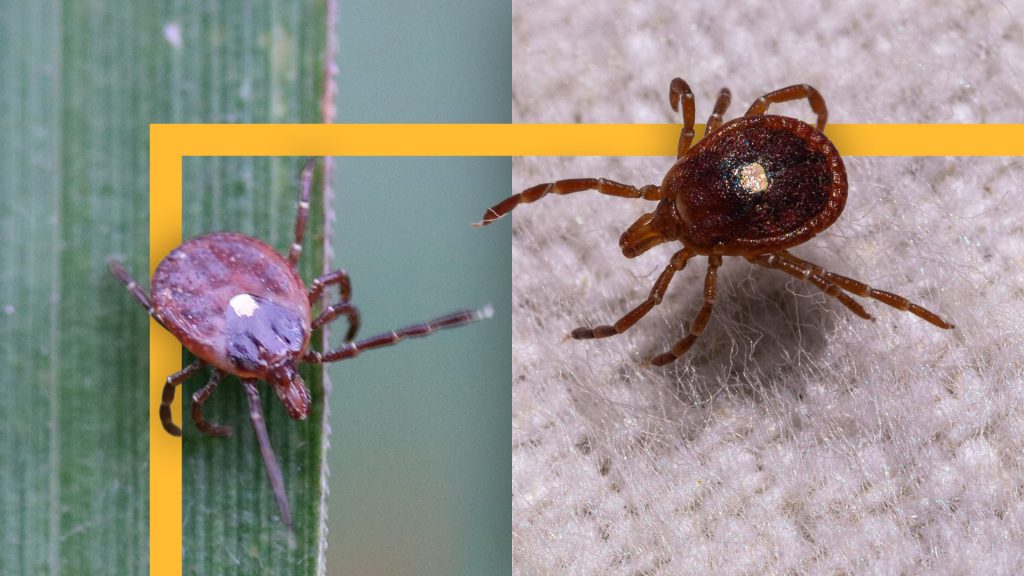
Emergency room visits for tick bites hit their highest levels since 2017 earlier this season, likely driven by an “out of the ballpark” surge in Lone Star ticks that can trigger a permanent allergy to red meat.
The U.S. is home to three main species that humans encounter: American dog ticks; black-legged, or deer, ticks; and Lone Star ticks. Each carries different health risks, so warnings in one corner of the continent may not apply to Americans elsewhere.
“Different ticks occur in different places, and they’re not going to be bad everywhere,” Thomas Mather, a professor and director of the University of Rhode Island’s Center for Vector-Borne Diseases, told Straight Arrow.
For instance, black-legged ticks are responsible for the germ that causes Lyme disease, babesiosis, anaplasmosis, relapsing fever and Powassan virus. Each one of those has a different level of risk, though, Mather said. While Lyme disease is very prevalent in blacklegged ticks, Powassan virus is rare in them — though cases are still rising.
Lone Star ticks, meanwhile, are responsible for alpha gal syndrome.
The Centers for Disease Control and Prevention tracks bites that lead to Emergency Room visits. In April, weekly rates of ER visits for tick bites were the highest since 2017, accounting for 105 of every 100,000 ER visits. By July, the number had fallen to 88 out of 100,000 visits.
But this tool doesn’t distinguish the kinds of ticks that are biting.
The Center for Vector-Borne Diseases found that, based on a 10-year average of reports of tick encounters and tick spotters, that black-legged and American dog ticks are running just about average, or even a little under average, while Lone Star ticks are running well above average, Mather said.
“The risk for Rocky Mountain Spotted Fever that the American dog ticks transmit is probably just about average, but the risk for encountering Lone Star ticks that might stimulate this alpha gal syndrome allergy could be higher because it’s really out of the ballpark high this year on Lone Star ticks,” Mather said.
Why are there more ticks?
Several factors explain why certain tick populations are increasing.
Dr. Paul Auwaerter, a professor of medicine at the Johns Hopkins University School of Medicine, said warmer winters have led to longer tick seasons.
“We have shorter winters, warmer, we’re outdoors more, you have more exposure, so it’s obviously a pretty dynamic and complex interplay between us, the ticks, weather and ecological environments,” Auwaerter told Straight Arrow.
With a denser population, more Lone Star ticks will be in places with more people, leading to more encounters, Mather said.
An expanding geography of ticks that carry these pathogens, as well as changing ecological systems, plays a part as well.
Lone Star ticks have been moving northward for a while, Mather said. About 15 years ago, they took over Long Island, he said. Ten years ago, they came to Rhode Island and southeastern Massachusetts.
“Some of our most highly infested places, places like Martha’s Vineyard in Massachusetts and in Rhode Island, some of our coastal islands are also that way — these ticks seem to be thriving in those kinds of settings,” Mather said.
Some of this can be explained by climate change, but even that is complicated, said Jean Tsao, a professor of Large Animal Clinical Sciences at Michigan State University.
“The black-legged tick, the northern tick that causes Lyme disease — it’s moving south, so that’s not due to warming climates, right? But it is also moving into Canada,” she told Straight Arrow. “It’s been in Canada, but further north, so further north in Canada it probably is a bit due to climate change, because you need a long enough summer for the life stages to be able to find a host and then get the whole blood meal and then molt to the next stage.”
Ticks don’t typically move on their own — instead, they are transported on the backs of deer or birds. Tsao compared this to a “baton for relays.”
“Ticks in one area will feed on hosts,” she said. “As those hosts expand in their range, they can then introduce the ticks to the next neighboring area.”
After deer were hunted nearly to extinction, people began managing deer populations through forest management and creating habitats that support deer.
“There’s more forests, there’s greater deer populations, so a lot of the ecology has changed over the last 30, 40, 50 years, that favors the increased number of rodent populations, deer populations,” Auwaerter said.
Tsao said the black-legged tick is a generalist parasite.
“It can feed on so many different hosts, and that helps it as a species that’s going to be invading new areas now,” Tsao said. “The Lone Star tick doesn’t have as huge of a range of hosts it can be on, but it’s pretty wide, and the thing is, all the life stages feed on deer, so as long as you have deer, all the life stages feed on them.”
Now, Lyme Disease is moving into new areas.
“I could tell you 20, 25 years ago, we rarely saw Lyme disease in Virginia, the upper Midwest, in Ohio, northern Indiana, and now those are really areas where we see it quite frequently,” Auwaerter told Straight Arrow.
People also increasingly report that they have alpha gal syndrome.
“They’re reporting it, of course, in areas where this Lone Star tick has been found, and now it’s being found in more places than it was, even 10 years ago,” Mather said.
Around 476,000 people may be diagnosed and treated for Lyme disease each year in the United States, according to the CDC, which notes that the number could include people who are treated for it based on “clinical suspicion” but do not actually have it.
A vaccine is not currently available — but a clinical trial for one in development, which Auwaerter was one of the investigators for, showed more than 70% efficacy in preventing it in people who are 5 or older.
However, until a vaccine hits the market, much will depend on geography.
In Illinois, an analysis of state health department data showed that more than 6,400 residents were diagnosed with tickborne diseases between 2004 and 2022.
“My big takeaway for the public is that we see tickborne diseases 12 months out of the year and in every county in the state of Illinois,” Becky Smith, an epidemiologist and professor of pathobiology at the University of Illinois Urbana-Champaign who led the research, said in a statement. “We have different tickborne diseases in different places and different risks in different places, but every county, every month, there is a risk.”
Round out your reading
- With more prison space than prisoners, correctional facilities are shutting down.
- ‘Game changer’: New cancer treatment turns major surgery into an outpatient procedure.
- Viewers overwhelmingly support ‘The View’s’ fight against the FCC. Will that matter?
- Why an ICE shooting in Houston isn’t leading to mass protests.
- Milwaukee detective is the latest officer charged with misusing Flock cameras.
Ella Rae Greene, Editor In Chief