Populists on the left and right see AI as a threat. The middle isn’t sure yet.
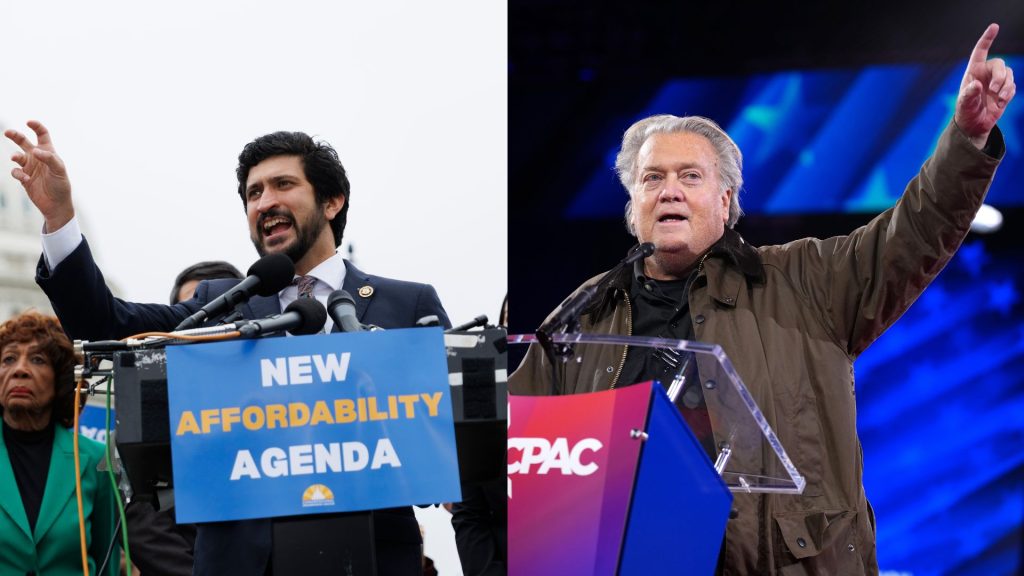
Rep. Greg Casar, D-Texas, is chair of the Congressional Progressive Caucus and is pushing a “New Affordability Agenda” that addresses issues from oil prices to corporate influence on elections.
Steve Bannon is a former strategist for President Donald Trump and a proponent of “economic nationalism” who wants to limit the power of global corporations over working-class Americans.
One personifies the populist left; the other, the populist right.
But they share a core belief — that the federal government needs to regulate artificial intelligence to address concerns about data centers, job displacement and wealth disparity.
Those concerns are shared by voters across the political spectrum, according to a recent Quinnipiac University poll that found 74% of Americans don’t believe the government is doing enough to regulate AI.
The question is why most of Washington doesn’t seem to agree and whether that’s about to change.
What’s Casar’s approach to AI?
Casar wants to ban “surveillance pricing,” the practice of using AI to set individualized prices based on personal data. More broadly, he wants to show voters that progressive Democrats “have a plan to stop their lives from getting significantly worse through unregulated AI development,” he told Politico.
“Look, I smell blood in the water,” Casar said of the political moment, describing the rising public anger over corporate price gouging as an opening Democrats can’t afford to waste.
His Stop AI Price Gouging and Wage Fixing Act would bar companies from using automated systems to set individualized prices or wages based on people’s personal data. Casar told NBC News in 2025 that Delta Air Lines is already using this technology. The airline later disputed the claim that it uses personal data to set prices.
Casar’s plan also targets the influence he believes is distorting the whole debate — money. His agenda calls for abolishing super PACs, which are political action committees that can raise unlimited funds for politicians. Politico reported that a new pro-AI super PAC, Leading the Future, spent roughly $8 million trying to defeat AI-safety advocate Alex Bores in a congressional primary in New York and that it was one of several PACs funded by the AI industry that have poured tens of millions into the midterms.
“I know for a fact that there’s a lot of consultants telling their clients that you don’t want an AI super PAC to spend millions against you, so just don’t touch the issue at all,” Casar told Politico. “We absolutely cannot let the AI money silence us.”
What’s Bannon’s approach to AI?
On the opposite side is Bannon, whose approach runs through the executive branch rather than Congress. Bannon has taken to describing Silicon Valley’s influence on Trump in military terms. He said tech “broligarchs” have positioned themselves at the White House “like they’re on display, like on the deck of the battleship Missouri” during Trump’s last inauguration. He described Trump as the general accepting a surrender, except that, in Bannon’s telling, the surrender hasn’t actually happened.
“They’re inside the wire,” he told The New York Times in 2025.
In May, Straight Arrow reported that Bannon joined more than 60 Trump allies in a letter organized by the conservative group Humans First, urging the president to regulate AI. The group pushed the president to require mandatory testing, evaluation, vetting and government approval of the most powerful AI systems before they’re released.
Bannon told Axios after the group released the letter that he’s been warning people in Trump’s circle that AI could lead to job loss.
“This letter takes us next level,” Bannon told Axios. “The letter lays out [that] we must have mandatory testing and government approval.”
The contrast between Casar and Bannon shows differing theories for addressing the same issue.
Casar wants to break up concentrated power by legislating limits on it and funding regulators to enforce them. Bannon wants to concentrate power differently, working through a president rather than a party platform, to wield it directly against the tech industry. While both identify the lack of AI regulation as an issue, they don’t agree on who should hold the leverage to change it.
Other AI proposals
Like Casar, Sens. Ted Cruz, R-Texas, and Mark Warner, D-Va., are trying to legislate, too, but without the campaign urgency.
Neither is treating AI as a midterm rallying cry the way Casar is, or warning of a small class of tech elites the way Bannon does when he talks about “broligarchs.”
Cruz’s approach centers on keeping the federal government’s hand light and keeping states entirely out of the way. His SANDBOX Act would let AI companies apply for waivers from existing federal regulations. Cruz argues this would allow the companies to test new products without running into rules written before the technology existed. He’s paired that with a broader push to preempt state-level AI laws altogether, arguing that a patchwork of 50 different state regimes could strangle innovation before it can compete globally.
His preemption push didn’t go far last year after senators stripped it from a larger bill on a 99-1 vote. Cruz said he isn’t done.
“I still think we’ll get there and I’m working closely with the White House,” he told Axios. “Whichever nation wins the race for AI, the values of that nation will dominate AI.”
In late June, Warner released a discussion draft of the AI AGENT Act, his first legislative attempt to regulate agentic AI. These are AI systems that don’t just answer questions but also act on a user’s behalf. The bill would require large platforms to allow users to bring independent AI agents of their choosing and impose real legal obligations on those agents, such as safeguarding users’ data.
It’s real regulation that would be enforced by the Federal Trade Commission — just built on a different theory than Casar’s. While Casar wants to ban specific practices outright, Warner wants to embed consumer protections into the architecture of AI systems, drawing on many of the same interoperability principles from a social media bill he introduced in 2019.
What happens next?
Casar is betting Democrats can win by running at AI companies. Bannon is betting Republicans can do the same through the president.
Cruz is betting the backlash burns out first. Warner is betting he can regulate his way to the middle before either flank forces his hand.
This November may be the first real test of who’s right.
Round out your reading
- With more prison space than prisoners, correctional facilities are shutting down.
- ‘Game changer’: New cancer treatment turns major surgery into an outpatient procedure.
- Viewers overwhelmingly support ‘The View’s’ fight against the FCC. Will that matter?
- Why an ICE shooting in Houston isn’t leading to mass protests.
- Milwaukee detective is the latest officer charged with misusing Flock cameras.
Ella Rae Greene, Editor In Chief