When clickbait looks like the news: How ‘Angry Farage’ spread on British X
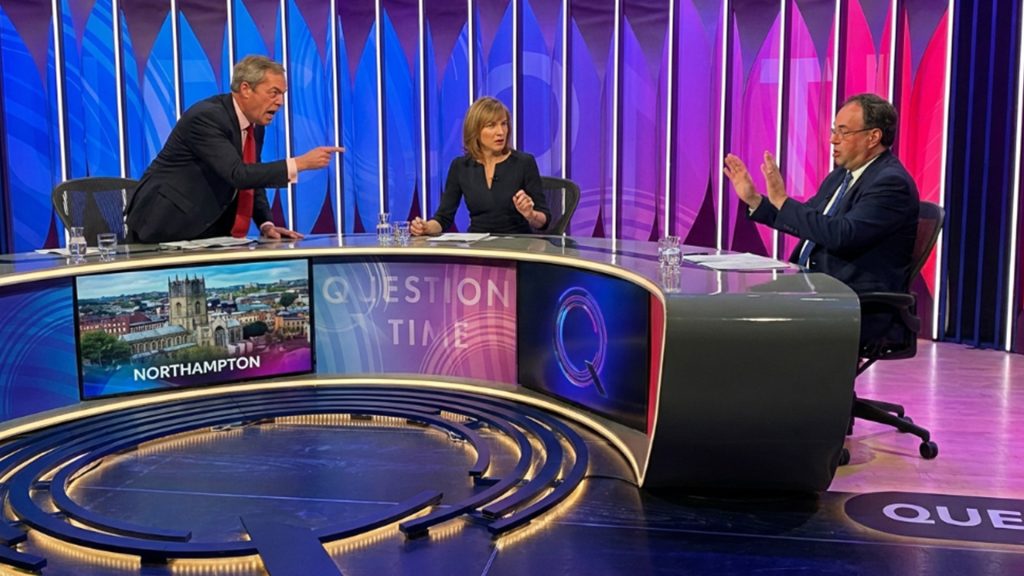
Over the past several months, social media users in the U.K. have been inundated with unusual AI-generated images, including several of a British politician in a fight with the governor of the Bank of England. The strange images have spread widely and are linked to a scam involving a fake AI investment platform.
Throughout May and June, users on X were shown “non-stop” paid posts in which Nigel Farage, leader of the far-right political party Reform UK, kicked, pushed or otherwise grappled with Andrew Bailey, who heads the Bank of England. The scene played out against a backdrop of the popular news panel show “Question Time.” The comments above the ads are often ambiguous: “What’s happened?” one asked.
Social media users have questions of their own.
“Why do I keep getting fake ads of Nigel Farage booting a guy on Question Time?!” X user @graceyldn asked on June 9th.
The Guardian reported that the Bank of England had responded to the initial wave of videos by warning of the proliferation of AI scams. Farage contacted X “at the highest level” over the ads, according to the BBC. On X, he wrote, “Whilst Andrew Bailey and I have our disagreements, I would never take it that far!”


Yet the trend persisted.
The sponsored posts linked to scam versions of the BBC’s news website, with fake stories about Farage yelling at the hosts of the panel show and at Bailey, about how a new, secret, AI-enabled investment platform would be good for working families.
Last week, users found more ads that featured Emily Maitliss, a former BBC presenter. An example of one of the linked scam posts headlines: “‘You earn in a week what she earns in three years’: How Emily Maitlis exposed Britain’s banking elite on live radio — before the NatWest CEO walked out.”
That never actually happened.

Screenshot/ Fake Site

What is the purpose of these images?
The pictures are deepfake clickbait, according to Sohan Dsouza, a technology and open-source intelligence investigator. Dsouza told Straight Arrow the images were posted by “referral farmers” — people who make money baiting folks to click on links with ads or spam. Dsouza has been tracking this phenomenon since 2023, when he found examples of a similar scam featuring Elon Musk.
Clicking on the ad images often leads to more similar posts, some of which feature a “play” logo that makes a static image look like a video. Those images then lead to a fake version of the BBC website, promoting an “AI investment” or automated trading platform called Garlenix.
The images are “an attempt to lure you on to a fake page,” where they might steal a user’s money, Dsouza said.
These kinds of pages could confuse users in several ways. The presence of the BBC logo gives the images a legitimate appearance. The fake news site is also formatted with many of the tabs, topic segments and labels that could be found on the actual BBC site — except the thematic verticals have slightly unusual names, such as “New Tech Economy”.
The pages also feature fake comment sections, with some posts that are enthusiastic but others are skeptical toward the AI investment. That, Dsouza said, could be an attempt to lull users into a false sense that the site is real.
Faking that type of discourse is a common technique of online scammers, often used to “reassure people who are skeptical that other people feel the same way,” Dsouza said. When people are added to group chats against their will, for example, scammers might pretend to be hesitant about what is being sold.
But with the fake-BBC site, there was a clear tell that this was not real, Dsouza said: The BBC doesn’t have a comment section.
The Daily Mail reported on Sunday that the ads were being posted online by “Russian gangs.” However, the picture may be more complex. In the “ad transparency” section of the posts, Dsouza found they were posted by advertisers apparently based in Mexico. He also looked into the URLs of the websites and found an Uzbek connection rather than a Russian one; this might explain the Cyrillic characters that the Daily Mail reported.
Dsouza has found versions of the scam sites with website addresses that appear to have been stolen. The scam BBC sites can be found on a range of website domains, including disused political groups like NorthTexasTeaParty.org. Dsouza found that the site appeared to have been legitimately used in the past, and also found mentions of the group in the news from that time. This means that a search engine would find it to be more legitimate. However, the site was for sale in November on NamePros, a marketplace for URLs.
The seller referred to it as an “aged SEO domain,” meaning it has “backlinking” and a historic presence that increases legitimacy and search engine optimization. This is “super valuable,” according to Dsouza, because they look legitimate. “If you can snag them,” he said, “you can avoid tripping some of the algorithms that can catch threats.”
READ MORE: How search engine optimization reduced Simone Biles to an ‘NFL wife’
Why are these ads showing up on X?
Charles Arthur, a freelance technology journalist and previously an editor at The Guardian, posted in June that the proliferation of the posts was a sign that X didn’t have enough paid ads. The posts’ presence, he said, “indicates that after 9 of the quarter’s 12 weeks, X has run out of real paid-for ads.” He also said that the posts were “absolute barrel-bottom stuff; there’s no real advertiser spend out there.”
“These scams are typical spam,” Arthur told Straight Arrow, adding that the price for inserting them must be very low, and their quantity means they’re outbidding other ads. “Which means the other ads they’re outbidding are either incredibly cheap or just don’t exist. Either way: X is desperately short of ads to show.”
Arthur said the fake ads appeared to be posted by accounts shown as “verified” by X. But he said those accounts clearly had been hacked. Some of the accounts had existed as long as 16 years, but had potentially been commandeered, with previous posts deleted.
“This is all avoidable,” Arthur said. “And the bad user experience becomes an upsell for the verified account level — because those accounts don’t see adverts,” Arthur said. “But it also encourages scammers, which is an abrogation of X’s wider responsibilities.”
X did not respond to Straight Arrow’s request for comment.
The ads are still coming. Arthur said he spotted 30 in 42 minutes on X Tuesday morning.
“That’s a lot of scam ads!”
Round out your reading
- Scientists are now eyeing a possible ‘Mega El Niño’.
- Critics mocked Mamdani’s AC request. Republicans made the same ask.
- Social Security was supposed to be a safety net. To young Americans, it’s a broken promise.
- What happens when the water dries up? Much of the American West is close to finding out.
- Political insiders are targeting the two-party system’s grip on America.
Ella Rae Greene, Editor In Chief