IOC lifts Russia’s Olympic ban after country backs off Ukrainian sports
The International Olympic Committee (IOC) announced Tuesday that it provisionally lifted its ban on the Russian Olympic Committee (ROC). The ban was lifted not because Russia stopped attacking Ukraine, but because it stopped interfering with sports that fall under the Ukrainian Olympic Committee’s jurisdiction.
“The decision was taken following a thorough analysis by the IOC’s Legal Affairs Commission, considering that the ROC no longer includes as its members any regional sports organisations in territories falling under the jurisdiction of the National Olympic Committee (NOC) of Ukraine,” the IOC wrote in a statement. “In addition, the ROC confirmed that it does not, and will not, conduct any activities in these territories.”
The IOC said it lifted the ban now to give Russian athletes time to qualify for the 2028 Los Angeles Games, even if the organizing body would not invite officials like President Vladimir Putin to attend.
“We wanted to ensure all athletes have the possibility to compete at the Olympic Games and not be held responsible for their governments’ actions, and I believe that this is what this decision speaks to,” IOC President Kirsty Coventry said during a press conference. “It allows for Russian athletes to take part in sport competitions, but we’ve also been very clear that we do not condone any violence and war around the world, and we will continue with that stance.”
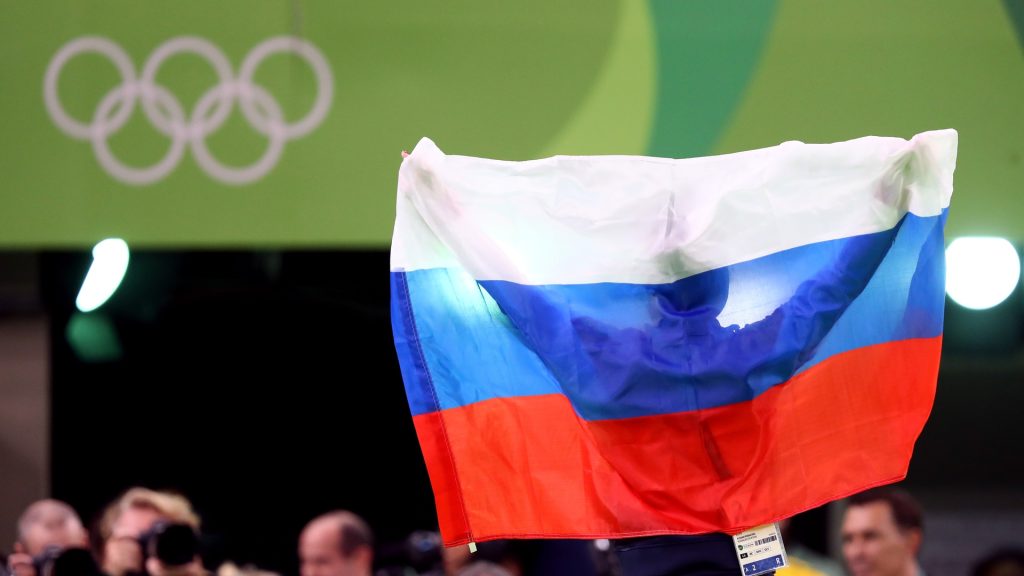
The IOC said it had not decided whether athletes would be allowed to compete under the Russian flag or instead participate as the Russian Olympic Committee.
Olympic experts say the move to lift the ban was expected.
“This has definitely been in motion for a long time, and Olympics watchers are not at all surprised by it, because of all the hints that have been given,” said Jules Boykoff, a professor at Pacific University who studies the connection between sport and politics.
Why was Russia banned in the first place?
Russian athletes have faced two separate controversies preventing teams from competing as the Russian Federation. The first was a state-sponsored doping scandal during the 2014 Sochi Olympics. After the widespread program was uncovered, athletes were allowed to compete as the Russian Olympic Committee — an independent organization instead of a state-sponsored one — only after meeting strict anti-doping requirements.
The second, more widespread ban took effect after Russia invaded Ukraine in February 2022 — in between the 2022 Olympics and Paralympics in Beijing. At the time, the IOC gave two reasons for the ban. First, Russia violated the Olympic Truce — a non-binding United Nations treaty in effect for one week before the Olympics through one week after the Paralympics. Several nations, including the United States and Israel in February, previously violated the truce without facing bans.
What made Russia’s case different in the eyes of the IOC, however, was that when it invaded Ukraine, it also took over local Ukrainian sporting organizations under the Ukrainian Olympic Committee’s jurisdiction. The IOC cited that action as the second reason to ban Russia, but experts said that was the primary reason Russia actually received a ban. Now that Russia is no longer attempting to control those organizations, the IOC lifted its ban on the Russian Olympic Committee.
“The International Committee did stand by the criteria that it had given previously for banning Russia,” Boykoff told Straight Arrow. “If they were to take these criteria seriously moving forward, a lot of other countries would be in the spotlight of potentially being suspended from the Olympics.”
What happens now?
Russian athletes officially have a path to compete as Russians — not Independent Neutral Athletes — for the first time since the 2022 Beijing Games. They’ll need to undergo extensive doping testing in the lead-up to and during future Olympics, starting with the 2028 Los Angeles Games.
At events run by international federations — like the 2026 FIFA World Cup — it’s up to the governing body. While FIFA has not lifted its ban on senior Russian teams, FIFA President Gianni Infantino in February signaled openness to allowing Russian teams to compete again. The organization also began allowing Russian youth teams to participate this year.
Boykoff said it’s a sign of a changing political climate.
“FIFA and the International Olympic Committee are not immune from the larger cultural and political forces of the world and I think that’s really what we’re witnessing here,” Boykoff said. “There’s a push backwards in both organizations to sort of cling desperately to this mantle of political neutrality.”
That includes the decision in February to bar a Ukrainian skeleton athlete from competing in the 2026 Games with a helmet depicting fellow Ukrainians killed in Russian attacks.
The IOC also made changes to the Olympic Charter, effective June 24, that cemented its main purpose is “to apply neutrality at all times, free from governmental, cultural, societal or economic pressure.”
Boykoff said the shift away from a peace-first stance is more in line with the IOC’s historic stance on global conflicts.
“For the people who felt like we were in a new era with Kirsty Coventry being the first president from Africa, being the first woman president, this should be a wake-up call for them,” Boykoff continued. “The IOC is pretty much the same old, same old. It’s different faces in the same places, but the sort of juggernaut of pseudo-neutrality, the juggernaut of looking out for their own interests, remains firmly entrenched.”
Round out your reading
- Scientists are now eyeing a possible ‘Mega El Niño’.
- Critics mocked Mamdani’s AC request. Republicans made the same ask.
- Social Security was supposed to be a safety net. To young Americans, it’s a broken promise.
- What happens when the water dries up? Much of the American West is close to finding out.
- Political insiders are targeting the two-party system’s grip on America.
Ella Rae Greene, Editor In Chief