Why an eradicated parasite is back in the American Southwest
In 2017, a group of scientists warned a warming planet would result in the re-emergence of ailments once considered eradicated.
“Accumulating evidence has begun to show that climate change is altering the spread and distribution of parasitic diseases,” researchers from the Rochester Institute of Technology and the University of Liverpool concluded in a paper published in the journal Infectious Diseases: Research and Treatment.
“This poses both a direct and indirect threat to human quality of life,” they wrote, citing, among other things, the threat to food production.
Nearly a decade later, their words read like a prophecy.
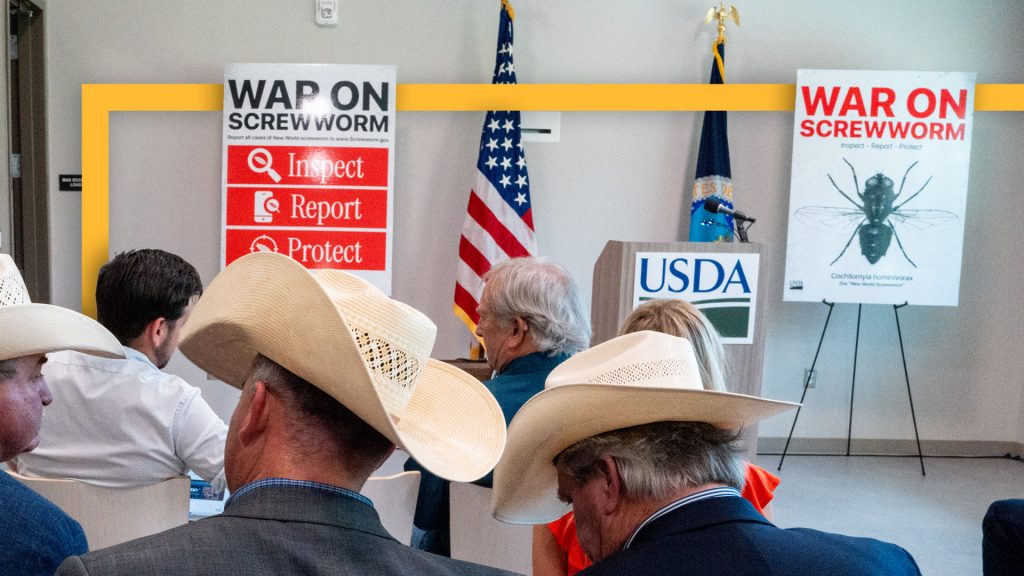
The new world screwworm, a flesh-eating parasite that infects cows and was declared eradicated in the U.S. in 1966, is roaring back as other diseases and parasites push deeper into the country. Screwworm has already spread through Central America and more than two dozen cases were detected in Texas and New Mexico this June, according to the USDA.
Cases of screwworm were occasionally discovered in Central America through the early 21st century. But prior to the current outbreak, the last confirmed infection in this country was in the 1980s. The parasite’s re-emergence in the U.S. comes as rising temperatures make northern countries more appealing to screwworm. Meanwhile, the poultry industry continues its fight against an avian flu that contributed to surging egg prices in the run-up to the 2024 election — a major campaign issue for President Donald Trump.
Parasites and pathogens affecting livestock could force farmers to cull herds and take expensive precautions, both of which can push up meat, dairy and egg prices.
The current screwworm outbreak may be a harbinger of things to come. Experts warn these afflictions will spread more frequently as average temperatures rise.

Why did a dangerous cattle parasite return to the U.S.?
“Insects are highly responsive to temperature, moisture and season length,” Georgina Bingham, an associate professor of entomology at the University of Nebraska, told Straight Arrow. “And in certain regions, we’re seeing more drought, which brings more animals together, because they all drink from the same watering hole.”
Climate change has already pushed up beef prices, experts say, as grazing lands dry out and ranchers sell cattle they can’t feed. A 2011 drought in Texas, a state renowned for its longhorn steers, was particularly damaging to beef production. And the American Farm Bureau Federation has named drought as a key reason the U.S. cattle inventory reached a 75-year low in January.
The shortage pushed the price of ground beef to $6.75 per pound in May, according to the Federal Reserve Bank of St. Louis, up more than a dollar from a year earlier. April’s average price of $6.90 per pound was the highest ever recorded.
Screwworm is serving up another potentially existential threat to U.S. beef. The parasite’s re-emergence is a “sentinel event” presaging the spread of more communicable diseases, according to Tyler Evans, an adjunct associate professor in population and public health sciences at the University of Southern California.
“It’s an example of what could and what is likely to come, and there’s not too much that we can do in terms of stopping that,” he told Straight Arrow.
Screwworm’s near eradication is considered one of the great entomological success stories.
“Essentially, it was eliminated in the U.S. in the late 20th century,” Evans said.
Because the flies that spread screwworm — New World Screwworm Flies —mate only once in their lifetimes, scientists introduced sterile flies into the wild to disrupt the breeding cycle. The strategy proved strikingly effective, Evans said.
Now screwworm is back.

How does the screwworm outbreak impact farmers and consumers?
“I wouldn’t blame it entirely on climate change, but it’s changing conditions, and making it more favorable” for infections like screwworm, Barry Davis, a professor emeritus at the UTHealth Houston School of Public Health, told Straight Arrow.
Screwworm flies like it hot and dry. Burning fossil fuels renders those conditions much more common compared with pre-industrial times.
“Whether it’s ticks or insects, they will occupy any environment where they can survive,” said Cassandra Olds, a livestock entomologist at Kansas State University’s agricultural extension. “You will see pest populations move into areas where they were not a problem before.”
Farmers far from the southwest have become more vigilant during the outbreak.
“If I get horses that I think are a little suspicious, I’ll keep them [isolated] past the quarantine period,” Montana rancher Casey Mott told Straight Arrow. “Especially if they come from an area that I’m not sure about.”
Screwworm affects most warm-blooded animals, including sheep, goats, horses and humans, although human infections are rare.

Southern New Jersey farmer Lucas Haring couldn’t order baby chicks directly to his southern New Jersey farm this spring thanks to an avian flu outbreak. Instead, he had to drive a half-hour to a third-party location, siphoning off time from his schedule and money from his bank account as both face a deficit.
“These small, unnecessary headaches make everything more difficult,” he told Straight Arrow. “If you tell me I can’t get them this week, but I can get them next week, that throws off my entire schedule.”
Outbreaks are a constant source of anxiety for farmers like Haring, who said he receives regular alerts about possible avian flu infections, so much so that he’s stopped relying on the internet.
“I’ve learned through the years that staying on social media and keeping up with the news cycle gets you in a poor mental state,” he said.
Some farmers are unable to source breeding cattle from Texas and New Mexico, where screwworm is spreading. Canada and some U.S. states have banned or restricted Texan cattle imports.
“It’s definitely impacting day-to-day operations,” Lia Sieler, executive director of the Western Organic Dairy Producer’s Alliance, told Straight Arrow. “There’s a lot of fear and a lot of nerves around it.”
The alliance’s farmers are especially vulnerable to infections because few preventions are conducive to organic farming, Sieler said.
That’s proven a tough problem to solve for Kristin Ramey, who raises sheep and poultry in Northern Colorado.
“You have to keep wildlife off your farm, but I don’t know how you realistically do that,” she said.
And livestock interacts with other animals at routine events like fairs and auctions, Ramey added, noting that it’s nearly impossible to keep the animals away from one another.

What public health programs stop the spread of livestock parasites?
Farmers and ranchers are generally optimistic that the screwworm outbreak can be contained.
“My father grew up in the southwest and screwworms were just a part of life,” Mott said. “We’ve dealt with this before, and we can tackle this problem again.”
Even so, further reduction in cattle herds could push up prices even further. In a time of rapidly escalating inflation, this adds one more hurdle for American consumers. But it’s not a problem without a solution.
While the world is unlikely to wean itself off fossil fuels any time soon, public health experts pointed to several steps countries can take to battle the spread of parasites and infections.
“Through better surveillance, sharing trusted information and practical support, we can get ahead of this problem,” Bingham said.
A well-funded, robust public health system is among the more effective countermeasures, Evans said.
“Microbes don’t know the difference between conservative and liberal states,” he said. “They’re going to make their way into different states and across borders. Strengthening public health is absolutely essential.”
Farmers like Ramey agree, which is why she seethes when she thinks about the Department of Government Efficiency cutting money from a new world screwworm monitoring program last year.
“Something like that could have been a huge help,” she said.
Pathogens and parasites other than screwworm and avian flu also threaten the agriculture industry, Bingham said.
The asian long horn tick, which transmits the theileria parasite and prefers warm climates, has also been spotted in cattle in the United States this year, she said.
“It’s moving northward as we’re seeing shorter winters,” Bingham said.
Round out your reading
- Scientists are now eyeing a possible ‘Mega El Niño’.
- Critics mocked Mamdani’s AC request. Republicans made the same ask.
- Social Security was supposed to be a safety net. To young Americans, it’s a broken promise.
- What happens when the water dries up? Much of the American West is close to finding out.
- Political insiders are targeting the two-party system’s grip on America.
Ella Rae Greene, Editor In Chief