Trump’s Supreme Court wins and losses; Venezuela rescue efforts turn desperate
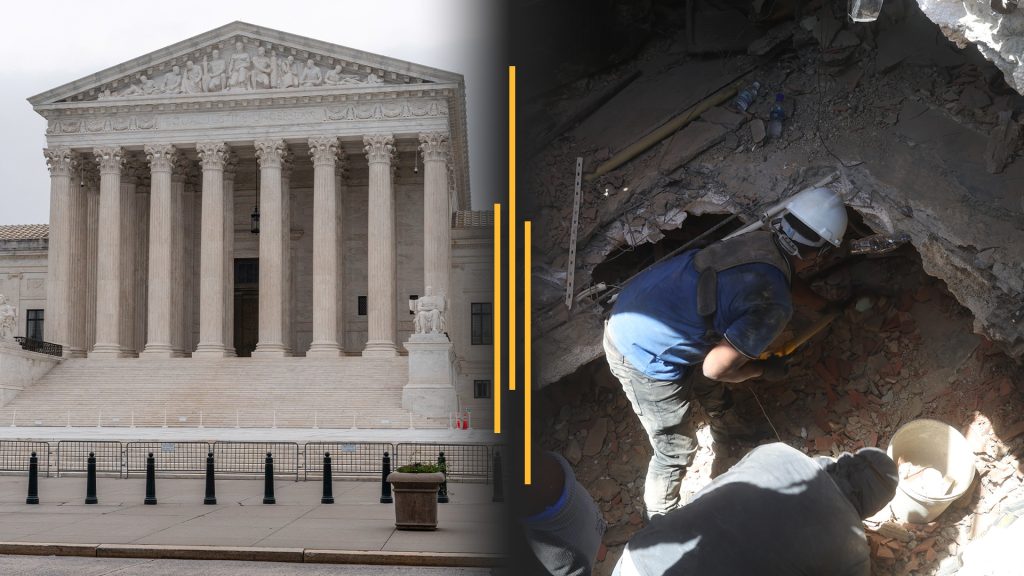
The Supreme Court is issuing several major new opinions. President Donald Trump calls one a “big win,” but others don’t go his way.
Plus, the United Nations is preparing for even more tragedy in Venezuela as rescue crews run out of time to pull survivors from last week’s earthquakes.
And why critics say a newly passed House bill to protect kids online misses the mark.
These stories and more highlight your Unbiased Updates for Tuesday, June 30, 2026.
SCOTUS hands down several high-profile opinions, delivering wins and losses to Trump
The Supreme Court has handed down a flurry of opinions this week as the justices gear up for their summer recess. More rulings are expected Tuesday, after SCOTUS made four major decisions Monday.
Two of the opinions centered on the firing of government officials: one a loss for Trump, and the other a win.
In a 6-3 decision along party lines, the conservative-led justices said presidents have free rein to fire federal agency heads, despite federal laws requiring cause and a prior decision nearly a century ago that limited executive authority. The president called the ruling a “big win.”
However, the justices ruled that Federal Reserve Gov. Lisa Cook can keep her job while she fights Trump’s efforts to fire her over allegations of mortgage fraud.
She has long denied any wrongdoing.
In other news, the court declined to take up Trump’s attempt to throw out a jury’s $5 million finding that he sexually abused and defamed writer E. Jean Carroll, so that case stands.

In another high-profile move, the justices ruled 5-4 that states can continue to count mail-in ballots that arrive after Election Day, as long as the ballots are postmarked in time and the practice is part of state law.
Trump has long questioned the validity of mail-in ballots and continues to challenge his 2020 election loss.
After that opinion came down, Trump used it to bolster his argument that Congress should pass his controversial voting bill, the SAVE America Act.
“Well, because of the mail-in ballot ruling, which was a little bit surprising, gives people more time to vote illegally, let’s say. But the SAVE Act is even more important, and that’s the right — you have to be a citizen of our country, okay, you have to show you’re a citizen of our country called citizenship. Voter ID by photo, photo voter ID,” Trump said. “And no mail-in ballots unless you’re in the military, disabled, you’re ill, or you’re away, even on a vacation; we’re being very open about it. It’s pretty easy. And we’ll have honest elections.”
House Minority Leader Hakeem Jeffries praised the Supreme Court’s decision.
“The Supreme Court did the right thing with respect to preserving each state’s ability, consistent with the United States Constitution, to manage the electoral process relative to voting by mail,” Jeffries said. “Voting by mail has never been a partisan issue until Donald Trump decided to peddle conspiracy theories related to his own failures to win back in 2020.”
And lastly, a win for privacy advocates.
The court held that constitutional privacy protections do extend to cellphone location information.
The ruling stems from a 2019 bank robbery case in which police obtained a geofence warrant and used it to locate cellphones near the bank around the time of the robbery, leading them to a suspect but also revealing other people’s information.
Still to come out of the court this week are rulings on birthright citizenship, a ban on transgender athletes and a campaign finance ruling.
US delegation heads to Qatar for Iran talks
The U.S.-Iran ceasefire remains on shaky ground Tuesday morning as Washington and Tehran give conflicting updates on where negotiations stand.
Despite that and recent attacks between the U.S. and Iran, White House Press Secretary Karoline Leavitt said U.S. officials will be in Doha, Qatar, on Tuesday for “high-level meetings.”
“Iran has requested a meeting this week, so Special Envoy Witkoff and Jared Kushner will be flying to Doha for high-level meetings this week as we continue to discuss the memorandum of understanding,” Leavitt said. “On the sidelines of those high-level talks will be the technical talks. So as far as we’re concerned, we’re holding up our end of the ceasefire. Violence will be met with violence.”
Iran’s foreign ministry said no talks with the U.S. are scheduled in the coming days, but an Iranian delegation will travel to Doha later this week.
Spokesman Esmail Baghaei said the U.S. delegation’s visit “has nothing to do with the Iranian delegation’s visit.” The talks were originally scheduled to take place in Switzerland this week.
Venezuela rescue efforts turn desperate as death toll hits 1,719
Frustrations have risen in Venezuela as the death toll from last week’s powerful twin earthquakes continues to rise while the search for survivors grows more desperate. Fewer people are being pulled from collapsed buildings, and survivors say help is too slow.
National Assembly President Jorge Rodríguez said the confirmed death toll has reached 1,719, with more than 5,000 injured and nearly 16,000 displaced. Among the dead are three Americans, according to U.S. officials, while 12 more Americans remain missing.

Venezuela’s latest government tally shows nearly 200 buildings completely flattened and several hundred more severely damaged.
Experts told Reuters the disaster was likely made worse by years of poor building-code enforcement, weak licensing practices and infrastructure neglect.
And as they’ve yet to excavate many of the collapsed buildings, the United Nations coordinator in Venezuela said the organization is preparing for the death toll to rise significantly.
“At least 2,500 structures are affected, most of which fully collapsed. So, we are definitely looking at a number that is higher than the one already reported,” Gianluca Rampolla Del Tindaro, U.N. resident coordinator in Venezuela, said. ”I can give you an approximate indicator. We are procuring, and this is something that has been agreed with the authorities here, 10,000 body bags.”
-

Jesus Vargas/Getty Images -

Jesus Vargas/Getty Images -

Edilzon Gamez/Getty Images -

Edilzon Gamez/Getty Images -

Edilzon Gamez/Getty Images -

Cem Tekkesinoglu/Anadolu via Getty Images -

Jesus Vargas/Getty Images -

Manaure QUINTERO / AFP via Getty Images -

Manaure QUINTERO / AFP via Getty Images -

Miguel MEDINA / POOL / AFP via Getty Images
Meanwhile, relatives of more than 100 Venezuelans deported by the U.S. government just hours before the quakes are searching for their loved ones after the hotel they were staying in, which was in the hardest-hit state of La Guaira, collapsed.
Officials said some of the 146 deportees, which included 19 women and 7 children, made it out, but many remain trapped under the rubble.
Trump won’t commit to signing housing bill, calls it a ‘yawn’
Trump has cast more doubt on whether he’ll sign a bipartisan affordable housing bill while the House has a trick up its sleeve to pass the voter ID law, the Safeguard American Voter Eligibility (SAVE America) Act.
The president put the 21st Century ROAD to Housing Act in limbo last week when he canceled the signing just hours before it was set to take place. He said at the time he wouldn’t approve it until Congress passes the unrelated SAVE Act, which imposes new restrictions on voter registration and mail-in voting.
When asked this week whether he would sign the housing bill, the president said:
“I think it’s so unimportant compared to the SAVE America Act. I think the SAVE America Act is exactly what it says it is: it’s saving America from crooked elections. And the housing bill is a bill that can get approved. They worked on it long and hard. It’s very bipartisan. That means the Democrats like it … They’re getting things that I wouldn’t necessarily agree to.
It’s a yawn. Somebody would say it’s wonderful. To me, compared to the SAVE America Act, just about everything is a big yawn.”
The housing bill aims to lower the cost of buying a home by building more housing and restricting large corporations from buying single-family homes to turn them into rental properties.
It passed Congress last Tuesday.
Despite the president calling it a big yawn, Republican House Speaker Mike Johnson later said he knows the president won’t veto it. He’ll either sign it or let the 10 days pass, after which it will automatically become law.
As for the Save America Act, Johnson has plans to wrap that tough-to-pass legislation with a must-pass defense bill, the National Defense Authorization Act. That maneuver now goes to the House floor for consideration.
Kids online safety package clears House
The House just passed a major children’s online safety package, but the bill has already run into resistance.
The Kids Internet and Digital Safety (KIDS) Act passed Monday night in a bipartisan vote of 267-117.
Supporters say it would give parents more control over kids’ online activity, require new safety features and place new limits on how minors’ data can be used. It would also create rules for AI chatbots, online games and age verification on pornography sites.
But the House version is narrower than the Kids Online Safety Act that the Senate previously passed.
House lawmakers removed a “duty of care” provision that placed greater responsibility on online platforms to prevent harm to minors. Supporters of that provision say it was one of the most important parts of the Senate bill.
Criticism of the House bill comes in both directions: not far enough and too far. Digital rights and tech groups warn it could threaten privacy, free expression and online anonymity.
The bill now heads to the Senate, where the path is less certain.
Sen. Richard Blumenthal has called the House version “dead in the Senate,” while Sen. Ted Cruz has said he is open to negotiations.
Feliks the eagle rescued after poaching ordeal
An eagle from Serbia is back home after a migration turned into a cross-border rescue mission.
Feliks is a year-old eastern imperial eagle. He set off on his first migratory flight last year, going from Serbia across North Macedonia, Greece and Turkey before they lost his tracking signal over Syria.

Then came the worrying news. Poachers captured Feliks and put him up for sale in WhatsApp groups used to sell illegally trapped wild birds.
Michel Sawani, who leads the Lebanese Association for Migratory Birds, helped track Feliks down.
Michel Sawan, president of the Lebanese Association for Migratory Birds
”It was a complicated mission actually, because there has been some clashes on the borders on that day. And there has been a storm, rainstorm, and the river that separates Lebanon from Syria, the level of water was very high, so we had to wait nine days. We had to wait for someone to transport it with a human illegal refugees.
We could not record, of course. But if you see how they manage to get it, it is crazy. They put it in a potato box and they hold it in their hands and they cross the river.”
Michel Sawan, president of the Lebanese Association for Migratory Birds
Feliks was sold to a buyer in Lebanon, then resold back into Syria before Sawan’s network retrieved him.


Getting him out was its own ordeal. After three failed attempts to get him home, the Serbian army helped bring Feliks back on a military transport plane on June 22.
He is now in quarantine at a zoo in northern Serbia. Experts say he will get a new transmitter before he can take to the skies as a free bird again.
More from Straight Arrow:

Americans are earning more than ever. So why does the middle class feel stuck?
Jennifer Bringle sits almost exactly in the middle of America’s vast middle class.
Bringle, a 47-year-old freelance writer, and her husband, a 49-year-old wheelchair-services worker, live in Greensboro, North Carolina, with their 11-year-old son.
Their combined annual income has averaged about $110,000 in recent years, Bringle told Straight Arrow. In their best year, they earned $160,000.
And yet, Bringle said, “it’s frustrating because I feel like at this point in our lives, with the money we make, we should be in a different position.”
“If I’m not living paycheck to paycheck, I feel like I’m almost there,” she said. “And we’re like one catastrophic event away from being in a really terrible state financially.”
Her status – and her fears – reflect the challenges facing middle-income Americans as the nation marks the 250th anniversary of its founding. For many who consider themselves middle class, the American dream is slipping away.
Ella Rae Greene, Editor In Chief