Supreme Court allows state bans on trans athletes
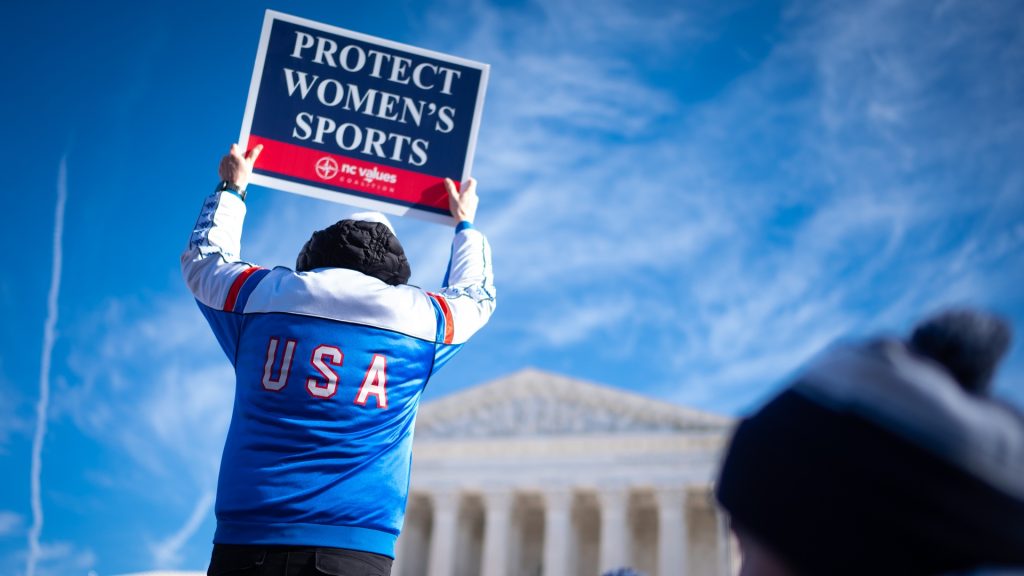
States may ban transgender athletes from joining women’s and girls’ athletic teams, the Supreme Court ruled Tuesday as it concluded its term with a series of blockbuster opinions.
The court upheld state laws from Idaho and West Virginia that limit sports participation in public schools to an athlete’s sex at birth. Twenty-five other states have similar laws, and analysts on SCOTUSBlog, a news site covering the Supreme Court, suggested the ruling may pave the way for future cases that may seek to extend the ban transgender athletes to all states.
The bans, the court’s majority said, do not violate Title IX, a federal law that prohibits sex discrimination in publicly funded schools.
The ruling came on the same day that the court upheld the principle of birthright citizenship, in a rebuke of President Donald Trump, and held that laws preventing political parties from coordinating spending with candidates violate the First Amendment.
In the transgender cases, the court 6-3 along ideological lines as it overturned rulings by lower courts that the state laws illegally discriminated against trans persons.
Biological sex, not gender identity
Both cases, which were heard back-to-back in January, centered on whether states can categorize athletes based on their biological sex, rather than the gender with which they identify.
“These cases concern two of those state laws, from West Virginia and Idaho,” Justice Brett Kavanaugh wrote for the majority. “The question before the Court is: Under Title IX and the Equal Protection Clause of the Fourteenth Amendment, may schools maintain women’s and girls’ sports for biological females? In other words, may schools determine eligibility for women’s and girls’ sports based on biological sex? The answer is yes.”
Justices Sonia Sotomayor, Elena Kagan and Ketanji Brown Jackson dissented from the ruling.
“This litigation implicates deeply sensitive, contentious, and evolving issues,” Sotomayor wrote. “These circumstances demand exercising judicial restraint, not rushing to answer conclusively difficult questions without sufficient evidentiary development. The majority wrongly dismisses the alleged overbreadth in this case because, in its view, the subclass at issue is not large enough to matter.”
Advocates of transgender rights criticized the decision, arguing that the ruling’s implications will narrow protections for transgender students — on and off the playing field.
Relatively few transgender girls and women play organized sports. The NCAA has said no more than 10 trans women compete in college athletics.
“Today’s decision is not really about sports. It never was,” Chastity Bowick, executive director of Marsha P. Johnson Institute, an organization that advocates for Black transgender people, told Straight Arrow. “For years now, we have witnessed a coordinated, cynical campaign turn a tiny fraction of American children into a manufactured crisis. Lawmakers and litigators have asked the public to fear young people who simply want to run on a track, swim in a pool, or kick a ball on a field with their peers. Today, the highest court in the land endorsed that fear.”
President Donald Trump celebrated the ruling in a post on Truth Social.
“BIG WIN: The United States Supreme Court just RULED AGAINST MEN PLAYING IN WOMEN’S SPORTS,” Trump wrote. “Wow! That takes that ridiculous situation off the table!!!”
Round out your reading
- America at 250: Straight Arrow’s week-long look at the pressures testing modern America.
- Ketamine is booming in America. The reasons go beyond drugs.
- Cluster of AI news sites suddenly goes dark after human reporter starts asking questions.
- A 79-year-old, obese, well-connected man gained exclusive access to a new weight loss drug. Is it Trump?
- Newsom pushes national wealth tax after opposing California billionaire tax.
Ella Rae Greene, Editor In Chief