Cluster of AI news sites suddenly goes dark after human reporter starts asking questions
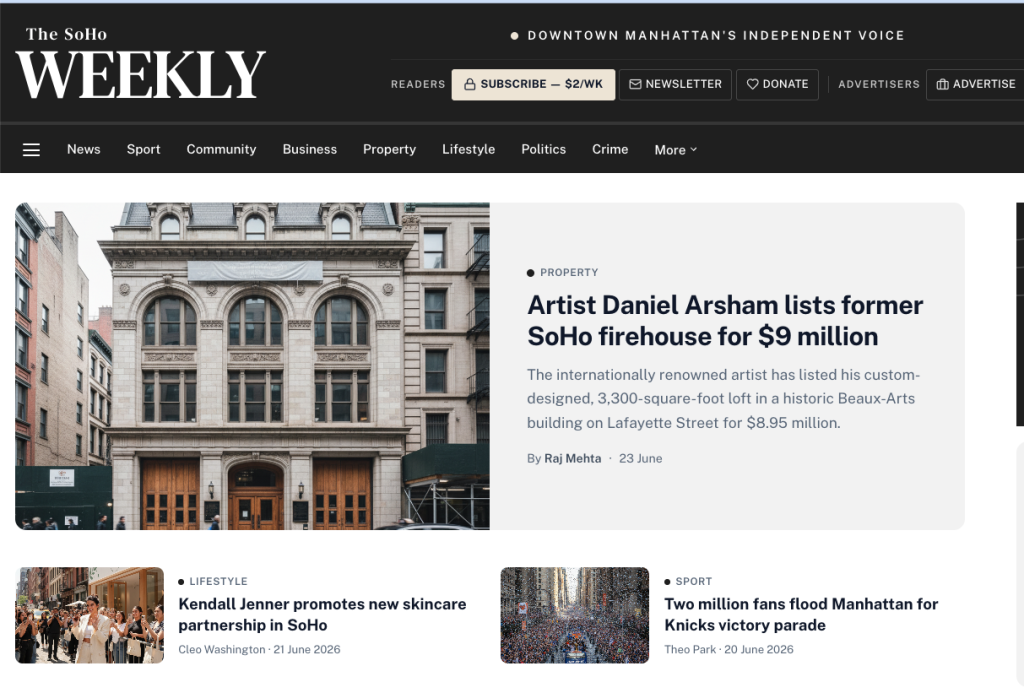
Several websites that regularly published news articles credited to people who did not appear to be real were abruptly taken down Thursday evening after Straight Arrow contacted the man responsible for creating them.
The man, Anton Lucanus, said in a statement that the 21 websites identified by Straight Arrow were part of a “project” that “was abandoned a while back,” but added some “were missed and still live, but those are now down as well.” Lucanus said he would not comment further on the matter and did not respond to a follow-up email seeking further comment.
Fifteen of the 21 sites were created between late February and the end of March, including the Ontario Citizen in Canada (Feb. 23), Daily Times Advocate in Illinois (March 8), LA Advertiser in California (March 11), Tauranga Time in New Zealand (March 29) and Miami Age in Florida (March 31).
The SoHo Weekly in New York was created on March 8 and published articles as recently as June 19.
One article in SoHo Weekly about an Assembly candidate in a competitive election was published on June 13, the first day of early voting. The candidate seen in that story did not resemble Ryder Kessler, and in the background, a supporter held a sign with the word “affordable” misspelled. A campaign aide said Kessler never spoke to the reporter, and, after learning about the article from Straight Arrow, said it left him “profoundly disturbed.”
On June 19, SoHo Weekly published another article, describing how a New York City Council member was pushing legislation to protect artist housing in the area. But the person seen in the story did not resemble the Council member, Margaret Chin, who left office at the end of 2021, and whose legislation was vetoed in early 2022.
An analysis by the website GPTZero, which detects AI content, said there was a 96% chance the June 19 article was entirely generated by AI, and a 100% chance the June 13 article was too.
“As a democracy and voting rights professional,” Kessler said in a statement, “I am profoundly disturbed by this kind of AI slop entering our elections discourse. It undermines the real local reporting that we depend on, and it demonstrates the ease with which AI-generated content can proliferate.”
State regulation of AI technology, Kessler said, would go a long way “to protect the jobs of local journalists and to protect the integrity of our elections.”
A cluster of news websites
Straight Arrow was able to link SoHo Weekly to at least 21 other similar websites in the United States, Canada, New Zealand and Australia.
The shuttering of local news outlets and proliferation of AI-generated content has led to a rise in “pink slime” websites, which the Poynter Institute describes as outlets producing “poor quality reports that appear to be local news,” and are “frequently produced via automation and templates.” Often these sites are, according to Poynter, “funded by outside companies with a partisan source of financing.”
For example, a sprawling network of 450 websites — including 189 that “were set up as local news networks across 10 states” — was discovered ahead of the 2020 election cycle by the Columbia Journalism Review.
CJR linked the network to a conservative businessman’s company “known for its low-cost automated story generation,” as well as for “faking bylines and quotes, and for plagiarism.” In Knox County, Ohio, a proposed wind farm became the subject of critical coverage in a local outlet after it was purchased by Metric Media, “part of a ‘pink slime’ network,” ProPublica reported at the time.
But Jennifer Sparks, an assistant professor of journalism at Auburn University in Alabama, said she would label the sites identified by Straight Arrow as “synthetic local news.” In a statement, Sparks said a “synthetic local news” site “focuses more on the attempt to mimic real journalism without anything independent.”
Whatever it’s called, Sparks warned about websites that pretend to be legitimate local news outlets.
“Every time we see a fake outlet enter a community, we see more skepticism and more distrust,” Sparks said in an interview. “It’s not very good for legitimate journalism.”
Even publishing innocuous info sites could suddenly change and produce a stream of biased or fake news to an unsuspecting audience.
How we traced this cluster of fake websites
A publicly available view of Soho Weekly’s website infrastructure revealed its unique AdSense publisher ID number.


That number is like a bank account number, letting Google know where to send money generated from an ad on a site they control. Websites that share an AdSense publisher ID number mean they are using the same AdSense account. A search of that unique number on the website DNSlytics, which provides technical information about websites, showed it was used across a cluster of 22 websites.

Those websites include the California Sun, Los Angeles Advertiser, the Daily Times Advocate and Miami Age in the United States; Ontario Citizen and Toronto Sentinel in Canada; Claremont Courtier and Perth Free Press in Australia; and Christchurch Chronicle, Dunedin Voice & Quill and Kiwi Herald in New Zealand.
Each of the 15 websites in that cluster that were still accessible as of June 24 claimed to be owned by “APG.” An email sent Thursday to a local media company by that name, which later rebranded as Adams MultiMedia, was not immediately returned. Adams MultiMedia’s website indicates it owns publications in numerous U.S. states, but none in New York, California, or Illinois, nor any overseas.
Recycled information and misleading images
The information on the websites ranges in quality and accuracy.
As the Miami Age reported in early April, Florida Gov. Ron DeSantis hosted an event at the Perez Museum in Miami to tout economic development in the south, alongside fellow Republican, Texas Gov. Greg Abbott. But the event was indoors, not outdoors. Most strikingly is the fact that the governors, including the wheelchair-bound Abbott, were not standing as the image in the Miami Age article showed.


A Google search for a quote from the Miami Age article attributed to Abbott appeared in only one other outlet, Local 10 News in Miami.
On June 15, Cal Matters published a guest column urging state lawmakers not to cut $15 million in funding earmarked for local journalism, written by co-executive director Martin G. Reynolds of the Robert C. Maynard Institute for Journalism Education. “When trusted local information disappears, misinformation fills the void,” Reynolds wrote. That same quote also appeared in just one other article on the California Sun website. That article did not link to, or even mention, the source of the quote.


The people and the links
SoHo Weekly had links for paid subscriptions (“$2/WK”), a newsletter, donations and advertising, though none were operable. Each website in the cluster had similar links, and a spot check of a handful of them yielded similar results.


In total, the websites listed 93 employees, with titles ranging from reporter and senior reporter, to newsletter editor, chief revenue officer, sales director and account manager. Twice, a single publication had two people with different headshots and biographies listed under the same name.


Follow the links
The Google Chrome extension Link Gopher automatically generates a list of every link on a given website. Using that extension shows that SoHo Weekly and related publications rarely link to websites outside of their cluster.


Despite the debatable quality of the content from those publications, it appears that several websites have found reasons to link to them, according to information from BackLinkChecker.com, which, as the name suggests, shows which sites are linking to a given webpage.
Straight Arrow identified 534 links to the ten sites in the cluster that were accessible as of June 25; more than 30% of those links ended with the same way: “powered-by-scholastica.” All seven backlinks to Christchurch Chronicle, all 25 backlinks to SoHoWeekly.com and 25 of the 26 backlinks to the Daily Times Advocate, in Illinois, ended with powered-by-scholastica.”
Other webpages linking to sites in the cluster appeared to mimic well-known companies and brands, with names like CNNDirectory, YelpDirectory, and FLickerDirectory.
One of the webpages linking to SoHo Weekly, according to this search, was The Bunbury Guardian. Last month, an investigative reporter with the Australian Broadcasting Company identified Bunbury Guardian as part of a group of “pink slime” websites poaching content from other news organizations. The outlet also identified Lucanus as the person “behind” the sites and quoted him saying the websites were an “experiment” that had gone wrong.
“The tech is so exciting so people can’t wait to see what it can build, but as I have learned here, there does need to be guardrails,” the outlet quoted him as saying. An email sent Thursday afternoon to Scholastica through their contact page was not returned. One business directory listed Lucanus as the founder and chief executive officer of a company called BackLink.com, whose website says it sells “backlinks on real editorials, with real traffic, with real results.”
Round out your reading
- Not red or blue: America’s politically homeless middle.
- Peter Thiel’s ‘Dialog’ network was super-secret. A data leak changed that.
- The novel legal strategy that Taylor Swift and Matthew McConaughey are using to fight AI.
- Illinois balances budget with new $200 million social media tax that tracks in-state users.
- When Trump serves up ‘Just the News,’ it comes with a side of bias.
Ella Rae Greene, Editor In Chief