‘Say it different ways’ videos highlight how social media companies benefit from viral trends
Internet trends are hard to miss out on. Anyone who’s been online over the last two decades has probably forwarded an email to 10 people, tagged themselves in a Disney princess meme or thrown a bucket of ice water over their head.
Since the 2020 pandemic-era boom in short-form scrollable content, video trends have become a much bigger part of the online landscape.
That is likely intentional, digital ethicist and influencer Clara Fulks told Straight Arrow. In a recent video, Fulks explained how the virality of certain types of trends could be a boon for the platforms that host them.
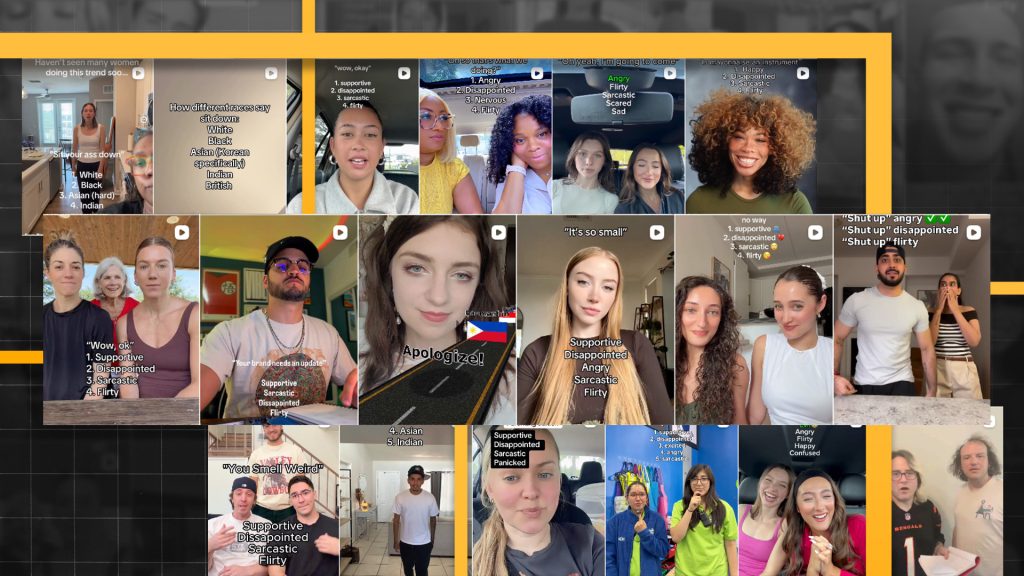
Her video highlights one specific trend: a series of Instagram and TikTok videos in which people film themselves repeating the same phrase in different tones of voice, with the different tones overlaid in writing on the screen. Fulks said this could be providing rich training data for corporate AI training — and that this data is especially valuable, since it pairs a description of human emotion with information about how that emotion sounds.
Platforms like Instagram and TikTok “are most definitely benefiting from this trend going viral,” said Fulks, who previously worked alongside the trust and safety teams of tech companies to build and develop detailed data sets that let them identify and interact with users.

The platforms could even be “algorithmically encouraging or pushing that trend forward into the public eye, so more people participate,” she said.
Well-labelled emotional data is extremely hard to come by, and can be very expensive. This new trend provides a kind of repeatable script — for free. Saying the same sentence using different emotions, with text labeling exactly what the emotions and tones are, is not dissimilar from the work a voice actor might be asked to do when training a voice agent.
AI models can be trained with even a small amount of high-quality, detailed, and well-structured data, Hal Triedman, a Computer Science PhD student at Cornell University, told Straight Arrow.
Data-collection platforms — like Mercor and Handshake — often post “jobs” where the purpose is to collect emotional data, said Fulks, who has seen plenty of these job postings over the years.


“If a company is investing half a million dollars into one emotionality data set, that tells me something right about what their priorities are,” Fulks told Straight Arrow. A free, crowdsourced dataset would be extremely valuable.
And participating in the trends is attractive for users.
“It’s funny, it’s silly, it’s entertaining,” Fulks said. “I don’t blame people for using trends as a point of connection, but also as a point of like, boosting their own content.”
A lot of the phrases in this newest trend can feel weird or random — “you smell weird” or “you do you boo!” said in ways that range from supportive to sarcastic. Jumping on an online trend means the platform will amplify user content to others who have shown they like that type of content.

Why would this be useful?
AI models rely on mathematical pattern recognition; in order to recognize a pattern, the model must “see” it many times. This is especially true in later stages of model training, when the model is learning and reinforcing the difference between good and bad answers.
Neither Meta nor TikTok responded to Straight Arrow’s requests for comment. And while the folks who spoke with Straight Arrow said they could never be 100% certain whether this latest trend was a definite attempt to farm training data for social media companies, computational social science consultant Sohan Dsouza said this data “would certainly be helpful for training a model.”
But, he told Straight Arrow, the platforms “don’t share that publicly.”
What products would this be used for?
Companies have several uses for emotional data.
“If you want to create a model that can produce sarcastic, sultry, serious and whatever, like, if you want a model that can produce those vocal tones, then having that data set would be very useful,” Triedman said.
OpenAI tells users they can customize ChatGPT’s “personality”. It can perform in modes that include “friendly” (described as “best for: decision support”), “quirky” (“more playful, less formal”) or “cynical” (“an irreverent tone”).
Interactive voice agents also benefit from being able to detect tone, rather than produce it; for example, a well-known influencer who goes by @Huskistaken has gone viral for his videos trolling ChatGPT when it responds sincerely to his ironic or sarcastic interactions with it.
In corporate settings, being able to track and rate the emotional tone of a customer-service worker can be profitable. Wired previously reported on emotional surveillance of workers in call centers.
Emotions can also come into play in understanding the behaviour of the public, Fulks said. They can also be biased or used to unnecessarily target people for additional screening.
Emotions can be “used to criminalize people and say: This person, you know, our emotion models showed that this person was angry or about to commit a crime for whatever reason, let’s apprehend them,” she said. She is concerned about the ways that that technology could be unfairly used against groups of people who are not properly represented in data.
What should users consider?
Any video uploaded to Instagram can be used to train a model. Fulks pointed out that it is clear in Meta’s terms of service that data from public posts is fair game, and that users should be aware of that when adding any video to their platform or participating in any trend.
If users have a particular stance toward the way their data is used, it is important to be informed about the full range of the technology and how they could be contributing, she said. Meta has made its large language models available for use across all branches of the federal government under the OneGov initiative announced in September 2025. The company also partners with organizations like Anduril, for battlefield intelligence.
READ MORE: Private data leaked after Meta tracks employees’ keystrokes to train AI
While Meta has not clarified whether this specific trend is a data-collection effort, it is clear Meta is trying many strategies to make more sophisticated models. A Monday article from Business Insider revealed that the company had just paused its internal monitoring program that gathered information for model training from employees. This mandatory “Model Capability Initiative” had been tracking keystrokes, clicks and mouse movements and was intended to improve the company’s AI models. It was shut down after a data breach that revealed employee conversations and performance information.
What is very clear is that the broader landscape of model training is highly competitive, said Fulks.
“All these tech companies are battling it out, trying to be the leader, the supreme leader,” she said. “And ultimately the one who wins is the one with the most data.”
Round out your reading
- Not red or blue: America’s politically homeless middle.
- Peter Thiel’s ‘Dialog’ network was super-secret. A data leak changed that.
- The novel legal strategy that Taylor Swift and Matthew McConaughey are using to fight AI.
- Illinois balances budget with new $200 million social media tax that tracks in-state users.
- When Trump serves up ‘Just the News,’ it comes with a side of bias.
Ella Rae Greene, Editor In Chief