Jupiter-sized planets are as fluffy as cotton candy, and NASA isn’t sure why
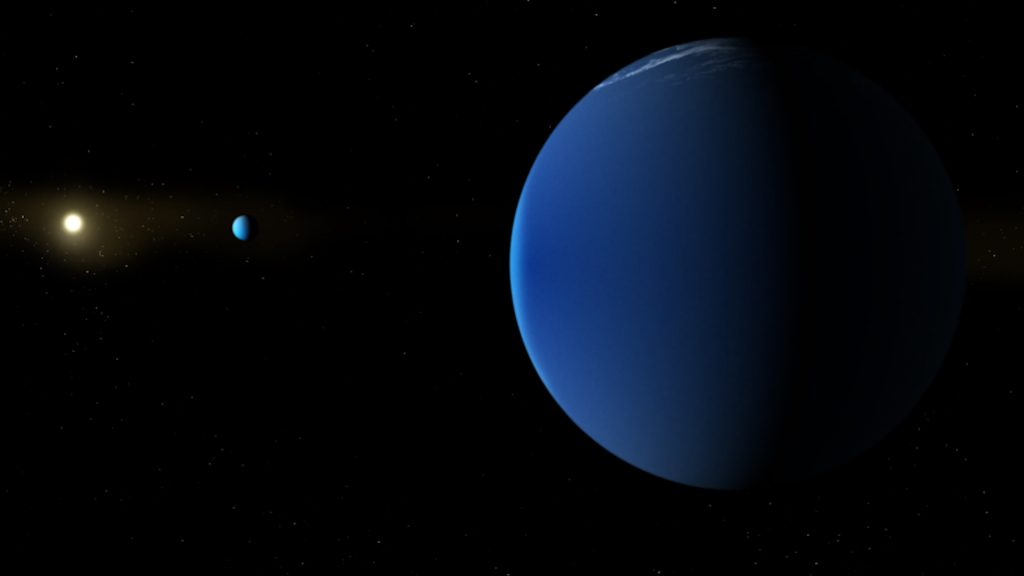
Scientists have found two giant planets with an unusual combination. They are roughly the size of Jupiter but have densities comparable to cotton candy.
NASA said data from its Transiting Exoplanet Survey Satellite, or TESS, revealed the planets orbiting a Sun-like star more than 1,100 light-years from Earth. The planets are called TOI-791 b and TOI-791 c.
Both worlds are large but extremely low in mass for their size. TOI-791 b is nearly the same size as Jupiter but has just 3% of Jupiter’s mass, according to NASA. TOI-791 c is even larger than Jupiter but has only 5.9% of Jupiter’s mass.
That makes them part of a rare class known as “super-puff” planets, which are unusually large for their low mass.
Why the discovery stands out
Scientists have identified only a handful of super-puff planets, making the discovery of two in the same planetary system even rarer.
SCIENTISTS JUST DISCOVERED TWO GIANT PLANETS LIGHTER THAN CANDY FLOSS.
An international team has found two of the lowest-density planets ever detected “super-puff” gas giants with densities even lower than cotton candy.
The planets, TOI-791 b and TOI-791 c, orbit a sun-like… pic.twitter.com/BliISYFfNX
— TheNewPhysics (@CharlesMullins2) June 25, 2026
“The main reason these planets are interesting to study is that we didn’t expect to see them at all,” Jon Jenkins, science lead for the Science Processing Operations Center at NASA’s Ames Research Center, said in NASA’s announcement.
Jenkins said the planets raise questions about how giant planets like Jupiter and super-puff planets form.
The cotton candy comparison does not mean the planets are soft or sugary. It means their material is spread over a very large volume, giving them extremely low average densities.
How scientists confirmed their masses
The planets also have unusually long orbits. NASA said TOI-791 b takes 139 days to orbit its star, while TOI-791 c takes 232 days.
Long-period planets can be difficult to confirm because scientists must observe a star for extended periods to see repeated transits, or dips in starlight caused when a planet passes in front of the star. NASA said TESS gathered 1,122 days of data on the system over seven years.
Researchers also found that the planets tug on each other gravitationally as they orbit. Those interactions slightly change when each planet crosses in front of the star.
Scientists used those timing changes to calculate the planets’ masses, confirming that both are extremely low-density worlds.
What scientists hope to learn
The study was published in the Monthly Notices of the Royal Astronomical Society. NASA said the research was led by the University of Oxford in collaboration with Université Côte d’Azur/Observatoire de la Côte d’Azur and the University of Birmingham.
Researchers said further study could help explain how giant planets form and evolve. Scientists also hope to learn more about the planets’ atmospheres, how their rotation affects their shape and how they moved through their planetary system during development.
Round out your reading
- Not red or blue: America’s politically homeless middle.
- Peter Thiel’s ‘Dialog’ network was super-secret. A data leak changed that.
- The novel legal strategy that Taylor Swift and Matthew McConaughey are using to fight AI.
- Illinois balances budget with new $200 million social media tax that tracks in-state users.
- When Trump serves up ‘Just the News,’ it comes with a side of bias.
Ella Rae Greene, Editor In Chief