What to know as US, Iran delegations enter into talks in Switzerland Sunday

Negotiations between the U.S. and Iran will be held Sunday in Bürgenstock, Switzerland, days after the two nations signed a memorandum of understanding establishing a 60-day ceasefire.
Mediators from Pakistan and Qatar will participate in the discussions as well, Pakistan’s Ministry of Foreign Affairs said on X.
This trip was initially planned for Friday, but was postponed, reportedly because of fighting in Lebanon.
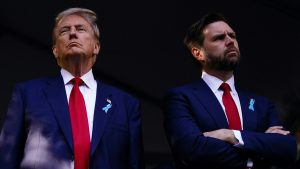
Vice President JD Vance said in an interview with Fox News Saturday he will be with Middle East special envoy Steve Witkoff and Jared Kushner, Trump’s adviser and son-in-law, for the negotiations.
Kushner and Witkoff, who arrived before Vance, dealt with some of the negotiation’s “technical elements,” Vance said on Fox.
“My understanding, talking to Jared and Steve this morning, is things are going well,” the vice president added.
Before he left for Switzerland Saturday evening, Vance told reporters he can only be in Switzerland “for a day or two.”
The two big issues the delegations will focus on are the nuclear issue and the Lebanon ceasefire, Vance said, which Israel and Hezbollah reportedly agreed to on Friday. Hours later, though, Israeli strikes on southern Lebanon killed at least 16 people. The Israeli military said Hezbollah launched at least 50 projectiles toward its soldiers in southern Lebanon, so it responded by striking dozens of its infrastructure sites in the area throughout the night. Hezbollah denied this.
Iran Foreign Ministry spokesman Esmaeil Baqaei said the Switzerland trip “is intended to pursue accountability and follow up on the implementation of the other side’s obligations,” according to the semiofficial Tasnim News Agency.
Baqaei, Iran lead negotiator Mohammad Bagher Ghalibaf and Foreign Minister Abbas Araghchi will reportedly lead the Iran delegation.
The Swiss Federal Department of Foreign Affairs confirmed on X that the Iranian delegation arrived in Switzerland Saturday.
What’s in the memorandum of understanding?
The U.S. and Iran formally signed the memorandum of understanding late Wednesday.
It includes:
- The “immediate termination” of military operations on all fronts, including between the U.S. and Iran, as well as in Lebanon. It also called for “ensuring the territorial integrity and sovereignty of Lebanon.” Israel began warring with Hezbollah a few days after the war in Iran started on Feb.28. Officials in Israel, though, have said they don’t feel bound by the U.S. memorandum.
- A final deal in a maximum of 60 days, “extendable with mutual consent.”
- The U.S. ending its naval blockade of Iranian vessels in the Strait of Hormuz within 30 days, and Iran restoring the traffic of vessels in the strait to “prewar levels.”
- The U.S. working with regional partners to develop a $300 billion fund for the reconstruction and economic development of Iran
- The termination of U.S. sanctions against Iran, with Treasury Department waivers for the export of Iranian crude oil until sanctions are lifted
- The U.S. making frozen or restricted funds available to Iran
- Iran’s affirmation it will not procure or develop nuclear weapons, and an agreement that the two parties will discuss enrichment
Both Democrats and Republicans criticized the memorandum, saying it gives too many concessions to Iran.
“None of the President’s objectives have been achieved, Iran has won significant financial concessions, America’s relationships globally are in tatters and the new, even more hardline regime in Tehran is emboldened,” Democratic Sen. Jeanne Shaheen, ranking member of the Senate Foreign Relations Committee, said in a statement.
Sen. Bill Cassidy, R-La., called it the “worst foreign policy blunder in decades.”
“Iran’s nuclear ambitions were not curbed, and they have learned that threatening the Strait of Hormuz works and will undoubtedly leverage it in the future. Now, Iran gets to build brand-new infrastructure under this deal,” Cassidy said.
Sen. Ted Cruz, R-Texas, told The Hill he thinks the president is receiving “some very poor advice on this deal.”
“History teaches that giving billions of dollars to theocratic lunatics who want to murder us is not a good idea,” he said.
President Donald Trump defended the memorandum on Truth Social, criticizing former presidents Barack Obama and Joe Biden for their past actions on Iran.
“Radical Left fools and Dumocrats [sic] realize how well we have done in our War against Iran, with their Country being completely defeated militarily,” he said. “Iran got away with ”murder” for 47 years, until I came along. Then it all changed. AMERICA IS BACK!!!”
Karen Young, a senior research scholar at the Center on Global Energy Policy at Columbia University, told CNBC the memorandum is “not a final settlement in anyway, and it is very tentative.”
The tension points right now are over Lebanon, Young said.
“Iran has a lot of leverage here, and so the threat to walk away, even over the weekend of starting formal negotiations within this 60-day window, it’s a point of leverage that they have, and so it puts pressure on President Trump to try to rein in Israel,” Young said.
Round out your reading
- Could a common dietary supplement accelerate Alzheimer’s?
- NY AG Letitia James gets hundreds of taunts, racial slurs in ICE public reporting portal.
- As Musk becomes the first trillionaire, historian sees warning signs.
- An experimental weight loss drug is so effective, many Americans don’t care it’s not FDA approved.
- How search engine optimization reduced Simone Biles to an ‘NFL wife’.
Ella Rae Greene, Editor In Chief