The novel legal strategy that Taylor Swift, Matthew McConaughey are using to fight AI
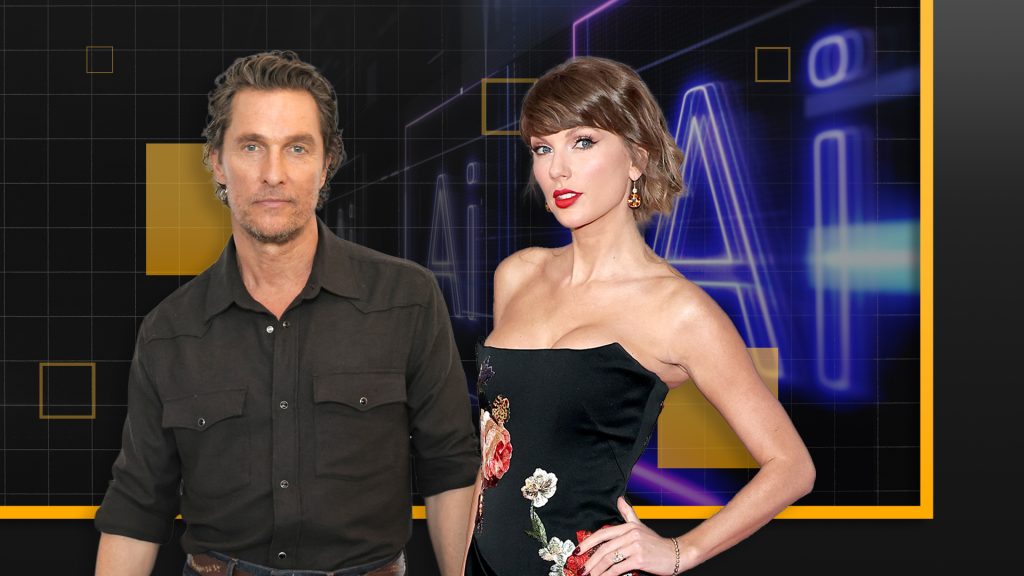
“Alright, alright, alright.”
This Matthew McConaughey line, delivered in the actor’s silky smooth Southern drawl in the 1993 film “Dazed and Confused,” has lived on for decades.
Now, that signature phrase is protected by the U.S. Patent and Trademark Office.
It took two years, but the actor and his legal team managed to do something cutting-edge: They secured a trademark for this recognizable soundbite, as well as six other phrases and visual clips of the Oscar winner — all to prevent their unauthorized use through artificial intelligence.
“My team and I want to know that when my voice or likeness is ever used, it’s because I approved and signed off on it,” McConaughey told The Wall Street Journal.
This unusual maneuver highlights a growing legal issue: artificial intelligence is moving faster than laws can govern it.
In a world of AI-generated voices and deepfakes, McConaughey’s novel trademark move could become a common strategy for celebrities — from Taylor Swift to a Bollywood superstar — who want to protect themselves against AI misuse.
Using trademarks in a new way
“I think it’s fair to characterize the registrations as experiments in the laboratory of ideas, looking for ways to adapt the law to fit new circumstances,” Christian Mammen, a patent and intellectual property attorney at Womble Bond Dickinson in San Francisco, told Straight Arrow.
“Perhaps more than anything else I’ve encountered in my 30-year legal career,” said Mammen, who has a doctorate in legal philosophy from Oxford University, “the impact of AI on IP has drawn on both my legal training and experience but also my doctoral studies.”
Famous people have long relied on trademarks. Swift, for example, has already registered over 400 trademarks in at least 16 jurisdictions.
“Each trademark is a tool in a larger branding symphony,” Leticia Caminero, an intellectual property lawyer, wrote for the World Intellectual Property Organization. “Whether it’s a line from a hit single or a reference beloved by fans, these marks help ensure that anything associated with Taylor comes from Taylor.”
What’s new is that celebrities are beginning to use trademark law to prevent AI from appropriating their personas and likenesses. Traditional copyright law, long used to protect intellectual property, may not be enough to protect famous people from quickly advancing generative AI.
Exposing gaps in existing laws
Copyright law was designed to protect works such as books, films and music. But copyright law did not — or could not — anticipate the advancement of AI and just how quickly and accurately it could impersonate human creators.
So far, artists have relied mostly on copyright statutes to take on AI in court. For instance, authors sued Anthropic for using their copyrighted books to train its Claude chatbot; the court ruled that while Anthropic did not steal the works, it took the books’ text from pirated sites without compensating the authors or their estates.
“Right of publicity” laws may also protect a person’s face, likeness and name from unauthorized commercial use. States such as New York, California, Texas and Virginia have enacted laws that target deepfakes in regards to political elections and pornography that is non-consensual.
But Mammen, who has worked in this arena since the first dot-com bubble, told Straight Arrow that AI has made these legal protections outdated.
”The speed, scale and fidelity with which anyone’s voice, face, and mannerisms can be generated, in commercial and noncommercial contexts, has left the patchwork of state ‘right of publicity’ laws in the dust,” Mammen said. “I believe that celebrities’ efforts to register trademarks on particular iconic recordings is an effort to brainstorm ways to fill the gap in the right-of-publicity laws.”
Swift is among those exploring a similar legal strategy. On April 24, her company, TAS Rights Management, filed trademark applications for one image and two voice clips.
Bollywood’s Arijit Singh also has turned to trademark law. A lawsuit filed by Singh — whose songs were streamed more on Spotify last year than Swift’s — set a legal precedent in India, establishing individuals’ personality rights in the age of AI misuse.
Like copyright laws, intellectual property laws are not equipped to respond to the challenges of AI, Mammen said.
“There is a real and growing gap between IP issues arising out of AI’s prodigious capabilities and the IP legal framework,” he said. “I’d say the two key ingredients for a trend like we’re seeing now are (a) ‘edge cases,’ where some emerging technology raises issues that are hard for existing doctrines to resolve, and (b) that technology catching on in both popular culture and the economy. AI clearly meets both of these conditions.”
But there has always been a need for the law to catch up with emerging technologies.
“Edge cases at the intersection of celebrity and copyright have been with us for about 140 years,” Mamman said.
For instance, in the 1880s, there was a copyright lawsuit over lithographic reproductions of an Oscar Wilde photo.
“Although it was argued that the photo could not be copyright-protected because it merely represented a capture on film of the real world in front of the lens, the courts ruled that the creative choices involved in making the photograph provided a basis for copyrightability,” Mammen said.
Now, celebrities, artists and creators are facing the next frontier. Using trademarks to protect a persona is new. However, what is yet to be seen is how this trademarking strategy will play out in the courts in the future.
Round out your reading
- Could a common dietary supplement accelerate Alzheimer’s?
- NY AG Letitia James gets hundreds of taunts, racial slurs in ICE public reporting portal.
- As Musk becomes the first trillionaire, historian sees warning signs.
- An experimental weight loss drug is so effective, many Americans don’t care it’s not FDA approved.
- How search engine optimization reduced Simone Biles to an ‘NFL wife’.
Ella Rae Greene, Editor In Chief